

Ransomware Production Shutdown: The Question Protection Plans Never Ask
A ransomware production shutdown doesn’t require touching a single machine on the plant floor. When ransomware hit Coca-Cola’s Fairlife operations, U.S. production was temporarily suspended after the company disclosed unauthorized third-party access to a portion of its systems, including production-related systems. Coca-Cola has not publicly established that plant-floor machinery itself was encrypted or disabled — Cybersecurity Dive and The Register both flagged that same ambiguity in their coverage. What the incident does establish is more interesting for architects: production became unavailable when the systems supporting it could no longer be relied upon.
Coca-Cola later disclosed that certain data was taken, and that the majority of production had subsequently resumed across Fairlife’s four U.S. facilities. But the data-loss question isn’t the architectural point, and neither is the recovery timeline. The operational impact was the story: a plant with production-related systems affected stopped shipping product, whatever the precise mechanism turns out to have been.
Most ransomware coverage — including a good amount of Rack2Cloud’s own — treats incidents like this as a story about backup architecture, recovery time objectives, and whether the encrypted data comes back clean. A ransomware production shutdown is a different story. Production systems don’t generally fail because a factory loses machinery. They fail because the systems coordinating the machinery become unavailable — and the public record here is enough to raise that question, even without telling us exactly which system going dark did the damage.
WHAT’S ESTABLISHED, WHAT’S ARCHITECTURAL INFERENCE
Established, from Coca-Cola’s own disclosures: a ransomware event; unauthorized third-party access; production-related systems affected; U.S. production temporarily suspended while Canada continued operating; certain data later confirmed taken; the majority of production subsequently resumed at Fairlife’s four U.S. facilities.
Not established — the architectural reading that follows: which specific systems were responsible for the shutdown, or whether ransomware reached operational technology directly versus only the IT systems supporting it. The rest of this piece treats that second layer as a general manufacturing-architecture question the incident raises, not a reconstruction of Fairlife’s internal systems.
What a Ransomware Production Shutdown Actually Breaks
Walk backward from “the plant stopped,” in the general case this incident illustrates, and the failure isn’t mechanical. It’s coordination. This is exactly the blind spot most Data Protection architecture programs carry: heavily invested in recovering systems, rarely architected around what happens to physical operations while those systems are down.
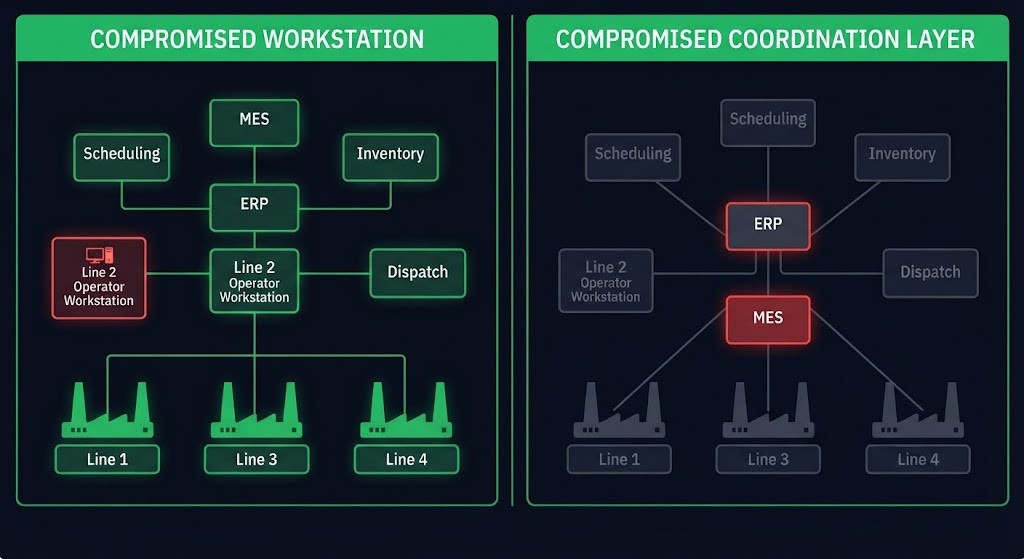
The relevant dependency chain in a modern manufacturing operation can include an ERP system issuing production orders, an MES layer sequencing what runs on which line, a scheduling system allocating capacity, an inventory system confirming raw material availability, a quality-control workflow releasing batches, and a dispatch system routing finished product out the door. None of those systems has to touch a single valve or conveyor belt directly to become operationally load-bearing.
The Fairlife disclosure doesn’t establish which of those dependencies, if any, was responsible for the shutdown — it establishes that production-related systems were affected and that U.S. production was suspended during the disruption. That’s enough to expose the architectural question, without claiming more certainty about Fairlife’s own systems than the public record supports.
A plant survives a compromised workstation. Someone loses a laptop, IT isolates it, production keeps running. A plant can fail operationally even when its physical assets remain fully intact if critical production decisions require a coordination system that is unavailable — what to run, how much, where it goes next, now dependent on a system that’s unreachable. The organization hasn’t lost any equipment. It’s lost the ability to tell that equipment what to do.
This is the question worth asking about a ransomware production shutdown, and it’s a different question than the one most security programs are built to answer: what systems become mandatory for production to continue? Not “was the network segmented.” Segmentation is a real control, and it matters — but it answers a narrower question than the one that actually determines whether a plant keeps shipping product.
Rack2Cloud’s own dependency-architecture content has spent a lot of time on a related but distinct problem: platforms that accumulate so much operational authority that their true dependency surface can no longer be reconstructed from documentation. That’s about discovering hidden dependencies before a migration. This is about dependencies that are rarely hidden at all — everyone on a plant floor generally knows which system schedules the lines — but whose criticality to physical continuity has often never been architected for, tested, or planned around.
The Difference Between Protection and Continuity
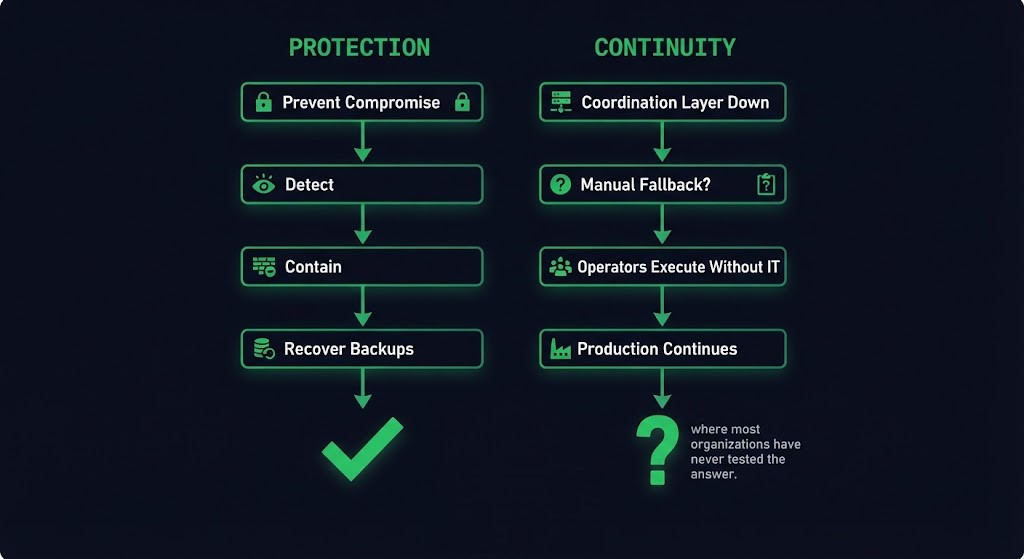
Most organizations’ exposure to a ransomware production shutdown sits entirely on one side of a distinction that rarely gets named explicitly: the difference between preventing compromise and surviving it operationally.
| Question | Protection View | Continuity View |
|---|---|---|
| Can ransomware reach OT? | Segmentation, monitoring, access control | Still important, but not sufficient |
| Can production continue if supporting IT disappears? | Often secondary | The primary architectural question |
| Are backups recoverable? | Critical | Critical, but answers a different question |
| Can operators run manually for the duration of a realistic recovery window? | Often assumed | Must be demonstrated |
Every organization running critical infrastructure has some version of a ransomware recovery plan — whether backups restore cleanly, how long recovery takes, whether the recovery chain itself survives the same compromise it’s recovering from. Recoverability Gap territory is well-trodden, and worth having solved. But recoverability answers “can we get the systems back.” It doesn’t answer “could we have kept running without them in the meantime.”
That second question is a genuinely different discipline. It’s the difference between a fire suppression system and a fire escape — one is designed to stop the event, the other is designed to get you through it while it’s still happening. Most Data Protection budgets buy fire suppression almost exclusively.
Why Segmentation Alone Doesn’t Solve It
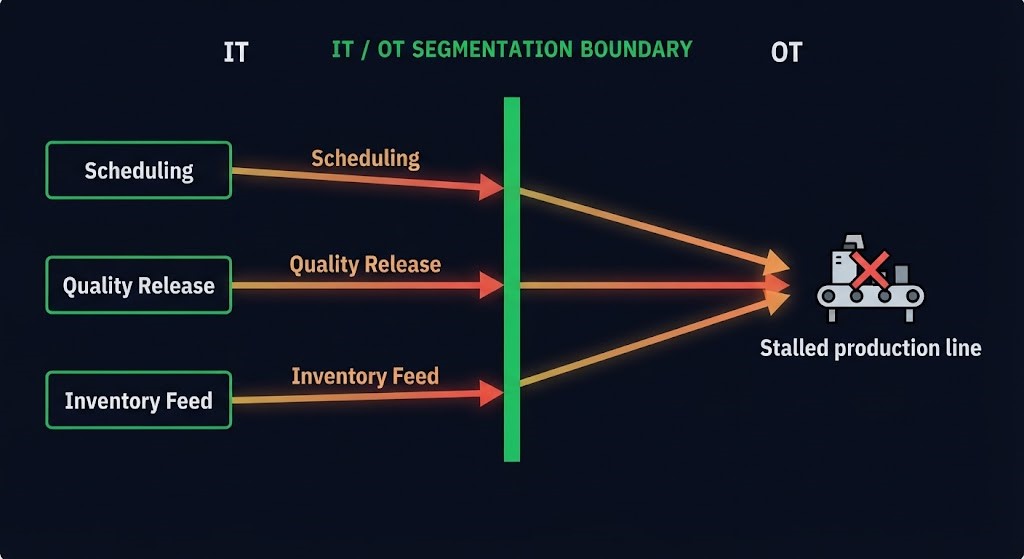
The instinct, reading about a ransomware production shutdown like this one, is to reach for network architecture. Better OT/IT segmentation. A cleaner Purdue-model boundary. Tighter microsegmentation between the plant floor and the corporate network. Those are legitimate controls, and organizations that lack them should build them. But they answer a narrower question than the one incidents like this actually raise, and it’s worth being precise about why.
Segmentation controls access. It doesn’t eliminate dependency. Even a well-segmented environment — one where ransomware genuinely never touches an OT system directly — can still produce a full production halt if the plant’s ability to operate depends on an IT-side system that segmentation correctly kept the attacker away from, but that the plant still can’t function without. Many manufacturing organizations describe their OT environments as isolated, but the business workflows running on top of that isolation often bridge IT and operational processes anyway — a scheduling system that lives in the data center, an inventory feed that syncs from a cloud ERP, a quality-release workflow that requires a corporate identity provider. The segmentation held. The dependency didn’t care. That’s a different failure than the one connected air gap territory covers — whether an isolation mechanism survives compromise. This incident is about whether the plant can operate at all, not whether a recovery vault stays sealed.
That’s why this can’t be fully solved by hardening the boundary. It has to also be solved by architecting for degraded coordination — deciding, in advance, what a plant can still do when the systems that normally run it are unavailable, and then actually testing whether that’s true. Undocumented recovery dependencies compound the same way in reverse: a recovery plan that hasn’t mapped what it actually depends on discovers those dependencies as failures, in production, during the incident that least affords the time to discover them.
The mechanism that survives this — the one worth architecting around going forward — isn’t ransomware-specific at all: physical operations inherit the availability requirements of their digital coordination layer, whether anyone designed for that or not.
This sits upstream of the Continuity Execution Boundary (Framework #163), the anchor framework for the Disaster Recovery & Failover Architecture stage. That framework asks whether the business resumes once recovery succeeds. The question here is whether production can keep operating before recovery is even relevant.
Architect’s Verdict
A ransomware production shutdown isn’t primarily a story about whether ransomware reached the plant floor. It’s a story about whether the plant floor could still function once the systems supporting it went dark — and that question is rarely tested in advance.
The gap this incident exposes isn’t simply a security gap. It’s an architecture gap: production systems can become fully dependent on IT-side coordination layers — ERP, MES, scheduling, quality release — without anyone deciding, on purpose, what happens operationally when those layers are unavailable. Segmentation, monitoring, and access control all reduce the odds of that scenario. None of them answer what happens once it occurs anyway.
Fairlife proves that production can become unavailable when production-related systems are compromised or taken offline. The public record doesn’t tell us exactly which dependency caused the shutdown. The architectural question is what organizations should have tested before an incident forces them to find out.
Additional Resources
Editorial Integrity & Security Protocol
This technical deep-dive adheres to the Rack2Cloud Deterministic Integrity Standard. All benchmarks and security audits are derived from zero-trust validation protocols within our isolated lab environments. No vendor influence.

R.M.
Senior Solutions Architect with 25+ years of experience in HCI, cloud strategy, and data resilience. As the lead behind Rack2Cloud, I focus on lab-verified guidance for complex enterprise transitions. View Credentials →
Get the Playbooks Vendors Won’t Publish
Field-tested blueprints for migration, HCI, sovereign infrastructure, and AI architecture. Real failure-mode analysis. No marketing filler. Delivered weekly.
Select your infrastructure paths. Receive field-tested blueprints direct to your inbox.
- > Virtualization & Migration Physics
- > Cloud Strategy & Egress Math
- > Data Protection & RTO Reality
- > AI Infrastructure & GPU Fabric
Zero spam. Includes The Dispatch weekly drop.
Architecture Audit Services
Fixed-scope audits for Zero-Trust Azure, VMware migration readiness, and recovery posture — no discovery call required to start.
>_ View Audit Services>_Related Posts
Your Recovery Program Has a Recovery Evidence Boundary
Recovery evidence boundary is the point where a recovery program stops being an engineering question and starts being a governance one — and most organizations cross it without ever finding out, because everything on the way there still looks like success. The backups completed. The DR test passed. The tabletop went well. Somebody wrote a…
Your Recovery Architecture Has A Bus Factor Problem
Recovery bus factor is the gap between a recovery plan that has been tested, documented, and signed off — and a recovery plan that can actually be executed when the one or two people who know how to run it aren’t in the room. The recovery program had passed everything that mattered on paper: RTO…
Your Ransomware Recovery Plan Has a Recoverability Gap
The recoverability gap is the structural distance between what your recovery plan assumes and what your infrastructure can actually deliver under failure conditions. Most organizations don’t discover it during planning. They discover it on day three of an incident. >_ Architect’s Brief 60-second read before you commit to the full post · Full post: 13…
Your Ransomware Plan Is Fiction: 5 Recovery Metrics Nutanix, Cohesity, Rubrik & Pure Can’t Hide
Ransomware recovery metrics are the only thing standing between your recovery plan and a PowerPoint. Every vendor demo shows a single VM booting in 60 seconds. Every real ransomware recovery looks like this: the backups are intact, the ransomware is neutralized, the executives are on the bridge — and nothing is coming back online. >_…
Your Logs Are Not Evidence If The Infrastructure That Produces Them Can Rewrite The Record
The evidence layer is not a byproduct of your infrastructure — it is infrastructure, and on August 30, Sygnia documented what happens when the evidence layer is captured along with everything else. Fire Ant, a China-nexus threat actor Sygnia has tracked since 2025, spent this year moving past the VMware hypervisors it was previously known…
Your Identity System Is Your Biggest Single Point of Failure
Part 2 of the Rack2Cloud’s Cloud Fragility Series >_ Cloud Fragility Series 01 Multi-Cloud Cascading Failure Risks 02 Your Identity System Is Your Biggest Single Point of Failure [CURRENT] 03 Vendor Lock-In Happens Through Networking — Not APIs 04 Your Cloud Bill Quietly Increased in 2026 — Here’s Where the Money Is Actually Going >_…