

The EU’s Huawei Ban Isn’t a Procurement Decision. It’s a Dependency Inventory Problem.
The EU Huawei ban is entering its most consequential phase yet. On May 4, 2026, the European Commission reissued a recommendation it first made in 2020: keep Huawei and ZTE out of critical telecom infrastructure. Nothing about that repetition was accidental. It was the public-facing half of a much harder structural shift — a January 2026 revision to the EU’s Cybersecurity Act (CSA2) that would convert six years of voluntary guidance into a binding legal obligation, with a proposed 36-month phase-out window starting once the law takes effect and scope extending past mobile networks into fixed broadband and transport infrastructure. The proposal is currently in front of the European Parliament and Council.
The story that gets written about the EU Huawei ban is “Europe bans Huawei.” That story is basically over — it’s been the direction of travel since 2020, and the only open questions are timeline and enforcement mechanics. The story that doesn’t get written is the one that actually matters to anyone building cloud infrastructure strategy around vendor dependencies: what happens when a regulatory decision sets a compliance clock that has no relationship to how the underlying dependency graph was ever meant to be replaced.
What the EU Huawei Ban Actually Changed
Two things happened six years apart, and the gap between them is the point. The 2020 5G Cybersecurity Toolbox was a recommendation — member states could act on it or not, and most didn’t. Only 13 of 27 had taken concrete action by early 2026. The January 2026 CSA2 proposal is different in kind, not just degree: if adopted, it would give Brussels the power to designate high-risk suppliers and mandate their removal from critical infrastructure, across 18 industries, with telecom as the most concrete and measurable category in the package.
The May recommendation reaffirmed the position. It didn’t change the law. The law is still moving through Parliament and Council, and the two things worth watching are whether the proposed 36-month phase-out window survives that process intact, and whether member states with the most exposure — Germany above all — negotiate it down before it’s binding. This is part of a broader pattern of EU technology-sovereignty moves this year — the same regulatory posture driving Europe’s sovereign cloud push is now reaching into telecom hardware.
For architects, the relevant fact isn’t the politics. It’s that a proposed compliance deadline, if CSA2 is adopted as currently drafted, is heading toward infrastructure that was never designed to be replaced on a legally-imposed schedule.
The Cost Estimate Nobody Agrees On
What the EU Huawei ban will actually cost is still disputed by a factor of three or four, and the disagreement itself is the more useful data point.
| Source | Estimate | Basis |
|---|---|---|
| European Commission | €10–13B | Original CSA2 impact assessment |
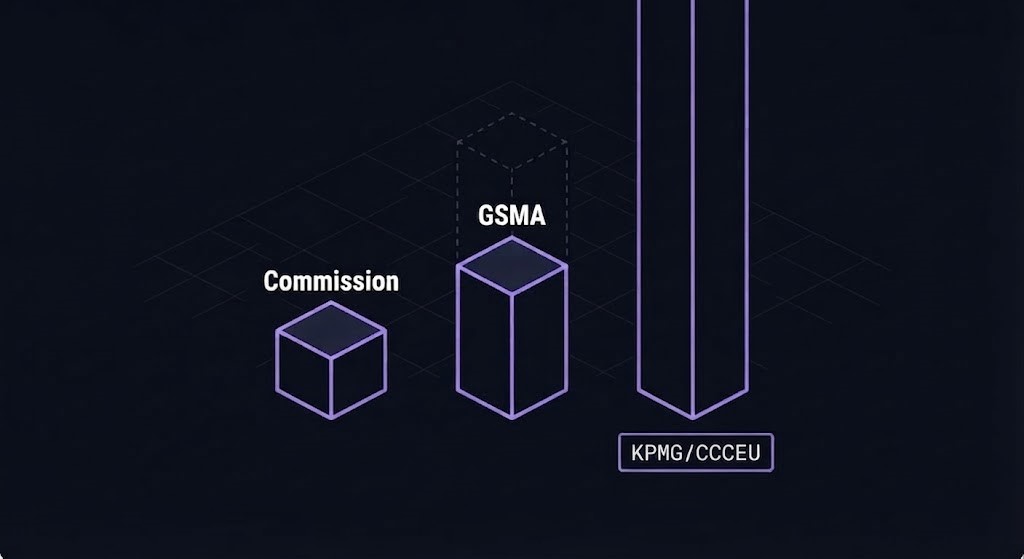
| GSMA Intelligence (commissioned by 7 operator groups, incl. Deutsche Telekom, Vodafone, Orange) | €30–40B (central estimate €35B) | Mobile €16–22B, fixed ~€5B, transport €9–12B |
| KPMG / China Chamber of Commerce to the EU | €367–370B economy-wide (€57.4B telecom-specific) | Broader disruption and spillover modeling |
The instinct is to treat this as a fact-check problem — which number is right. That’s the wrong question. A 3–4x spread between the regulator’s own estimate and the operators’ own estimate isn’t primarily a disagreement about arithmetic. It’s evidence that nobody involved has produced a consistent, shared model of the actual dependency surface being replaced. The Commission is pricing a policy. GSMA is pricing a rip-and-replace program built from real operator cost data. Those aren’t the same exercise, and the gap between them is the size of the thing nobody’s actually inventoried.
One line inside the GSMA figure matters more than the headline: reduced vendor competition is projected to add roughly €8.5B on its own between 2027 and 2030, independent of the direct replacement cost. That’s not a rip-and-replace number. That’s a market-structure number — and it’s the thread the rest of this argument pulls on.
Why Replacement Doesn’t Sequence Itself
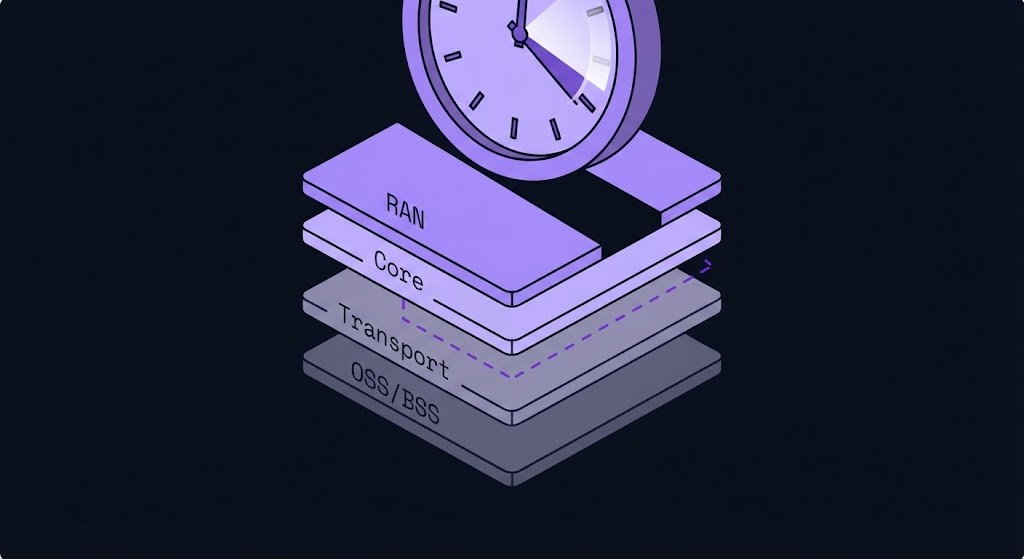
Telecom infrastructure isn’t one thing you swap. It’s a stack — RAN, core, transport, OSS/BSS integration — and each layer has a different dependency depth and a different failure consequence if you get the order wrong.
Core network components are the most centralized and highest-blast-radius layer: replace them badly and you risk a national-scale outage, but they’re also the layer regulators and operators have prioritized first precisely because the risk calculus is clearest. RAN — base stations, radio equipment — is the largest cost line and the most physically distributed, which makes it slow and logistically heavy but lower-risk per individual swap. Transport networks sit underneath both and are the layer most likely to get treated as an afterthought, right up until a core or RAN cutover depends on transport capacity nobody re-verified. OSS/BSS integration is the layer almost nobody prices correctly, because it’s software and process, not hardware, and it’s exactly where “the new vendor’s box works” and “the new vendor’s box works inside our existing operational stack” stop being the same claim.
Germany’s own timeline is the tell here. Berlin isn’t treating this as a single procurement cycle — core network removal starts in 2026, with broader restrictions on radio access and management systems extending out to 2029. That’s not caution for its own sake. That’s an operator with the clearest regulatory mandate in Europe concluding, on its own, that a compressed single-cycle replacement doesn’t match the actual dependency structure it’s replacing.
A compliance deadline treats “replace the vendor” as one decision. The dependency graph treats it as dozens of sequencing decisions, each with a different failure mode if rushed.
The Capital Reallocation Problem
The €30–40B figure gets reported as a cost. It’s actually three different costs, and collapsing them into one number is where the real damage hides.
Direct replacement cost is the number everyone’s arguing about — equipment, labor, integration. Opportunity cost is what doesn’t get built because that capital got redirected: 5G-Advanced rollout, transport capacity expansion, the infrastructure investment operators were planning before the clock started, not after. Operational risk cost is what happens during the transition itself — a multi-year window where networks run mixed-vendor configurations they didn’t design for, under time pressure they didn’t choose.
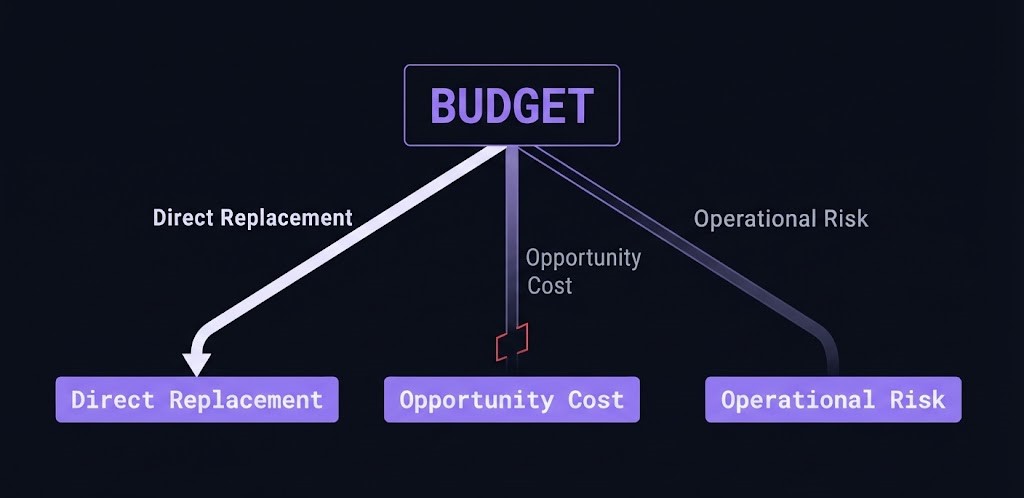
None of the published estimates cleanly separate these. GSMA’s own analysis flags this as a live methodological dispute — one industry critique argues the gross figure should be discounted for equipment operators would have replaced anyway on normal refresh cycles, which would move the real number closer to the Commission’s estimate. That critique might be right. It doesn’t change the architectural point: whatever the true incremental cost turns out to be, it’s capital that was earmarked for something else, redirected on a timeline set by law rather than by the infrastructure’s own investment cycle. This isn’t a uniquely European or uniquely regulatory problem — any forced vendor exit run on someone else’s clock hits the same wall, whether the trigger is a regulator or a licensing change.
That’s the actual cost of a forced-displacement mandate that most cost estimates never capture: not what you spend, but what you were going to build and now can’t, on the schedule you’d planned to build it.
The New Lock-In You Just Bought
Here’s where the story is supposed to end: Huawei and ZTE dependency goes down, mission accomplished. It doesn’t end there, because removing two suppliers from a market doesn’t create competition — it concentrates whatever’s left.
GSMA’s own modeling puts post-exclusion market share for Ericsson and Nokia at roughly 96% of the mobile equipment market, with projected price increases as high as 43%. That’s not a side effect. That’s the direct, mechanical consequence of removing the two largest low-cost alternatives from a market that already had limited supplier diversity before this started — the same lock-in-through-topology mechanism that shows up anywhere concentration gets treated as a contract problem instead of an architecture one.
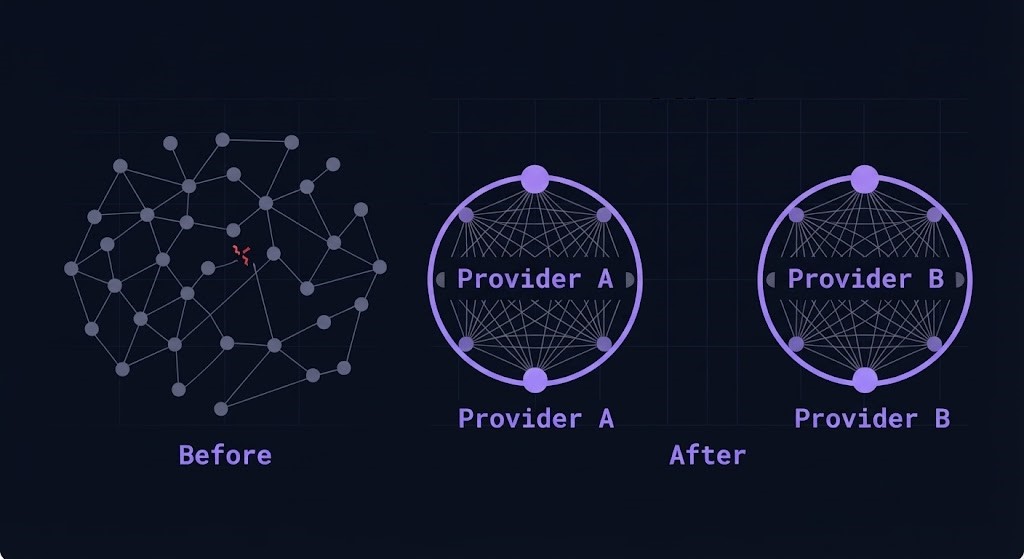
Open RAN and disaggregated architectures are the one real architectural lever against that outcome — not because they’re a mature drop-in replacement for every network layer today, but because disaggregation is the only approach that increases the number of independent choices at each layer instead of consolidating them into fewer, larger vendors. That’s a genuine trade: more architectural choice in exchange for operational complexity most operators haven’t fully absorbed yet. It’s a lever, not a solution, and treating it as a solved problem would be its own kind of overclaim.
The pattern generalizes past telecom and past this specific regulation: exiting one vendor concentration risk under time pressure, without an explicit plan for what fills the gap, reliably produces a different concentration risk on the other side. The regulation solves the problem it was written to solve. It doesn’t automatically solve the one it creates.
The Decision Surface: What a Compliance Clock Doesn’t Answer
A legally mandated deadline answers one question for the EU Huawei ban — by when. It doesn’t answer any of the questions that actually determine whether the deadline is survivable.
01 — WHAT DEPENDENCIES MUST BE REMOVED
Not “which vendor” — which specific components, at which layer, are actually in scope under the final CSA2 language once it’s adopted, since the January proposal’s scope (mobile plus fixed plus transport) is broader than the original 2020 toolbox ever covered.
02 — WHICH DEPENDENCIES CAN BE REMOVED INDEPENDENTLY
Core, RAN, transport, and OSS/BSS don’t fail or succeed as a unit. Sequencing has to be built around which layers can move without waiting on another layer’s cutover.
03 — WHICH REPLACEMENTS CREATE NEW DEPENDENCIES
A vendor swap that trades Huawei/ZTE exposure for Ericsson/Nokia concentration is a dependency inventory event, not a closed decision — the new dependency needs the same scrutiny the old one just got.
04 — WHAT SEQUENCING MINIMIZES OPERATIONAL BLAST RADIUS
The layer with the highest cost isn’t automatically the layer with the highest risk if replaced badly. Those are two different rankings, and conflating them produces a sequencing plan optimized for the wrong variable.
05 — WHO OWNS THE SEQUENCING DECISION
Not who owns compliance — who has the actual authority to decide that a technically safer sequence justifies slower progress against the legal deadline, and who’s accountable if that call turns out to have been wrong in either direction.
06 — WHAT HAPPENS WHEN THE DEADLINE CONFLICTS WITH THE SAFER SEQUENCE
This is the question the other five exist to set up, and it’s the one no compliance framework answers by itself. Compliance creates the deadline. Architecture determines whether the deadline is survivable.
Architect’s Verdict
The EU Huawei ban will get covered as a geopolitics story and a procurement story, and it’s genuinely both of those things. But for anyone whose job is the actual infrastructure, it’s neither. It’s a dependency inventory problem wearing a proposed compliance deadline — and the enormous spread between published cost estimates is evidence that the dependency surface has not been modeled consistently enough to produce an agreed number.
The organizations that come out of this well won’t be the ones that hit the 36-month deadline fastest. They’ll be the ones that treated “what are we actually dependent on, at what layer, and in what order can we safely unwind it” as the real project — with the compliance clock as a constraint on that project, not a substitute for it.
Compliance creates the deadline. Architecture determines whether the deadline is survivable.
Additional Resources
Editorial Integrity & Security Protocol
This technical deep-dive adheres to the Rack2Cloud Deterministic Integrity Standard. All benchmarks and security audits are derived from zero-trust validation protocols within our isolated lab environments. No vendor influence.

R.M.
Senior Solutions Architect with 25+ years of experience in HCI, cloud strategy, and data resilience. As the lead behind Rack2Cloud, I focus on lab-verified guidance for complex enterprise transitions. View Credentials →
Get the Playbooks Vendors Won’t Publish
Field-tested blueprints for migration, HCI, sovereign infrastructure, and AI architecture. Real failure-mode analysis. No marketing filler. Delivered weekly.
Select your infrastructure paths. Receive field-tested blueprints direct to your inbox.
- > Virtualization & Migration Physics
- > Cloud Strategy & Egress Math
- > Data Protection & RTO Reality
- > AI Infrastructure & GPU Fabric
Zero spam. Includes The Dispatch weekly drop.
Architecture Audit Services
Fixed-scope audits for Zero-Trust Azure, VMware migration readiness, and recovery posture — no discovery call required to start.
>_ View Audit Services>_Related Posts
Your Kubernetes Cluster Isn’t Out of CPU — The Scheduler Is Stuck
Compute Tier 1 Authority Cascades to ➔ >_ Architect’s Brief 60-second read before you commit to the full post · Full post: 9 min Generating brief… [Storage] [Network] 🚨 Failure Signature Detected Grafana shows cluster CPU utilization is under 50%, but pods are stuck in Pending. Events show: 0/10 nodes are available: 10 Insufficient cpu….
Your Identity System Is Your Biggest Single Point of Failure
Part 2 of the Rack2Cloud’s Cloud Fragility Series >_ Cloud Fragility Series 01 Multi-Cloud Cascading Failure Risks 02 Your Identity System Is Your Biggest Single Point of Failure [CURRENT] 03 Vendor Lock-In Happens Through Networking — Not APIs 04 Your Cloud Bill Quietly Increased in 2026 — Here’s Where the Money Is Actually Going >_…
Your Identity Provider Was Never Your Spend Boundary
Every enterprise cloud governance program assumes a spend boundary sits somewhere between identity and money — a checkpoint that catches compromised access before it becomes compromised spend. It doesn’t exist. Not as a distinct control. Not as a separate policy layer. Not anywhere in the architecture most organizations have actually built. >_ Architect’s Brief 60-second…
Your Identity Controls Passed. Your Authorization Chain Failed.
A credential chain functioned exactly as it was designed to. No firewall failed. No exploit executed. No malware bypassed a control. A red team walked past physical and social barriers using nothing more exotic than a plausible pretext, and came out the other side holding network admin credentials — issued correctly, authorized correctly, working exactly…
Your DR Test Passed. The Assumptions Didn’t.
DR plan failure rarely happens where you tested. It happens at the assumptions the exercise never reached — the dependencies that weren’t in scope, the runbook written for last year’s architecture, the authority chain nobody tested at 2am.
Your Cloud Provider Is Not Your HA Strategy
A Tactical Playbook for Architecting, Testing, and Automating Real Multi-Cloud & Multi-Region Resilience We’ve previously explored why cloud SLAs fail as guarantees in our deep dive, Cloud SLA Failure & Resilience Strategy. This article focuses on how to survive those failures in practice — architecturally, operationally, and financially. >_ Architect’s Brief 60-second read before you…