

Infrastructure Remembers Configuration. It Forgets Intent.
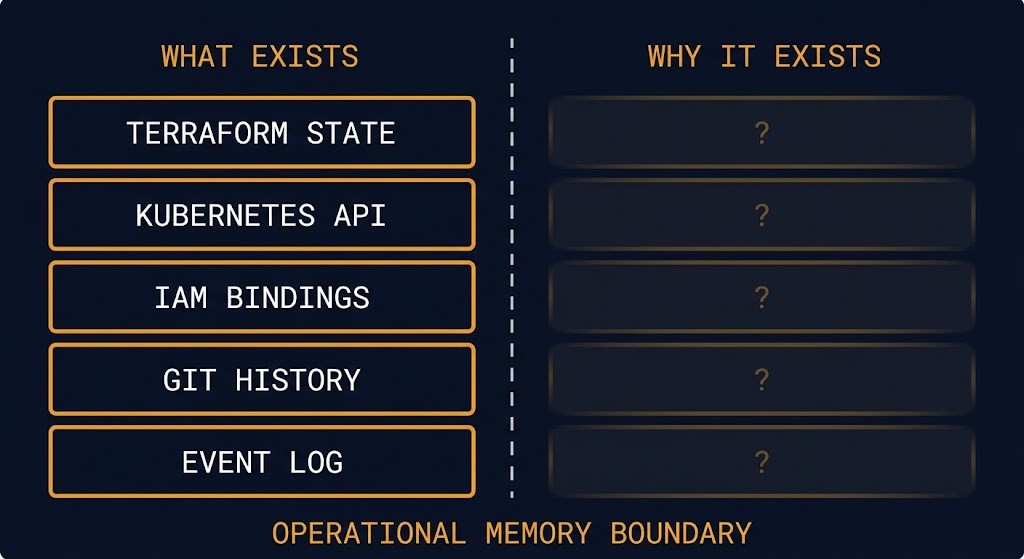
Your stack has a memory. It remembers configuration. It remembers resource state, change timestamps, access bindings, and event timelines. Ask it what exists, and most modern environments can answer with reasonable fidelity.
Ask it why, and the stack goes silent.
That silence is the substrate underneath every authority failure this series has named. Not missing tools. Not bad process. Missing operational memory — the persistent, recoverable record of intent, assumptions, authority context, and exception rationale that explains why the infrastructure is in the state it’s in.
Operational knowledge management for infrastructure teams has been treated as a documentation problem. It isn’t. It’s an architecture problem — and the gap between those two framings is where governance quietly collapses.
THE AUTHORITY LAYER
What Operational Memory Actually Is
Before the distinction that matters: operational memory is not documentation.
Documentation is a point-in-time snapshot created voluntarily by a human who may or may not have included the context that will matter at 2am during an incident six months later. Runbooks go stale. Wikis accumulate debt. Post-mortems describe what happened but rarely why the conditions for it were allowed to persist.
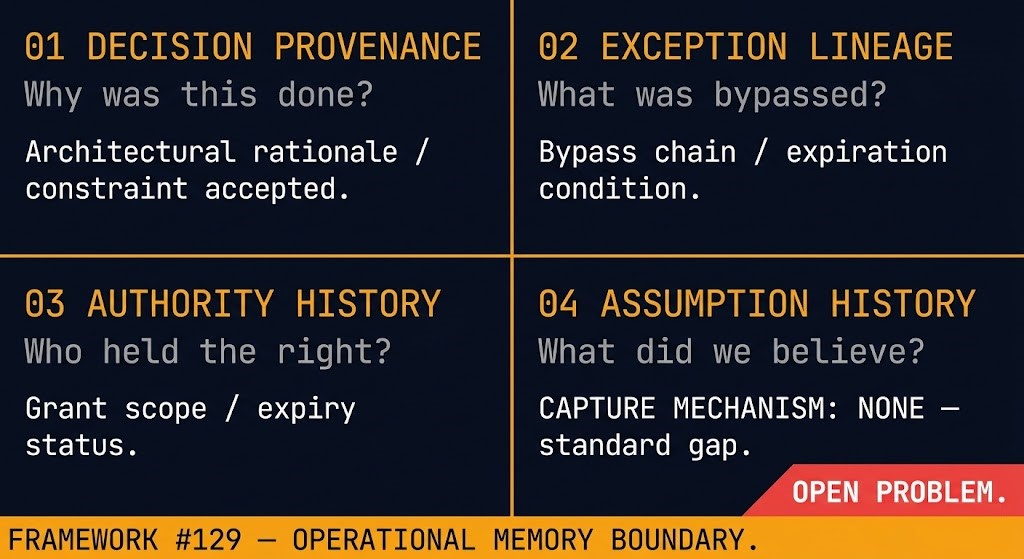
Operational memory is the persistent, queryable record of four distinct information classes:
Decision provenance — not just what a configuration is, but why it exists. The business context, the architectural rationale, the constraint that made this the least-bad option.
Exception lineage — what was bypassed to get here, under what conditions, by whose authority. Not the ticket that approved it. The full chain: what assumption justified the exception, what it was supposed to be temporary relative to, what review was supposed to close it.
Authority history — who held the right to act, when that right was granted, under what scope, and when it expired or should have. IAM audit logs are the closest most environments get to this. They record actions. They rarely record the intention behind the grant.
Assumption history — what the organization believed to be true when the decision was made. This is the most absent and the most consequential of the four. Assumptions don’t appear in commit messages. They don’t survive personnel transitions. They exist as shared context in the minds of the team that made the call — until those people leave, change roles, or simply forget.
Infrastructure Can Reconstruct State. It Cannot Reconstruct Intent.
This is the structural gap the rest of this post builds on.
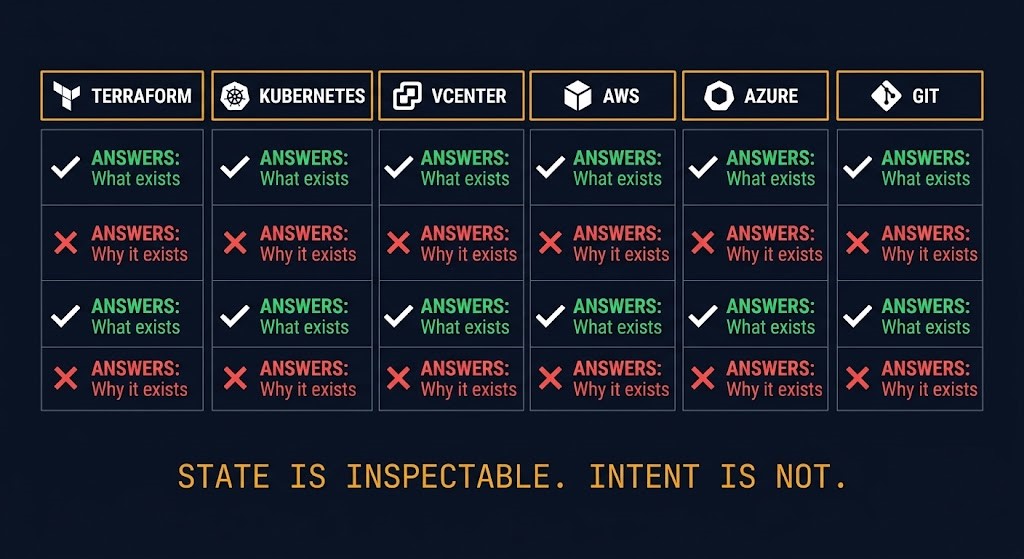
Inspect any modern infrastructure environment and you can determine what exists with high fidelity. Terraform state gives you the current resource inventory. The Kubernetes API gives you declared and actual workload state. vCenter gives you VM inventory, host assignments, and network topology. AWS and Azure resource graphs expose IAM bindings, policy attachments, and service configurations. Git gives you full change history with author, timestamp, and diff.
The stack is not missing information about state. It is structurally silent about intent.
The firewall rule example is the one every senior infrastructure engineer has lived. The rule exists. The stack can tell you who changed it, when it changed, what changed. It cannot tell you why the exception was approved, what risk was accepted in exchange, or when the exception was supposed to be reviewed. The engineer who wrote the ticket has moved to a different organization. The ticket itself was closed. The intent evaporated at the moment of decision because nothing was architected to capture it.
This is not a tooling failure. It is an architectural omission. Operational context was never modeled as infrastructure state. It has no schema. No persistence layer. No query interface. No recovery path. When the context is needed — during an incident, during an audit, during a compliance review, during offboarding — it is retrieved by asking a human. When the human isn’t available, it is reconstructed by inference.
Both paths fail under load.
DIAGNOSTIC QUESTION
“Can your infrastructure answer, at 2am during an incident, not just what is configured — but why, by what authority, under what assumption, and when that assumption last held?”
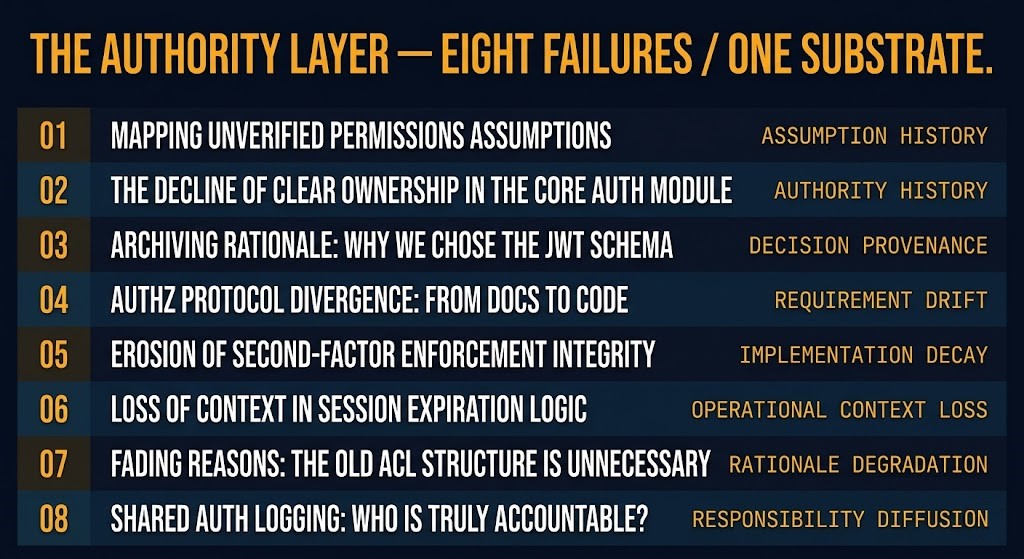
Every Authority Failure Is a Memory Failure
This series has named eight distinct authority failures across eight posts. Read them back through the intent lens, and the pattern is consistent: in every case, the failure wasn’t the decision that was made. The failure was that the decision’s assumptions weren’t persisted anywhere that survived.
Part 1 — CI/CD as control plane. The assumption that the deployment pipeline would remain a build tool — not a governance surface — was never written down. Teams hardened the pipeline mechanically, treating it as automation infrastructure rather than authority infrastructure, because the architectural intent behind that boundary had no durable record. By the time the distinction mattered, the context for it was gone.
Part 2 — Shadow control plane. Console access was granted as temporary. The assumption of temporariness had no expiration mechanism and no machine-readable record. It became permanent by default — not through deliberate decision, but through the absence of a system that could enforce the original intent.
Part 3 — Bus factor. Operational knowledge was concentrated in individuals who carried it as memory, not as infrastructure. The infrastructure bus factor problem is, at its root, an operational memory problem: when the person leaves, the context leaves with them. The knowledge never had a persistence layer.
Part 4 — Platform team cost drift. The commitments that generated spend were made with assumptions about utilization, governance scope, and authority boundaries that were never persisted. The spend remained. The context for why it was approved, under what model, with what review conditions, didn’t.
Part 5 — Private cloud governance. Operating model decisions accumulated exceptions. Each exception arrived with a rationale — a migration delay, a vendor dependency, a technical constraint — that was never stored alongside the exception itself. The exceptions outlived the rationales. The private cloud operating model degraded not because the governance intent was wrong, but because the assumption history that justified exceptions had no place to live.
Part 6 — AI infrastructure governance. Infrastructure was built to serve a model behavior envelope that was never formally captured as architectural state. When the behavior envelope shifted — when models were updated, when inference patterns changed, when new workloads were added — the infrastructure didn’t know. The AI infrastructure governance failure was a failure of assumption capture.
Part 7 — SaaS authority fragmentation. Access grants were made with assumptions about role scope and duration. Neither assumption was machine-readable. Both were eventually wrong. The SaaS control plane problem persists because the authority grants that created it were made in a context that no longer exists — and nothing recorded what that context was.
Part 8 — Operational memory itself. The infrastructure field has treated the absence of intent capture as a process discipline problem for decades. The assumption — that documentation habits and change management rigor would close the gap — has never held under operational pressure. That assumption was wrong, and nothing in any toolchain was built to surface when it stopped holding.
The thread across all eight: every failure was enabled by the same architectural gap. The system knew what existed. It had forgotten why.
Framework #129 — The Operational Memory Boundary
FRAMEWORK #129 — OPERATIONAL MEMORY BOUNDARY
The threshold at which operational context is no longer recoverable from the infrastructure’s own state — because intent, assumptions, and authority rationale were never modeled as durable infrastructure artifacts.
When any axis depends on a person who is still at the organization and still remembers, the Operational Memory Boundary has been crossed. Governance becomes retroactively impossible. The most tractable named instance of Assumption History failure at the IaC layer is Framework #133 — Policy Intent Drift: the original justification for a policy rule was never modeled as durable infrastructure state, conditions changed, and the GitOps controller continued enforcing the rule with no mechanism to surface that its assumption had expired. The downstream instance of the same omission at the pipeline execution layer is Framework #151 — Infrastructure Evidence Gap: when a pipeline cannot connect an execution to the authorization event and policy state reviewed at approval time, the execution is reproducible but the authorization chain is gone. The system remembered the policy. It had forgotten why.
Named failure state: Memory-Blind Infrastructure — infrastructure that can reconstruct its configuration state but cannot reconstruct the intent, assumptions, or authority context that produced it.
The passing condition is simple in statement and difficult in execution: all four axes are answerable from durable, machine-readable records that survive personnel turnover. The failing condition is any one axis that requires a phone call.
The fourth axis is the hardest to close. Decision provenance can be approximated with structured commit messages, Architecture Decision Records, and documented change rationale. Exception lineage can be captured in ticketing workflows with mandatory expiration fields. Authority history is partially covered by IAM audit logs, though coverage is inconsistent and the logs record actions rather than authorizations. Assumption History has no standard capture mechanism in any current toolchain. There is no field in Terraform, no label in Kubernetes, no attribute in AWS CloudFormation, no standard in any IaC tooling today that says: “this configuration reflects the following belief about the world — verify before applying changes.”
That is the open problem.
Operational Knowledge Management Is Not a Process Problem. It’s an Infrastructure Problem.
The standard response to operational memory failure is process. Better runbooks. Mandatory change tickets. Enforced post-mortems. Change Advisory Board sign-off. Architecture review requirements. None of that is wrong. All of it degrades over time under operational pressure.
The reason is structural. Process produces records when humans remember to create them, when they have the cognitive bandwidth to do it correctly, and when the organizational pressure to move fast hasn’t overridden the requirement to document. Process-dependent operational memory has a half-life tied to the discipline of the organization at its lowest-discipline moment. That moment arrives reliably, usually during the incident where the documentation would have mattered most.
Infrastructure produces state continuously, whether or not anyone is paying attention.
⚠ COMMON MISTAKE
Treating operational memory failure as a process compliance problem. The question isn’t whether the team followed the runbook — it’s whether the operational context was modeled as a durable artifact that survives the runbook author’s departure.
The distinction matters because the failure mode isn’t absence of process. Most organizations that have experienced these failures had processes. Post-mortems happened. Tickets were filed. Runbooks were written. The failure was that operational context was not modeled as infrastructure state — no schema, no persistence layer, no query interface, no recovery path. The context existed as human memory attached to a process artifact. When the human left, the context left with them. The artifact remained as an empty record.
Modern infrastructure and IaC architecture has solved this problem for configuration state. GitOps addressed configuration drift by making desired state declarative, versionable, and continuously reconciled against actual state. The Kubernetes operator pattern made desired state and reconciliation logic first-class primitives. Terraform made resource state an explicit artifact that can be stored, queried, and recovered.
Modern Infrastructure — Maturity Stage 1 — Declarative Infrastructure names the qualifying test behind that solved problem — not just that state became declarative, but that the underlying decision to declare it deserved to be made in the first place. Intent capture needs the equivalent qualifying test, and nothing in the current toolchain asks it.
The same architectural logic applies to operational context. The gap is that intent, assumption state, and exception rationale have not been modeled equivalently. There is no terraform plan for “check whether the assumptions behind this configuration still hold.”
What Closes the Boundary
Not a tool prescription — an architectural requirements statement. Three properties required for an operational memory layer to qualify as infrastructure-grade:
01 — DURABILITY
Survives personnel turnover, organizational restructuring, and tool migration. If it lives in a person’s head, a wiki that gets abandoned, or a ticketing system that gets replaced on the next procurement cycle, it doesn’t qualify as operational memory. It qualifies as temporary documentation.
02 — QUERYABILITY
Answerable at incident time, not only auditable post-mortem. The value of operational memory is highest when the system is failing and the team doesn’t know why. A record that can only be surfaced after-the-fact is forensic evidence. It’s useful. It isn’t operational infrastructure.
03 — PROVENANCE LINKAGE
Ties decisions to the infrastructure state they produced. A decision record that cannot be connected to a specific configuration change, access grant, or exception isn’t operational memory — it’s a document. The link between intent and state is what makes context recoverable rather than merely recordable.
Where the emerging surface area is: IaC metadata annotations with mandatory rationale fields, SBOM-adjacent decision lineage models that extend beyond software components into infrastructure decisions, policy-as-code audit trails with structured assumption capture, Architecture Decision Record tooling integrated into CI/CD pipelines rather than maintained as standalone wikis. None of these close the boundary alone. The integration layer — the connective tissue between decision context and infrastructure state — does not yet exist in mature form.
That is the architectural gap. The tools for capturing state are mature. The tools for capturing intent remain immature, fragmented, and almost entirely process-dependent.
Architect’s Verdict
Infrastructure remembers configuration. It forgets intent. That asymmetry is not a documentation gap or a process compliance failure. It is an architectural omission — one that every organization eventually discovers at the worst possible moment, during an incident, an audit, or an offboarding conversation where someone asks “why is this configured this way?” and the only honest answer is “we don’t know anymore.”
The eight authority failures in this series all have the same substrate. The CI/CD control plane problem, the shadow console problem, the bus factor problem, the platform team drift problem, the private cloud governance problem, the AI infrastructure misalignment problem, the SaaS authority fragmentation problem — each was enabled by the same gap. The system could reconstruct state. It had lost the intent, the assumptions, and the authority context that created it.
The architectural question this series ends on is not abstract. Your infrastructure can reconstruct its configuration state from first principles. Can it reconstruct its intent? At 2am during an incident, can it answer not just what is configured, but why, by what authority, under what assumption, and when that assumption last held?
If the answer requires a phone call, you are operating above the Operational Memory Boundary. Governance is retroactively impossible until that changes — and the first place that impossibility surfaces is not in the audit. It surfaces in the gap between what your governance policy says should happen and what the system, operating without recoverable intent context, actually does. That gap is the direct downstream consequence of crossing the Operational Memory Boundary at scale.
SERIES: The Authority Layer
← Previous
The SaaS Control Plane ProblemSeries Complete
Parts 1–8 PublishedAdditional Resources
Editorial Integrity & Security Protocol
This technical deep-dive adheres to the Rack2Cloud Deterministic Integrity Standard. All benchmarks and security audits are derived from zero-trust validation protocols within our isolated lab environments. No vendor influence.

R.M.
Senior Solutions Architect with 25+ years of experience in HCI, cloud strategy, and data resilience. As the lead behind Rack2Cloud, I focus on lab-verified guidance for complex enterprise transitions. View Credentials →
Get the Playbooks Vendors Won’t Publish
Field-tested blueprints for migration, HCI, sovereign infrastructure, and AI architecture. Real failure-mode analysis. No marketing filler. Delivered weekly.
Select your infrastructure paths. Receive field-tested blueprints direct to your inbox.
- > Virtualization & Migration Physics
- > Cloud Strategy & Egress Math
- > Data Protection & RTO Reality
- > AI Infrastructure & GPU Fabric
Zero spam. Includes The Dispatch weekly drop.
Architecture Audit Services
Fixed-scope audits for Zero-Trust Azure, VMware migration readiness, and recovery posture — no discovery call required to start.
>_ View Audit Services>_Related Posts
ZFS vs Ceph vs NVMe-oF: Choosing the Right Storage Backend for Modern Virtualization
I still have nightmares about a storage migration I ran back in 2014. >_ Architect’s Brief 60-second read before you commit to the full post · Full post: 7 min Generating brief… We were moving off a monolithic SAN and onto an early “software-defined” storage platform. The sales engineers promised infinite scalability and self-healing magic….
Your Vendor Review Process Never Saw The Real Supplier
Every vendor review process assumes it’s evaluating a supplier — but a scan finding foreign-origin code embedded in more than one in eight mobile apps used by US military personnel makes the actual assumption visible: organizations review the company they bought from, not the code that arrived inside what they bought. >_ Architect’s Brief 60-second…
Your Monitoring Didn’t Miss the Incident. It Was Never Designed to See It.
I’ve watched observability vs monitoring play out as a live incident more times than I can count. >_ Architect’s Brief 60-second read before you commit to the full post · Full post: 10 min Generating brief… The dashboard was green. The on-call engineer was not paged. The monitoring system did exactly what it was designed…
Your Kubernetes Cluster Isn’t Out of CPU — The Scheduler Is Stuck
Compute Tier 1 Authority Cascades to ➔ >_ Architect’s Brief 60-second read before you commit to the full post · Full post: 9 min Generating brief… [Storage] [Network] 🚨 Failure Signature Detected Grafana shows cluster CPU utilization is under 50%, but pods are stuck in Pending. Events show: 0/10 nodes are available: 10 Insufficient cpu….
Your Identity System Is Your Biggest Single Point of Failure
Part 2 of the Rack2Cloud’s Cloud Fragility Series >_ Cloud Fragility Series 01 Multi-Cloud Cascading Failure Risks 02 Your Identity System Is Your Biggest Single Point of Failure [CURRENT] 03 Vendor Lock-In Happens Through Networking — Not APIs 04 Your Cloud Bill Quietly Increased in 2026 — Here’s Where the Money Is Actually Going >_…
Your Identity Provider Was Never Your Spend Boundary
Every enterprise cloud governance program assumes a spend boundary sits somewhere between identity and money — a checkpoint that catches compromised access before it becomes compromised spend. It doesn’t exist. Not as a distinct control. Not as a separate policy layer. Not anywhere in the architecture most organizations have actually built. >_ Architect’s Brief 60-second…