

The Infrastructure Automation Ladder: Why Most Organizations Stall at Level 2
Most infrastructure teams believe they crossed the automation finish line the day they adopted Terraform — the infrastructure automation ladder says they reached Level 2 of 5, and the three levels above it have nothing to do with provisioning and everything to do with governing what gets provisioned.
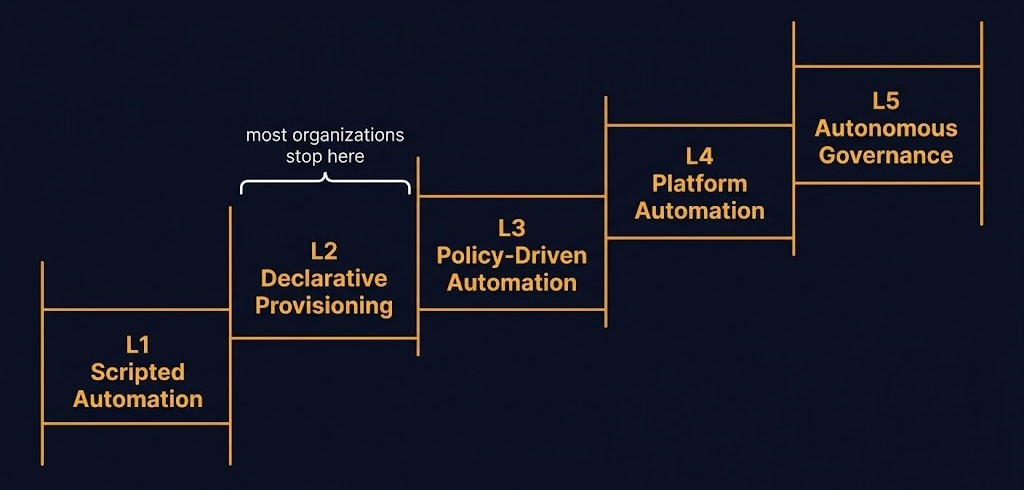
That gap between “provisioning works” and “provisioning is governed” is where most Modern Infrastructure & IaC organizations quietly stall — not because the tooling failed, but because nobody was ever assigned the job the tooling doesn’t do.
Framework #138 — The Infrastructure Automation Ladder
The infrastructure automation ladder measures how much governance responsibility has moved from humans into the operating model itself. It is not a measure of how much you’ve automated — it’s a measure of how much enforcement no longer depends on a person remembering to do it.
FRAMEWORK #138 — INFRASTRUCTURE AUTOMATION LADDER
Five levels describing how much governance responsibility has moved from humans into the operating model itself.
Most organizations stop at Level 2 — and a meaningful share of their estate never fully clears Level 1. The ladder isn’t a maturity trophy case; it’s a map of where enforcement responsibility currently sits, and who’s holding it.
Level 5 deserves one clarification before we go further, because it’s the level most readers misread. Level 5 is not infrastructure running itself. Level 5 is governance operating continuously without depending on human intervention for routine enforcement decisions. That’s a narrower, more mundane claim than “autonomous infrastructure” — and it’s the correct one. Nothing about this framework requires an AI agent making architectural decisions. It requires policy evaluation that doesn’t wait for a human to notice.
It’s also worth naming what the ladder doesn’t assume: that every organization is climbing in order, or that most of the estate has even cleared Level 1. Plenty of infrastructure — legacy platforms, acquired environments, edge deployments nobody wants to touch — still runs on manual change tickets. The stall at Level 2 is a story about the modern portion of the estate, the part that got Terraform and stopped there.
Why Declarative Feels Complete
Terraform and OpenTofu adoption gives every visible signal of infrastructure maturity. State exists. Plans are reviewable in pull requests. Changes are versioned, diffable, auditable in the sense that you can see what happened. For a platform team coming from ClickOps and tribal knowledge, this is a genuine, defensible improvement — and that’s exactly what makes it dangerous. It looks like the destination because it is dramatically better than what came before it.
But declarative provisioning answers one question — “did the system reach the state we described?” — and leaves a different question completely unaddressed: was the described state ever allowed to exist in the first place? A Terraform plan that provisions a public S3 bucket, an unencrypted volume, or a security group open to 0.0.0.0/0 will apply cleanly. The tool did its job. Nobody’s tool did the other job.
Most Organizations Never Reach Level 3
The jump from Level 1 to Level 2 is a tooling decision — pick Terraform or OpenTofu, migrate the manual runbooks, done. The jump from Level 2 to Level 3 is a governance decision, and governance decisions don’t get made by default. They require someone to own enforcement, and in most organizations, nobody does.
Platform teams own the Terraform modules. They own the CI/CD pipeline that runs plan and apply. What they typically don’t own — because nobody assigned it — is the authority to block a plan that’s syntactically valid but organizationally non-compliant. That authority either doesn’t exist, or it lives informally in a human reviewer’s judgment, which is a Level 2 practice wearing Level 3 language.
This is where day-2 operations debt starts compounding. Declarative provisioning handles day-1 cleanly; the drift, the exceptions, the modules nobody’s allowed to touch — that’s what accumulates when there’s no enforcement layer catching violations before they ship, only detecting them after they’re already load-bearing.
What Level 3 Actually Requires — The Three Gates
Level 3 isn’t a bigger Terraform module library or a stricter code review policy. It’s three specific gates a plan has to clear before it’s allowed to apply — and most organizations have built, at most, one of them informally.
01 — INTENT GATE
Answers: what should exist? This is the declarative state itself — the Terraform plan, the desired configuration. Most organizations have this gate by default; it’s what Level 2 tooling already produces.
02 — POLICY GATE
Answers: is it allowed? A policy engine evaluates the plan against organizational rules before apply — not a human eyeballing a diff, a system that fails the plan automatically when it violates a defined rule.
03 — OWNERSHIP GATE
Answers: who resolves it when it isn’t allowed? A rejected plan or a drifted resource needs a named owner responsible for remediation — not a shared queue nobody’s accountable for clearing.
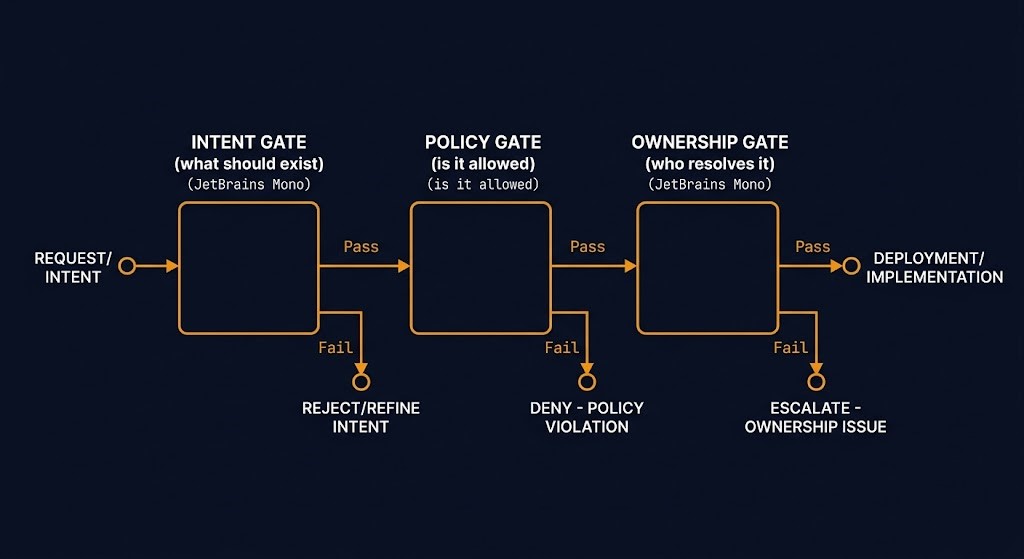
Most organizations that believe they’re at Level 3 actually have the Intent Gate and a partial Policy Gate — a linter, a tfsec scan, something that flags problems. What they’re missing is the Ownership Gate, which is precisely why policy violations that get flagged still ship: flagging isn’t enforcement if nobody’s assigned to act on the flag.
DIAGNOSTIC QUESTION
“If your Terraform plan can successfully provision infrastructure that violates organizational policy, what actually prevented the violation? If the answer is ‘code review,’ you’re still at Level 2.”
The Governance Debt Nobody Budgeted For
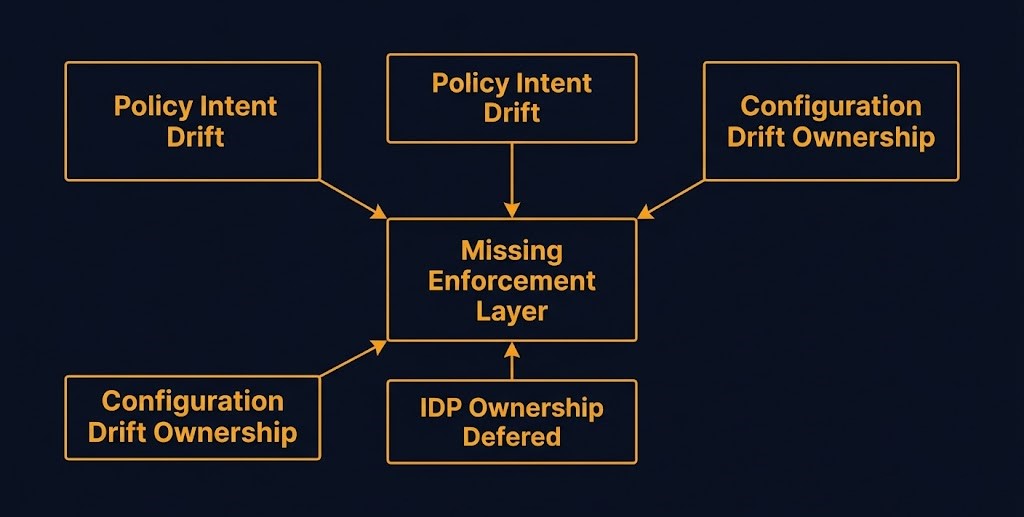
None of this is a new problem wearing a new name — it’s the same missing layer showing up in every incident report that gets filed under a different heading. Policy Intent Drift describes what happens when the policy encoded in your GitOps pipeline silently diverges from the policy your organization actually holds. Configuration drift describes the same gap from the runtime side — state that no longer matches intent, with nobody assigned to reconcile it. And the internal developer platform ownership problem describes what happens when you try to paper over the gap with self-service tooling instead of closing it — the platform absorbs the governance question instead of answering it.
All three are the same missing layer, observed from different angles: nobody owns enforcement, so drift accumulates faster than anyone notices it, until an audit, an incident, or a compliance review forces the reconciliation that should have been continuous.
Modern Infrastructure — Maturity Stage 1 — Declarative Infrastructure names the boundary all three of these symptoms sit downstream of: the point where declarative syntax gets adopted without the governance discipline required to back it.
Reaching Level 3 doesn’t end the story, either — it starts a different one. The Ladder measures how much governance responsibility has moved off a person; it says nothing about what it costs to keep that responsibility running once it has. That’s a separate question, and it compounds independently of whether you ever climb to Level 4. The Automation Debt Curve (Framework #139) is what answers it.
Architect’s Verdict
The industry talks about infrastructure automation as though provisioning is the objective. Provisioning is Level 2.
Governance is what separates automation from orchestration. Most organizations don’t have an automation problem. They have a Level 3 problem.
Additional Resources
View 2 more resources
Editorial Integrity & Security Protocol
This technical deep-dive adheres to the Rack2Cloud Deterministic Integrity Standard. All benchmarks and security audits are derived from zero-trust validation protocols within our isolated lab environments. No vendor influence.

R.M.
Senior Solutions Architect with 25+ years of experience in HCI, cloud strategy, and data resilience. As the lead behind Rack2Cloud, I focus on lab-verified guidance for complex enterprise transitions. View Credentials →
Get the Playbooks Vendors Won’t Publish
Choose the architecture problems you care about. Get field-tested playbooks and frameworks delivered to your inbox.
- > AI Infrastructure & Inference Economics
- > Cloud Strategy & Hidden Cost Models
- > Virtualization & Deterministic Migration
- > Kubernetes, IaC & Modern Infrastructure
- > Data Protection & Recovery Engineering
Zero spam. Includes The Dispatch weekly drop.
Need Architectural Guidance?
Independent review before major infrastructure decisions.
- > Validate assumptions
- > Identify hidden dependencies
- > Quantify migration risk
- > Challenge vendor narratives
Triage · Advisory · Fractional · Direct Hire