

Operational Parity Is Becoming The Real Virtualization Challenge
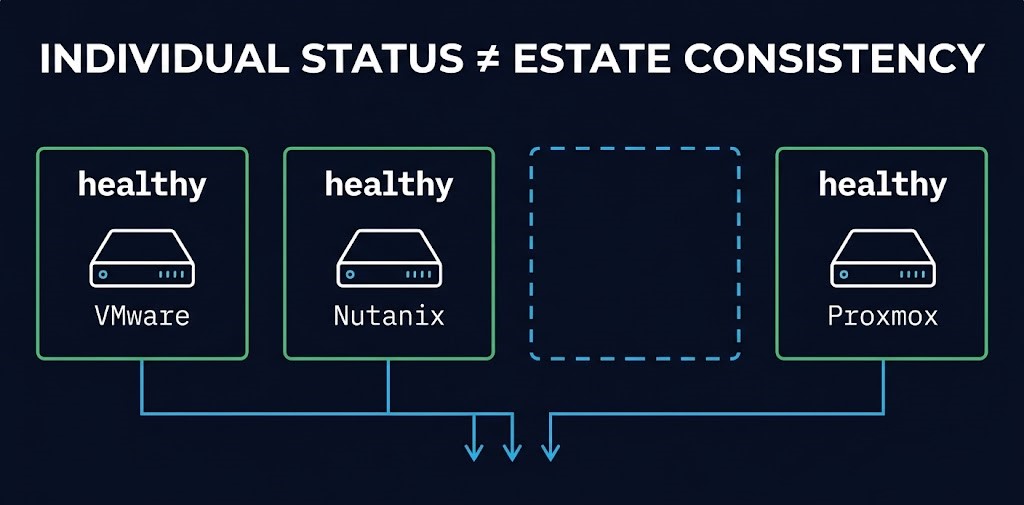
Operational parity across a multi-hypervisor estate is now harder to prove than platform competence ever was. Most enterprises can already demonstrate platform competence. Very few can demonstrate estate-wide operational parity. That gap — not a skills gap, not a tooling gap — is the actual condition virtualization architecture has to answer for in 2026.
Enterprises increasingly operate multiple virtualization domains simultaneously. VMware, Nutanix, Proxmox, OpenShift Virtualization, edge-specific platforms, and acquired environments all coexist. The challenge is no longer operating any one platform well. Every platform team on the estate can already do that. The challenge is proving operational consistency across all of them at once — and almost nobody has built the mechanism to prove it, because almost nobody has been asked to.
This continues an argument already made twice this cycle: operations became the differentiator once the hypervisor itself commoditized, and simplicity became the product once operations were where the competition moved. This post is the third act — the one where even organizations that got both of those right still can’t answer a harder question: does the estate behave consistently once operations are actually where the competition happens?
This Estate Was Never Going to Consolidate
Two-thirds of organizations are already on record as negative about Broadcom’s post-acquisition VMware licensing terms, and Gartner’s own client conversations point the same direction: a multi-year migration toward multiple hypervisors, not a clean cutover to a single replacement. That data point matters less for what it says about VMware specifically than for what it confirms structurally — the industry isn’t heading toward a new single-platform standard. It’s heading toward permanent coexistence — precisely the shift The VMware Exit Has Entered the Coexistence Era already named.
Many organizations assume this is an extended form of the Operating Model Transfer Gap (Framework #137). It isn’t. Framework #137 describes the delta introduced during a single migration event — the operating-model friction between what a platform used to require and what the new one requires — and it resolves once that migration completes. What’s described here doesn’t resolve when migration ends, because for a growing share of enterprises, migration never actually ends. A second platform arrives through a licensing exit, a third through an acquisition, a fourth because an edge use case needed something lighter than the primary estate. Nobody ever declares the migration “done,” because there was never a single target platform to finish migrating to.
That’s the actual condition: operational authority is now distributed across multiple, independently governed virtualization domains, and that distribution is the resting state, not a phase. The market’s current split into three camps — Consolidators, Replacers, and Absorbers — explains why: only Replacers and Absorbers actually land in this permanent multi-platform condition, while Consolidators, staying on a single platform, never trigger it at all. Whether the second platform is Nutanix, Proxmox, OpenShift Virtualization, or an acquired environment is almost irrelevant. What matters is that each one is operated by a team that has, entirely reasonably, optimized for its own platform’s maturity — and nobody has been asked whether those platforms, taken together, behave the same way.
| #137 Operating Model Transfer Gap | Operational Parity Boundary |
|---|---|
| Transitional | Permanent |
| Migration problem | Steady-state problem |
| One platform becoming another | Multiple platforms coexisting |
| Resolves when migration ends | Exists because migration ended |
The Operational Parity Boundary
Call the condition what it is: the Operational Parity Boundary — the point at which an organization can no longer demonstrate that the same operational action produces the same evidence, confidence, and outcome across every platform in its estate. Below the boundary, each platform is independently mature and nobody has tested whether that maturity is comparable across platforms. Above it, the estate can produce one answer — not five platform-specific answers — to the question “did this work.”
FRAMEWORK #168 — OPERATIONAL PARITY BOUNDARY
The point at which an organization can no longer demonstrate that the same operational action produces the same evidence, confidence, and outcome across every independently governed platform in its estate.
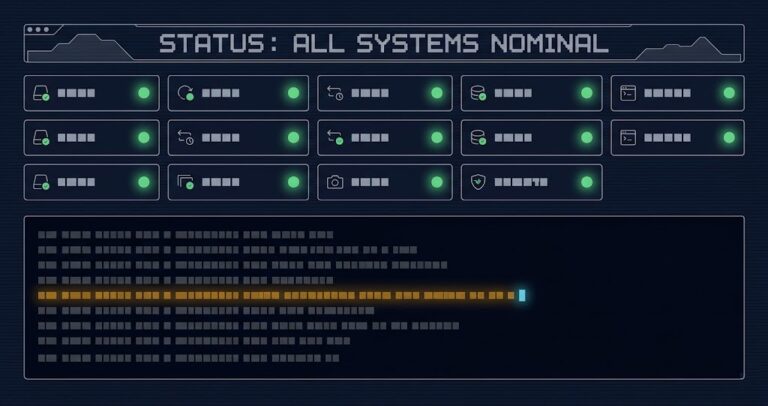
When platforms are governed independently and nobody measures the estate as a whole, every individual signal can stay green while the organization has no functioning answer to whether it’s actually consistent.
Architectural Relationships
Why It Connects
Distinguishes the migration-event delta (#137, transitional, resolves when migration ends) from the steady-state condition Operational Parity Boundary names (permanent, exists because migration ended). A bad or incomplete migration is one common origin of the condition, not the condition itself.
Explore Framework →The diagnostic is deliberately blunt:
DIAGNOSTIC QUESTION
“If the same operational action cannot be executed with the same evidence, confidence, and expected outcome across every virtualization platform in the estate, the boundary is open.”
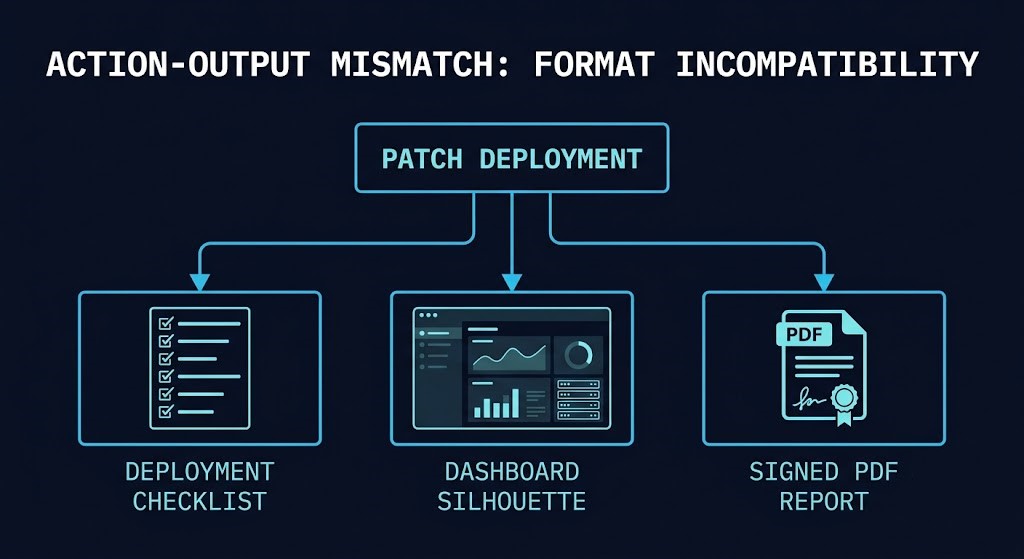
Patch deployment. A DR test. A capacity expansion. A security remediation. Run any one of those across the full estate and ask whether it produced the same thing everywhere.
That first test catches the obvious gap. The second one catches the gap most organizations still miss even after they think they’ve closed the first:
DIAGNOSTIC QUESTION — THE FOLLOW-UP TEST
“If proving parity requires a different evidence package for each platform, parity probably doesn’t exist.”
Every platform team can produce evidence that its own platform behaved correctly. The Operational Parity Boundary asks something harder: can leadership take those separate evidence packages, compare them, and reach the same conclusion — without an interpreter? That’s ultimately the same question Virtualization Deterministic Operations asks of the estate as a whole: can it behave deterministically, not just each platform within it, one at a time?
PORTABILITY NOTE
Although most visible in multi-hypervisor estates, the Operational Parity Boundary is not unique to virtualization. Any environment composed of independently governed operational domains can exhibit the same condition — multi-cloud estates, Kubernetes distributions, security tooling, and data protection platforms are all future candidates. The framework generalizes beyond virtualization, but virtualization provides the clearest contemporary example: platform-by-platform maturity is already high, consolidation assumptions are actively breaking, and multi-platform estates are now common enough to observe the condition cleanly.
Why Nobody Owns This
The instinct is to call this an ownership problem — nobody’s job description covers the whole estate. That’s true, but it’s downstream of the actual mechanism. Ownership follows measurement. Nobody owns estate-wide consistency because nobody measures it. The VMware team measures VMware success. The Nutanix team measures Nutanix success. The Proxmox team measures Proxmox success. Every one of those measurements is real, defensible, and reported up the chain in good faith. None of them are the same measurement, and nobody has ever asked whether they should be. Without a shared metric, operational parity has no owner by definition — the metric doesn’t exist, so the owner never appears, not because anyone declined the job, but because there was never a job posting for it.
That’s the same root cause named directly in Virtualization Sprawl: When Every Team Owns A Different Infrastructure Reality — every team’s operational assumptions about patch cadence, on-call coverage, automation standards, and DR-tested definitions are internally consistent and never checked against each other, which is exactly the condition that leaves no one positioned to measure the estate as a whole.
That absence is exactly what allows every individual platform to look mature while the estate as a whole has no idea whether it’s consistent. The signals an organization already collects aren’t just insufficient — they’re actively reassuring, which is worse:
SIGNALS THAT CREATE PARITY THEATER
- 100% platform-level patch compliance
- Successful DR tests, reported per platform
- Independent capacity reports, one per platform
- Independent audit scores, one per platform
- Platform-specific operational KPIs, all green
Every signal on that list is real. None of them measure whether the platforms agree with each other. An estate can produce all five, simultaneously, and still have no functioning answer to “is this consistent” — that’s what makes it theater rather than a gap: it performs the reassurance of governance without the substance of it.
Parity Theater
Parity Theater is what happens when that absence of measurement finally meets an event that assumes uniformity. It doesn’t surface gradually. It surfaces all at once, the first time someone runs the same operational action across the full estate and gets three different answers back.
Capacity parity. Governance over capacity expansion is enforced on Platform A — approval workflows, chargeback, a defined threshold before new nodes get provisioned. On Platform B, the same decision is made ad hoc, by whoever’s on shift, because that platform never got the same governance investment. Nobody planned this divergence. It just accumulated, one reasonable local decision at a time. On its own, this reads as operational untidiness — inefficient, not dangerous.
Security parity. A CVE lands against a hypervisor component present on both platforms. Platform A patches it in 24 hours — mature runbook, pre-approved change window, automated rollout. Platform B patches it in 21 days, because its patch process was never built to the same standard, and nobody had a reason to notice until an auditor or an incident asked why. This is no longer untidiness. For three weeks, the estate’s actual security posture was whatever the slowest platform’s posture was, and nobody could state that number, because nobody was tracking the estate, only the platforms.
DR parity. A cross-platform failover test runs. Platform A’s recovery is validated — tested, timed, evidenced. Platform B’s recovery is assumed, because it “uses the same process,” except it doesn’t, not really, and the test that would have caught that was never designed to run across both platforms at once. The gap surfaces during the only test that actually matters — a real failover — and by then the estate has already discovered, live, that “recovery works” was true for one platform and an assumption for the other. This is the escalation’s endpoint: not inefficient, not merely risky, but the exact scenario disaster recovery exists to prevent, failing on the one dimension nobody was measuring.
Same underlying condition, three different stakes. Capacity parity costs money. Security parity creates exposure. DR parity is existential. None of the three would have shown up in the five signals listed above — every one of those signals stayed green the entire time.
What Closing the Boundary Actually Requires
The instinctive fix is consolidation — get back to one platform, and the inconsistency problem disappears with it. That’s not available to most estates anymore, and even where it is theoretically available, it isn’t actually the fix. Consistency is achieved through governance, not platform consolidation. An organization that closes this boundary by standardizing on a single platform has postponed the problem, not solved it, because the next acquisition or the next licensing shock reopens it on schedule.
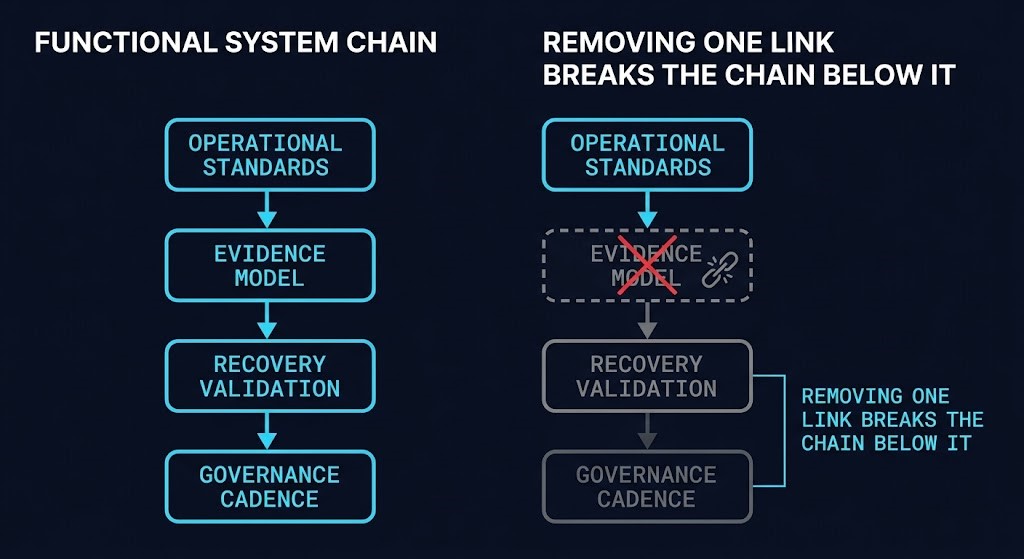
What actually closes it is a small system, not a single control, and each piece does a different job:
01 — COMMON OPERATIONAL STANDARDS
Create the consistency in the first place — one patch cadence, one change-approval threshold, one capacity-governance model, applied identically regardless of which platform is executing it.
02 — COMMON EVIDENCE MODEL
Prove the standard was actually followed — a single evidence format leadership can read across platforms without an interpreter, replacing five platform-specific reports with one estate-wide answer.
03 — COMMON RECOVERY VALIDATION
Test the standard under failure — a cross-platform failover test that treats the estate as one recovery unit, not a validated platform sitting next to an assumed one.
04 — COMMON GOVERNANCE CADENCE
Keep the first three from decaying — a recurring review that re-checks whether the standard, the evidence, and the validation are still holding as the estate’s platforms individually evolve.
Operational standards create consistency. Evidence models prove it. Recovery validation tests it. Governance cadence sustains it. Remove any one piece and the system degrades back toward Parity Theater — standards without evidence are just intentions; evidence without validation is unverified paperwork; validation without cadence is a one-time snapshot of an estate that keeps changing underneath it.
Architecting Beyond VMware already named half of this requirement in passing — “Operational Symmetry,” the same monitoring, logging taxonomy, and escalation paths applying across every hypervisor in the estate. That’s the right instinct, stated as a goal rather than built out as a system. What it doesn’t do is define the condition that exists when symmetry is absent, the diagnostic that detects it, the measurement mechanism that would catch it before an incident does, or the failure state it produces. The industry has already recognized the requirement. It has not yet defined the boundary, the diagnostic, or the failure state that emerge when that requirement goes unmet — which is the gap this framework closes.
Architect’s Verdict
The virtualization challenge isn’t choosing the right platform anymore. It’s proving that every platform behaves the same way when the organization needs evidence, recovery, capacity, or control. Platform maturity is no longer enough. Estate maturity is the new requirement — and estate maturity isn’t something any single platform team can produce on its own, no matter how good their individual runbook is.
Operations became the differentiator. Simplicity became the product. Consistency became the governance challenge. An estate that can’t prove operational parity across its platforms hasn’t failed technically — every platform passed its own review. It’s failed to ask the one question none of those reviews were ever built to answer: does the estate, taken as a whole, behave like one thing or five?
Additional Resources
View 2 more resources
Editorial Integrity & Security Protocol
This technical deep-dive adheres to the Rack2Cloud Deterministic Integrity Standard. All benchmarks and security audits are derived from zero-trust validation protocols within our isolated lab environments. No vendor influence.

R.M.
Senior Solutions Architect with 25+ years of experience in HCI, cloud strategy, and data resilience. As the lead behind Rack2Cloud, I focus on lab-verified guidance for complex enterprise transitions. View Credentials →
Get the Playbooks Vendors Won’t Publish
Field-tested blueprints for migration, HCI, sovereign infrastructure, and AI architecture. Real failure-mode analysis. No marketing filler. Delivered weekly.
Select your infrastructure paths. Receive field-tested blueprints direct to your inbox.
- > Virtualization & Migration Physics
- > Cloud Strategy & Egress Math
- > Data Protection & RTO Reality
- > AI Infrastructure & GPU Fabric
Zero spam. Includes The Dispatch weekly drop.
Architecture Audit Services
Fixed-scope audits for Zero-Trust Azure, VMware migration readiness, and recovery posture — no discovery call required to start.
>_ View Audit Services>_Related Posts
ZFS vs Ceph vs NVMe-oF: Choosing the Right Storage Backend for Modern Virtualization
I still have nightmares about a storage migration I ran back in 2014. >_ Architect’s Brief 60-second read before you commit to the full post · Full post: 7 min Generating brief… We were moving off a monolithic SAN and onto an early “software-defined” storage platform. The sales engineers promised infinite scalability and self-healing magic….
Your VMware Exit Was Successful. The First Incident Will Tell You If That’s True.
VMware exit survivability is the question your migration project never formally scheduled — and the first production incident on the new platform will answer it whether you are ready or not. The cutover completed. The workloads are running. The project closed green. None of that tells you whether the operating model, runbooks, authority structures, and…
Your VMware Exit Plan Assumed a Tool You Didn’t Control
A VMware exit plan usually treats the migration tooling as a given — something you download, install, and use, not something you have to keep asking permission for. In late August, the public self-service path to the Virtual Disk Development Kit (VDDK) stopped working. No deprecation notice. No public transition announcement. A download path that…
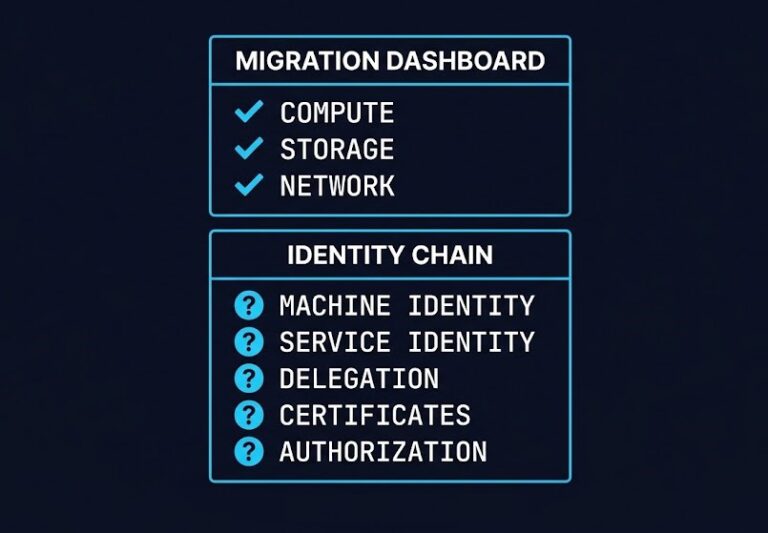
Your Migration Succeeded. The Identity Chain Didn’t.
Identity chain continuity is the thing every migration runbook assumes and almost none of them prove. A migration dashboard can go fully green — compute online, storage attached, network reachable — while the identity chain underneath it is already broken, and nothing in that dashboard will tell you. >_ Architect’s Brief 60-second read before you…
You Had Two Years To Decide On VMware. You Now Have One.
VMware deferral was a defensible posture for organizations that chose it — for the better part of two years, right up until this week, when Microsoft made it structurally impossible to keep pretending “later” was still on the table. >_ Architect’s Brief 60-second read before you commit to the full post · Full post: 9…
What Breaks First After You Leave VMware
On Day 32, the storage team escalates. Veeam SureBackup verifications are silently failing on a subset of workloads that migrated cleanly out of VMware four weeks earlier. The jobs report success. The backups complete. But the verification phase — the part that actually proves the data is recoverable — quietly stopped working somewhere between cutover…