

The Hidden Cost of Tool Sprawl Isn’t the Subscription
Tool sprawl gets budgeted like a subscription problem, and that’s exactly why it keeps getting worse. Every renewal cycle, someone runs the math on a spreadsheet: forty-one SaaS tools, average $38/seat/month, multiply by headcount, present the total as “the cost of tool sprawl,” and propose consolidating six of them to shave the line item. The number is real. It’s also the smallest part of what tool sprawl actually costs.
The Subscription Number Measures the Wrong Layer
The per-seat price is the most visible cost of tool sprawl because it shows up cleanly on an invoice, which is precisely why it becomes the number finance sees first. It’s also the only one that’s optional in the sense people mean when they say “we could cut this.” You can cancel a subscription in an afternoon. You cannot cancel the seven months of tribal knowledge about how your CI pipeline, your incident tooling, and your provisioning system pass state to each other — knowledge that exists because someone had to make three tools cooperate and nobody wrote down how.
This is where most infrastructure teams evaluate their tooling footprint: what the platform runs, what it costs to run, and when each renewal comes due. That’s a real and necessary view. It’s also a view built to answer “should we keep paying for this,” not “what does maintaining this tool’s relationships to everything else actually require.” Those are different questions, and enterprises consistently answer the first one while believing they’ve answered the second.
Every tool a platform adopts increases more than the invoice. It increases the relationships the platform has to maintain with every other tool it already runs — the handoffs between them, the duplicated functions each one quietly re-implements, the credentials that now exist in a fourth place, the policies that have to be kept consistent across systems that don’t share a policy engine, and the ownership boundary someone has to draw and defend when two tools both think they’re responsible for the same thing. None of that appears on the renewal invoice, and none of it is priced by a standard infrastructure architecture review built to answer “what does this cost to run,” not “what does this cost to maintain.” All of it accrues the moment the tool goes into production, and it keeps accruing for as long as the tool stays there.
Why Tool Sprawl’s Cost Compounds, Not Adds
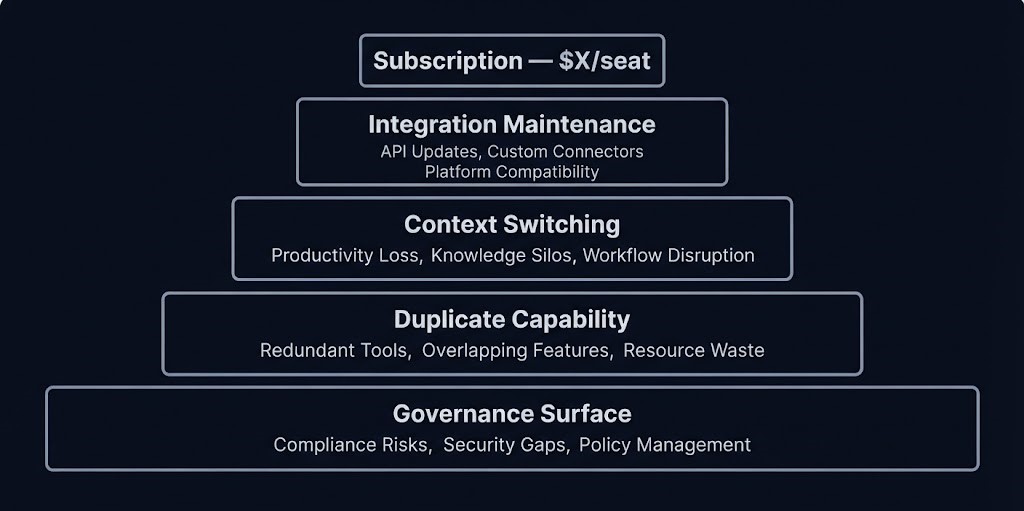
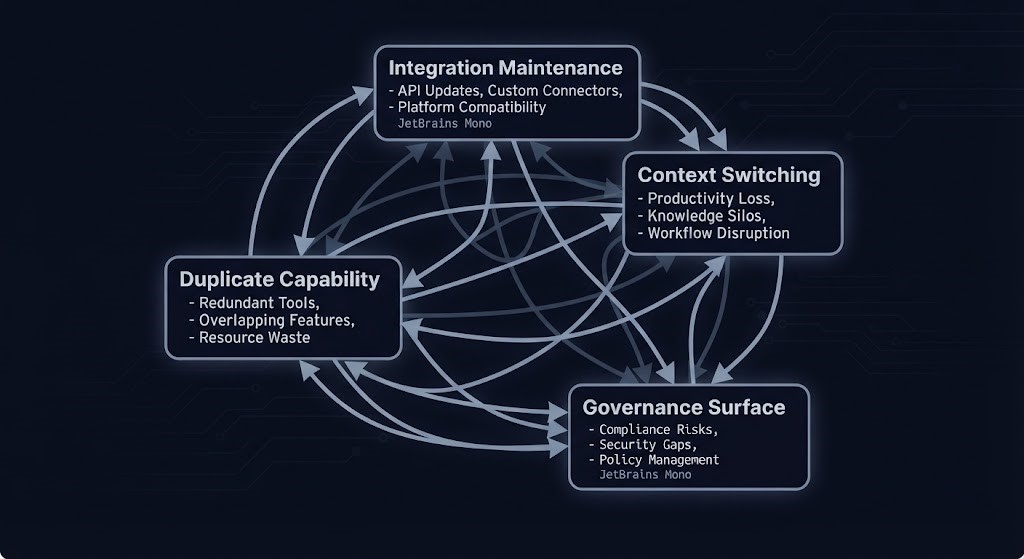
The instinct is to model this as arithmetic — one more tool, one more line item, cost scales linearly with tool count. It doesn’t. A useful mental model treats each new tool as increasing the relationships the platform has to maintain, not just the tool count itself, and relationships don’t add, they compound. Four separate mechanisms drive that compounding, and they’re cumulative — not four ways of describing the same cost, four costs that stack on top of each other.
Integration maintenance is the most visible of the four, and the one most teams already track in some form. Every integration between two tools is an operational contract neither vendor signed. When either side ships a breaking API change, updates an auth flow, or deprecates a webhook format, someone on your team absorbs the repair — and the number of integrations to maintain doesn’t track tool count, it tracks how many of those tools talk to each other, which is a much steeper curve.
Context switching is the cost nobody puts a dollar figure on because it doesn’t look like a cost — it looks like a Tuesday. An engineer diagnosing a deployment failure who has to correlate state across a CI system, a config management tool, an observability platform, and a ticketing system isn’t doing four small tasks. They’re paying a reassembly tax every time the mental model has to be rebuilt in a different tool’s vocabulary, and that tax scales with how many tools sit in the critical path of a single diagnostic question.
Duplicate capability is what happens when nobody notices that three tools now do version control, two do secrets management, and two do alerting — each adopted independently to solve a narrow problem, each now a redundant system nobody has consolidated because consolidation requires someone to own the decision to remove a tool that’s still technically working. Redundant capability isn’t free insurance. It’s redundant surface — more places the same class of failure can originate, more places a policy has to be enforced twice to actually hold.
Governance and security surface is the category most likely to get discovered by an audit instead of an architecture review. Every tool is a new place credentials live, a new place access has to be provisioned and deprovisioned, a new system that has to be included — or, more commonly, forgotten — in the next compliance review. This is a distinct cost from integration maintenance: two tools can have zero technical integration between them and still both expand the governance surface, because governance tracks systems that hold access and data, not systems that exchange API calls.
These four don’t sum politely. Integration maintenance creates more surfaces for context switching. Duplicate capability increases the number of systems that have to be governed. And governance requirements can expose integration dependencies that the original tool review never modeled. A platform with twelve tools isn’t necessarily carrying twelve times the operational overhead of one tool. It is carrying the relationships, overlaps, and governance obligations created by those twelve tools — and those surfaces can grow far faster than the tool count itself.
Five Tools, Zero Owners of the Combination
Here’s the pattern that makes this concrete, and it’s illustrative — a composite shape drawn from how this plays out repeatedly, not a specific customer engagement.
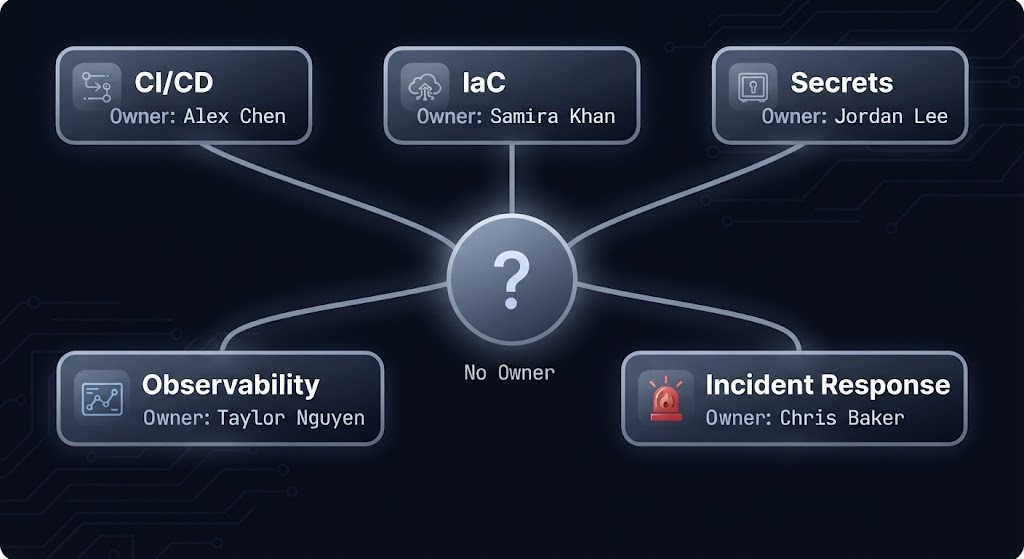
An infrastructure team runs five tools: a CI/CD platform, an infrastructure-as-code tool, a secrets manager, an observability stack, and an incident response system. Each one has an owner. The CI/CD platform has a platform engineering lead. The IaC tool has the same team, formally. Secrets management reports to security. Observability has its own on-call rotation. Incident response is owned by whoever’s running the postmortem process that quarter.
Every tool, in other words, is accounted for. Ask who owns the CI/CD platform and you get a name in under five seconds. Now ask a different question: who owns what happens when the CI/CD platform’s deploy hook fires a secrets rotation before the observability stack has finished re-registering the new credentials, causing alerts to fire against endpoints that are mid-rotation and technically healthy? That system — the combination of behaviors that only exists because these five tools are wired together — has no owner. It was never a job description. It was never a line in anyone’s OKRs. It exists entirely in the gap between five tools that are each, individually, someone’s responsibility.
Every tool can have an owner while the system created by the tools has no owner. That’s not a staffing gap you close by hiring a “tool sprawl coordinator.” It’s a structural consequence of how ownership gets assigned — per tool, because that’s how procurement and org charts work — while the cost actually lives at the seams between tools, where no procurement line item and no org chart box has ever pointed.
The Automation Debt Curve Is a Related, Not Identical, Cost
Tool sprawl’s compounding cost and automation debt are easy to conflate, and worth separating cleanly. Automation debt — the cost of keeping an automated system trustworthy as it scales — describes what happens within a single automated system as it grows: more pipelines, more policies, more tests required to keep one system reliable. Tool sprawl’s four-category cost describes what happens between systems as more of them accumulate. A platform can have low automation debt in every individual tool and still be deep in sprawl cost, because sprawl is a property of the relationships across tools, not the maturity of any one of them. The two models measure adjacent but distinct territory, and conflating them is exactly how a consolidation effort ends up “fixing” the wrong layer — hardening one tool’s internal pipeline while the actual cost keeps accruing in the handoffs nobody touched.
This isn’t an anti-tool argument, and it’s worth being explicit about that, because the instinct after reading four compounding cost categories is to reach for a tool count target. Tool count isn’t the problem. A platform with fifteen well-integrated, clearly-owned tools can carry a lower sprawl cost than one running six tools nobody has mapped the relationships between. The variable that matters is whether the interactions between tools — and the ownership of those interactions — are managed as deliberately as the tools themselves are procured.
What a Real Accounting Looks Like
Measuring tool sprawl’s actual cost means pricing the four categories directly instead of counting seats. That starts with mapping which tools actually integrate with which others — not which tools could integrate, which ones do, today, in production — and treating every edge in that map as a maintenance obligation, not a feature. It means auditing for duplicate capability explicitly, by function rather than by tool name, since “two secrets managers” doesn’t show up on a tool inventory sorted alphabetically. It means pulling context-switching cost out of incident postmortems specifically, by tracking how many distinct tools an engineer had to correlate before they found the actual fault. And it means treating governance surface as a headcount of systems that hold access, independent of whether those systems talk to each other technically, because a compliance review doesn’t care whether two tools are integrated — it cares whether both of them are accounted for.
None of that shows up if the review starts and ends at the renewal spreadsheet. This is the gap a cost architecture review is built to close — not “which subscriptions can we cancel,” but which relationships between systems are generating cost nobody assigned an owner to, and where the actual accountability for that cost should sit.
This same ownership failure shows up under different names elsewhere in the architecture. In configuration drift, the drift is often the visible symptom of an absent owner; in the shadow control plane, the console becomes a control surface nobody formally scoped; in AI tooling, a control plane can emerge accidentally from tools adopted for narrower purposes. The same blind spot extends beyond internal tooling: a vendor review process can miss the real supplier behind a tool because the procurement boundary hides the dependency.
Architect’s Verdict
Tool sprawl’s cost was never the subscription. The subscription is the one number in this whole picture that’s actually accounted for — it has a line item, an owner, a renewal date. The cost that compounds is the one nobody assigned to anyone: the integration maintenance, the context-switching tax, the duplicate capability, the governance surface, all of it accruing in the relationships between tools rather than inside any single tool’s budget line.
Most organizations will keep measuring this correctly at the tool level and incorrectly at the system level, because the tool level is what procurement tracks and the system level is what nobody’s job description covers. That mismatch isn’t a tooling problem. It’s an ownership problem wearing a tooling problem’s clothes.
Every tool can have an owner. The system those tools create together needs one too.
SERIES: Hidden Cost Models
← Previous
The Capacity You Paid For But Never UsedAdditional Resources
Editorial Integrity & Security Protocol
This technical deep-dive adheres to the Rack2Cloud Deterministic Integrity Standard. All benchmarks and security audits are derived from zero-trust validation protocols within our isolated lab environments. No vendor influence.

R.M.
Senior Solutions Architect with 25+ years of experience in HCI, cloud strategy, and data resilience. As the lead behind Rack2Cloud, I focus on lab-verified guidance for complex enterprise transitions. View Credentials →
Get the Playbooks Vendors Won’t Publish
Field-tested blueprints for migration, HCI, sovereign infrastructure, and AI architecture. Real failure-mode analysis. No marketing filler. Delivered weekly.
Select your infrastructure paths. Receive field-tested blueprints direct to your inbox.
- > Virtualization & Migration Physics
- > Cloud Strategy & Egress Math
- > Data Protection & RTO Reality
- > AI Infrastructure & GPU Fabric
Zero spam. Includes The Dispatch weekly drop.
Architecture Audit Services
Fixed-scope audits for Zero-Trust Azure, VMware migration readiness, and recovery posture — no discovery call required to start.
>_ View Audit Services>_Related Posts
Which Workloads Should Never Leave The Cloud
(Even When Repatriation Looks Tempting) >_ Architect’s Brief 60-second read before you commit to the full post · Full post: 5 min Generating brief… After publishing my piece on cloud repatriation, my inbox filled up fast. Not with disagreement—but with a different question: “Okay, fine. Some workloads should come home. But which ones absolutely should…
The Windows 10 ESU Price Doubles In Six Weeks. That’s The Procurement Decision.
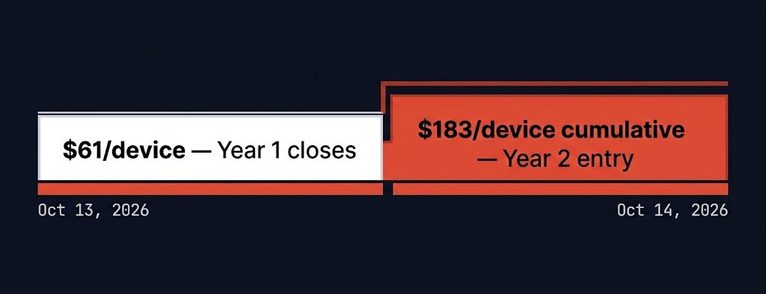
Windows 10 ESU has been purchasable since September 2025 — that part isn’t news. What changes on October 13, 2026 is the price: Year 1 coverage closes, and any organization that hasn’t enrolled yet moves into a cumulative Year 2 structure that requires paying for both Year 1 and Year 2 coverage, raising the minimum…
The VMware Exit Has Entered the Coexistence Era
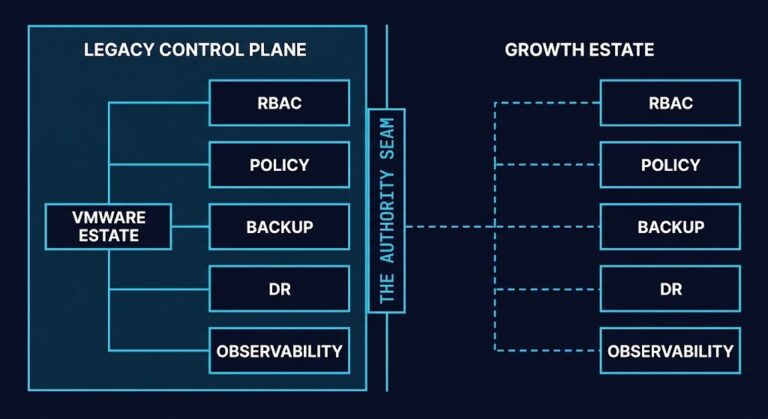
Somewhere around 2025, the enterprise conversation about VMware quietly rewrote its own objective. “Replace VMware” became “reduce VMware dependency” — not in any formal announcement, not in a strategy document, but in the actual architecture decisions organizations were making as migration programs ran longer than planned and the complexity of what they were replacing became…
The SaaS Control Plane Problem
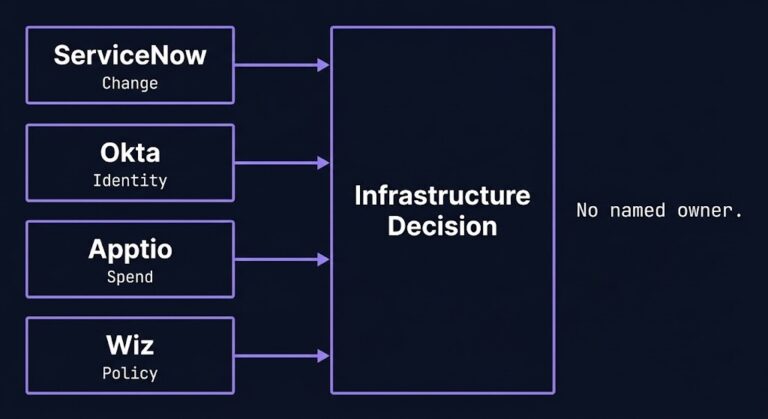
Most organizations do not have a SaaS governance problem. They have a SaaS authority problem — and the distinction matters because governance problems have vendors selling solutions to them. Authority problems do not surface until an audit, a contract renewal, or an incident reveals that a set of workflow tools your infrastructure team approved individually…
The Retirement Dates Converged. Your Teams Didn’t.
Lifecycle convergence is what happens on October 1, October 13, and November 10, 2026, when four unrelated Microsoft products — an identity policy, a productivity application, an office suite, and a server operating system — reach a support decision point inside the same six-week window. None of the four teams responsible for those products planned…
The Infrastructure Control Plane Is Consolidating
On Monday, Cisco unveiled Cloud Control at Cisco Live. One login. Networking, security, compute, observability, and collaboration unified into a single operational surface with a shared data layer and a shared automation model. Cisco called it the foundation for their AgenticOps operating model. >_ Architect’s Brief 60-second read before you commit to the full post…