

Cloud-Based Recovery Didn’t Eliminate USB Drives. It Eliminated Recovery Independence.
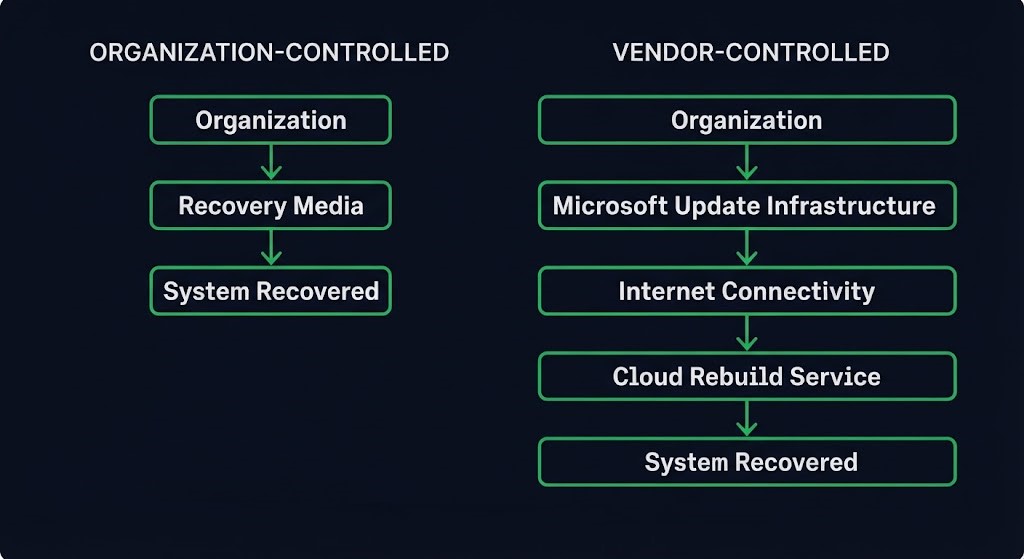
Cloud-based recovery is becoming the default way Windows 11 recovers a machine that won’t boot, and almost nobody signed off on the dependency that creates. Local recovery media was never the preferred repair path. It was the path that worked when every preferred path had already failed — no network, no identity provider, no vendor cloud, nothing that depended on the thing that just broke. That property is what’s disappearing, not the USB drive itself.
What Changed
Microsoft’s Cloud Rebuild feature moved from the Experimental Insider channel to Beta on September 9, 2026 (Build 26220.9343) — the clearest signal yet that this is headed toward general availability on a normal timeline, not sitting as a permanent preview curiosity. It runs from the Windows Recovery Environment (WinRE), reformats the system disk, and pulls a fresh Windows 11 image plus current drivers directly from Windows Update. No USB flash drive. No DVD. No dependency on a recovery partition surviving whatever failure triggered the rebuild in the first place.
For managed fleets, Cloud Rebuild integrates with Windows Autopilot and Intune: a rebuilt device can re-enroll automatically, with assigned apps, policies, and user settings restored through Backup for Organizations. Remote initiation isn’t available in this Beta — a rebuild still has to be triggered locally from WinRE or an elevated prompt — but Microsoft has said Intune-driven remote triggering is planned. That detail matters more than it looks. The roadmap points toward IT no longer needing physical hands on the device to initiate recovery at all, which only deepens the dependency this post is about.
Cloud-Based Recovery Improves Convenience. It Doesn’t Improve Recovery Architecture.
Microsoft’s case for this feature is not weak, and it’s worth stating plainly before making the counter-argument:
| Cloud-Based Recovery Improves | Cloud-Based Recovery Weakens |
|---|---|
| Media management — no drives to provision, label, store, or lose | Recovery independence — recovery no longer executes without external services |
| Image freshness — always the current build, not whatever was burned to media months ago | Recovery sovereignty — the organization no longer controls what recovery depends on |
| Driver currency — pulled live from Windows Update, not a stale recovery partition | Offline recoverability — no path left that survives a connectivity or vendor outage |
| Support simplicity — one documented process instead of per-device media variance | Vendor dependency isolation — the recovery path and the outage’s blast radius can now overlap |
Every item on the left is real and worth having. None of them is the same claim as the items on the right, and collapsing the two into a single “this is better” verdict is the mistake worth avoiding here. Cloud-based recovery can be operationally superior to what it replaces while simultaneously making the recovery architecture more centralized and more dependent on a single vendor’s availability. Those are two different arguments. Only one of them showed up in the feature announcement.
The Last Independent Recovery Path
Local recovery media was rarely anyone’s first choice. It was slow, it required physical custody of a drive, and it depended on someone remembering where that drive was kept. None of that was the point. The point was that it sat entirely outside the dependency chain that caused the outage in the first place — no network path, no identity provider, no vendor’s uptime, nothing the original failure could have taken down along with everything else. It’s the same principle the connected air gap argument makes about backup isolation — a fallback only counts as independent if it’s actually outside the failure domain, not merely labeled that way.
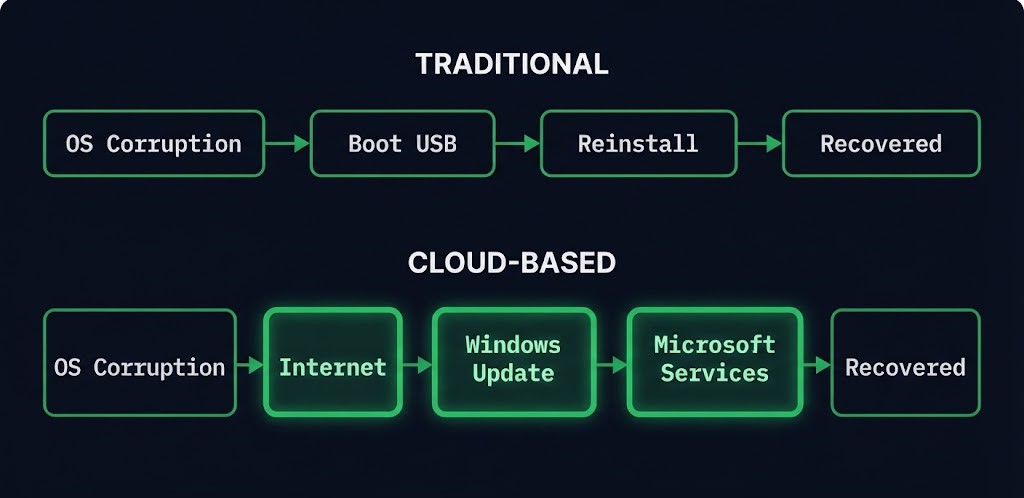
Two recovery paths responding to the identical failure make the difference concrete:
| Traditional Recovery Path | Cloud-Based Recovery Path |
|---|---|
| OS corruption | OS corruption |
| → Boot from USB | → Requires internet connectivity |
| → Reinstall from local media | → Requires Windows Update reachability |
| → System recovered — one dependency, and it’s physical custody | → Requires Microsoft service availability |
| → System recovered — three new dependencies, and none of them belong to the organization |
The traditional path has one dependency: whoever holds the drive. The cloud-based path has at least three, and all three sit outside the machine being recovered and outside the organization’s authority to guarantee.
Recovery Authority Transfer
Every recovery mechanism has an implicit authority chain — the sequence of things that have to hold true, and hold trusted, before a device comes back into service. For local recovery media, that chain was short: the organization decided what image and drivers a device would run, wrote that decision to media it physically controlled, and recovery executed against artifacts nobody outside the organization ever touched.
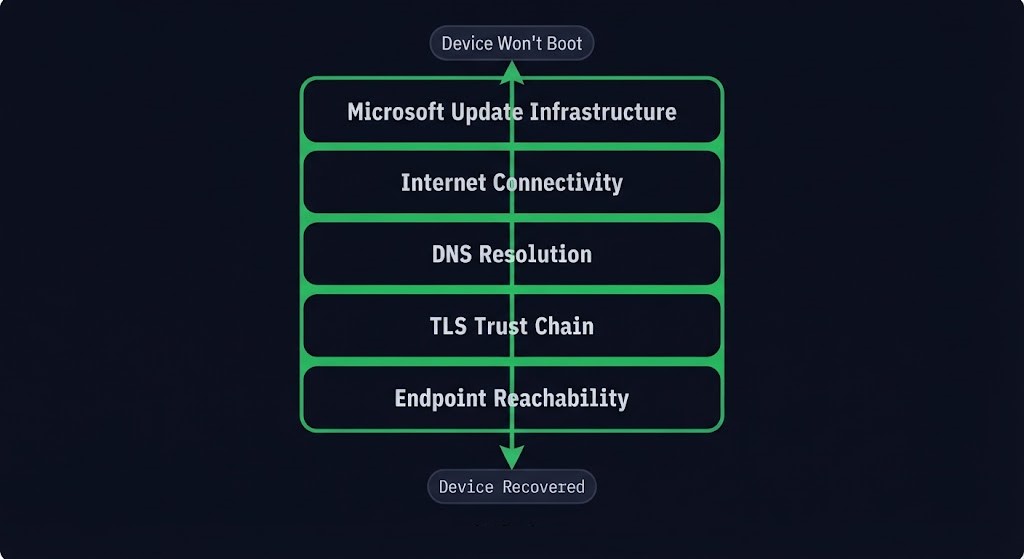
Cloud-based recovery replaces that chain with a longer one: Microsoft’s Update infrastructure, generic internet connectivity, DNS resolution, the TLS trust chain validating the connection, and the reachability of whichever Microsoft endpoint actually serves the rebuild. None of those five things sits under the organization’s authority, and all five now stand between “device won’t boot” and “device recovered.”
That’s the same drift The System Recovered. Your Recovery Boundary Didn’t. names on the other side of the lifecycle — dependency boundaries expanding faster than recovery boundaries account for. That post is about what a recovered system still depends on afterward. This is about what the recovery mechanism itself now depends on before it can even start.
That’s the question worth asking before this ships to production fleets, not after: has recovery authority moved outside the recovery boundary? Recovery Design Boundary — the framework naming what dependencies must exist before recovery can even begin — is built for exactly this question. A recovery mechanism that requires DNS resolution, TLS validation, and a third party’s infrastructure to stay healthy before it can execute has quietly redrawn where that boundary sits, whether or not anyone updated the architecture diagram to reflect it.
The question is not whether these dependencies usually work. They usually do. The question is whether they remain available during the exact class of event recovery procedures exist to address. Recovery mechanisms are not evaluated during normal operations. They’re evaluated during abnormal conditions, when multiple assumptions fail simultaneously.
Who Approved This?
Somewhere in most Data Protection programs there’s a decision record for which backup platform runs, what the RPO/RTO targets are, and who holds authority to declare a recovery complete. There is almost never a decision record for “OS recovery may now depend on Microsoft’s cloud infrastructure being reachable.” Nobody voted on that. It arrives as a default in an OS update, and it will reach most fleets the same way every other default setting does — silently, on whatever patch cadence the organization already runs.
Organizations rarely lose recovery independence through a formal architecture review. They lose it through default-path drift — a sequence of vendor defaults that gradually become production architecture without ever appearing in a design review.
The Governance & Recovery Assurance stage of Rack2Cloud’s own Data Protection Learning Path is where this kind of decision is supposed to get formalized — a recorded, accountable answer to what recovery may depend on, not a default absorbed silently through a patch cycle.
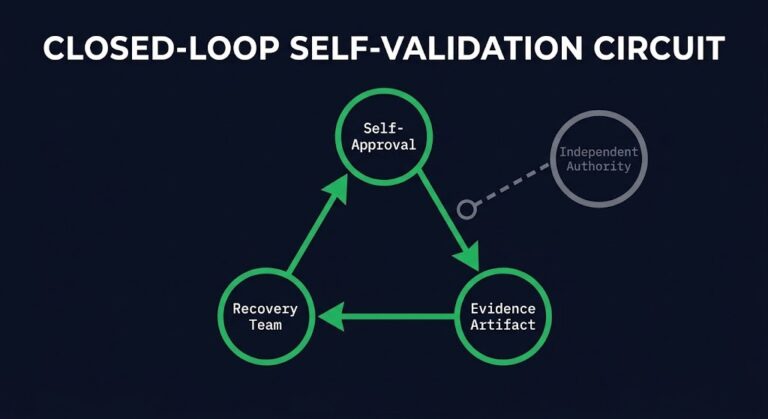
That’s a different failure mode from the one Recovery Evidence Boundary describes. Evidence Boundary is about whether anyone structurally independent can validate a recovery claim after the fact. This is upstream of that question — it’s about whether the organization ever exercised authority over the dependency in the first place. An unvalidated recovery claim is a governance failure at the audit stage. An inherited dependency nobody reviewed is a governance failure at the design stage, and design-stage failures are far cheaper to fix before a feature reaches general availability than after.
Architect’s Verdict
Cloud-based recovery is not a downgrade. It’s a different architecture, and most organizations are about to inherit it without ever deciding to.
The real problem isn’t Microsoft’s engineering choice — reinstalling from a live, current image is a legitimate improvement over media that goes stale the day it’s created. The real problem is that a recovery architecture decision is being made by a default setting instead of by the people accountable for recovery outcomes. Every organization running Windows 11 fleets is about to answer “does OS recovery depend on our internet connection and Microsoft’s availability” whether or not anyone ever asked that question on purpose.
An organization that has never reviewed what its recovery depends on doesn’t have a recovery architecture. It has an assumption that hasn’t failed yet.
Recovery architecture is not defined by how a system recovers when everything works. It’s defined by what recovery still depends on when everything else doesn’t.
Additional Resources
Editorial Integrity & Security Protocol
This technical deep-dive adheres to the Rack2Cloud Deterministic Integrity Standard. All benchmarks and security audits are derived from zero-trust validation protocols within our isolated lab environments. No vendor influence.

R.M.
Senior Solutions Architect with 25+ years of experience in HCI, cloud strategy, and data resilience. As the lead behind Rack2Cloud, I focus on lab-verified guidance for complex enterprise transitions. View Credentials →
Get the Playbooks Vendors Won’t Publish
Field-tested blueprints for migration, HCI, sovereign infrastructure, and AI architecture. Real failure-mode analysis. No marketing filler. Delivered weekly.
Select your infrastructure paths. Receive field-tested blueprints direct to your inbox.
- > Virtualization & Migration Physics
- > Cloud Strategy & Egress Math
- > Data Protection & RTO Reality
- > AI Infrastructure & GPU Fabric
Zero spam. Includes The Dispatch weekly drop.
Architecture Audit Services
Fixed-scope audits for Zero-Trust Azure, VMware migration readiness, and recovery posture — no discovery call required to start.
>_ View Audit Services>_Related Posts
Your Recovery Program Has a Recovery Evidence Boundary
Recovery evidence boundary is the point where a recovery program stops being an engineering question and starts being a governance one — and most organizations cross it without ever finding out, because everything on the way there still looks like success. The backups completed. The DR test passed. The tabletop went well. Somebody wrote a…
Your Recovery Architecture Has A Bus Factor Problem
Recovery bus factor is the gap between a recovery plan that has been tested, documented, and signed off — and a recovery plan that can actually be executed when the one or two people who know how to run it aren’t in the room. The recovery program had passed everything that mattered on paper: RTO…
Your Ransomware Recovery Plan Has a Recoverability Gap
The recoverability gap is the structural distance between what your recovery plan assumes and what your infrastructure can actually deliver under failure conditions. Most organizations don’t discover it during planning. They discover it on day three of an incident. >_ Architect’s Brief 60-second read before you commit to the full post · Full post: 12…
Your Ransomware Plan Is Fiction: 5 Recovery Metrics Nutanix, Cohesity, Rubrik & Pure Can’t Hide
Ransomware recovery metrics are the only thing standing between your recovery plan and a PowerPoint. Every vendor demo shows a single VM booting in 60 seconds. Every real ransomware recovery looks like this: the backups are intact, the ransomware is neutralized, the executives are on the bridge — and nothing is coming back online. >_…
Your Logs Are Not Evidence If The Infrastructure That Produces Them Can Rewrite The Record
The evidence layer is not a byproduct of your infrastructure — it is infrastructure, and on August 30, Sygnia documented what happens when the evidence layer is captured along with everything else. Fire Ant, a China-nexus threat actor Sygnia has tracked since 2025, spent this year moving past the VMware hypervisors it was previously known…
Your Identity System Is Your Biggest Single Point of Failure
Part 2 of the Rack2Cloud’s Cloud Fragility Series >_ Cloud Fragility Series 01 Multi-Cloud Cascading Failure Risks 02 Your Identity System Is Your Biggest Single Point of Failure [CURRENT] 03 Vendor Lock-In Happens Through Networking — Not APIs 04 Your Cloud Bill Quietly Increased in 2026 — Here’s Where the Money Is Actually Going >_…