

The Console Is The Shadow Control Plane
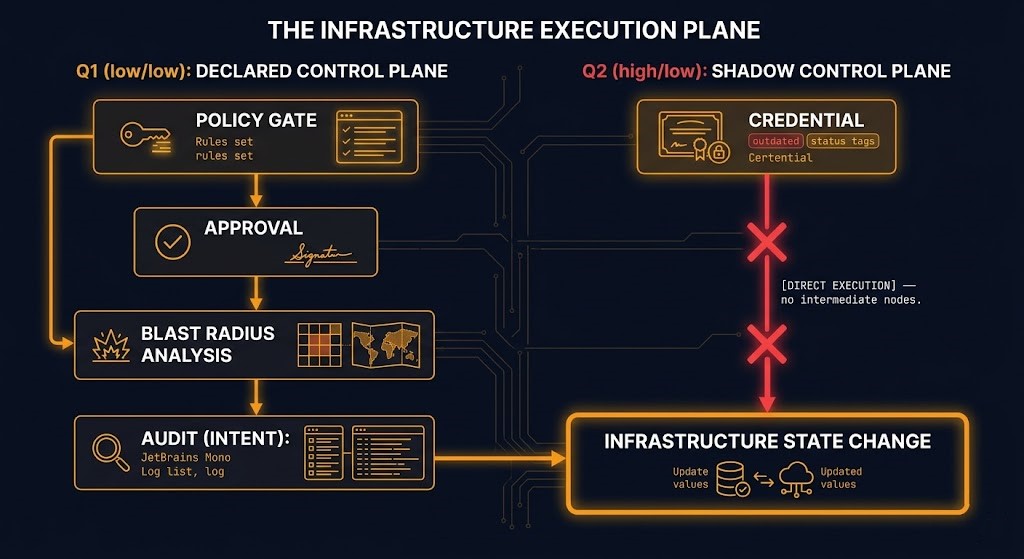
Most organizations believe they have one infrastructure control plane. They have two.
The declared control plane has policy gates, approval workflows, branch protections, and an audit trail that connects change to intent. The operational control plane has a browser and a credential. Both mutate production state. Only one of them is governed.
That gap — between the infrastructure authority you designed and the infrastructure authority that runs your environment — is the shadow control plane problem. It is not a tooling failure. It is not an operator discipline failure. It is an authority topology problem: modern infrastructure environments rarely operate through a single governance system. They operate through two competing ones simultaneously, and the ungoverned one has been winning for years.
THE AUTHORITY LAYER
What a Shadow Control Plane Actually Is
The term shadow control plane is often used to mean “people clicking in the console when they shouldn’t be.” That framing is wrong, and it leads to the wrong solutions.
A shadow control plane is any execution path that retains full infrastructure authority while bypassing the declared control plane’s governance layer. The emphasis is on retaining full authority. This is not a restricted path, a read-only viewer, or a monitoring interface. It is a fully operational execution environment — provisioning, modifying, deleting, reconfiguring — with no mandatory policy enforcement, no approval gate, no blast radius boundary, and no audit trail linking the change to an approved intent.
The cloud console is the most visible instance of this pattern. But it is not the only one. The CLI running from a local workstation with production credentials is a shadow control plane — the terminal layer of the same ungoverned execution authority problem is covered in The CLI Was Always the Control Plane. A SaaS integration writing directly to cloud APIs outside the pipeline path is a shadow control plane. An AI agent with infrastructure credentials operating outside declared governance mediation is a shadow control plane.
The defining characteristic is not the interface. It is the absence of governance mediation between the execution authority and the infrastructure it can reach.
Why Operations Falls Back to the Console
The shadow control plane does not grow because engineers are careless. It grows because operations trusts it more during failure — and in many cases, that trust is operationally justified.
During a major incident, the pipeline is often the wrong tool for recovery. Approval workflows are unavailable at 2am. Policy engines block changes that don’t match pre-declared patterns — exactly the kind of changes an incident requires. The IaC repository may not reflect current runtime state, because drift has accumulated since the last apply. Terraform plan output during an active incident can be actively misleading — showing changes against a declared state that no longer matches reality.
The console, by contrast, shows what is actually running. It allows direct intervention against the real state of the environment, without waiting for a pipeline trigger, a reviewer, or an approval queue to clear. During major incidents, the console often reflects operational reality more accurately than the IaC repository does. That is not a criticism of IaC. It is a description of what happens to state under failure conditions, and why operators reach for the tool that reflects reality rather than the tool that reflects intent.
This is the birth pattern of the shadow control plane:
THE SHADOW CONTROL PLANE BIRTH PATTERN
01 — INCIDENT OCCURS
Pipeline is too slow. Approvals unavailable. Console change restores service.
02 — NOBODY RECONCILES
Service is restored. The incident is closed. The IaC repository diverges permanently from production state.
03 — NEXT APPLY BECOMES DANGEROUS
Terraform plan output reflects declared state, not operational state. A full apply would overwrite the change production now depends on.
04 — PIPELINE TRUST ERODES
The declared control plane becomes less reliable as a representation of actual state. Console usage increases. The shadow control plane advances.
Each incident that goes unreconciled makes the declared control plane less reliable as a representation of actual state — and makes the shadow control plane more operationally rational as a result. The problem compounds itself.
The key insight: the shadow control plane grows wherever operational urgency exceeds governance friction. The solution is not to eliminate the console. It is to reduce the friction on the governed path and reduce the latency between emergency action and reconciliation.
The Execution Authority Gap
This is the named framework for the structural problem.
Pipelines govern intent. Consoles govern capability.
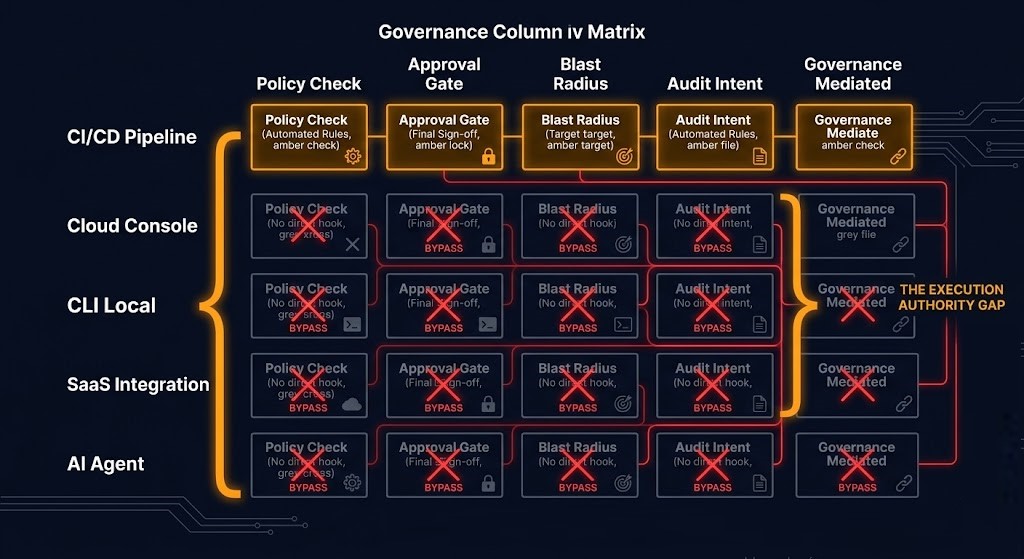
That contrast is the architecture problem stated precisely. The pipeline enforces who can change what, under what conditions, against what approved intent, with what blast radius analysis. The console enforces nothing except the presence of a valid credential. Both paths produce the same result — infrastructure state changes. Only one path carries governance.
Map what each path requires to execute an identical change:
| Execution Path | Policy Check | Approval Gate | Blast Radius Analysis | Audit Trail (Intent) | Governance Mediated |
|---|---|---|---|---|---|
| CI/CD pipeline | ✅ Yes | ✅ Yes | ✅ Yes (plan review) | ✅ Yes | ✅ Yes |
| Cloud console | ❌ No | ❌ No | ❌ No | ⚠ WHO only | ❌ No |
| CLI (local) | ❌ No | ❌ No | ❌ No | ⚠ WHO only | ❌ No |
| SaaS integration | ⚠ Varies | ❌ No | ❌ No | ⚠ Rarely | ❌ No |
| AI agent (ungoverned) | ❌ No | ❌ No | ❌ No | ❌ No | ❌ No |
The Execution Authority Gap is the delta between the left column and every row to the right of it. The pipeline is the only execution path that carries governance all the way through. Every other path retains full execution authority while dropping the governance layer.
A related but distinct gap shows up one layer up the stack, where the console problem has already been “solved” on paper. VMware Private AI Cloud Doesn’t Eliminate Fragmented Control Planes — It Creates an Authority Relay covers a coordinating console — VCF Operations — that does carry visibility across every execution path beneath it, and still can’t adjudicate a cross-layer incident, because visibility was centralized and enforcement authority wasn’t. The gap this post maps is missing governance. That one is governance that looks present and isn’t load-bearing.
Most organizations acknowledge this gap exists. Very few have mapped its scope — the full surface area of execution paths that carry production authority outside the declared governance model.
Governance surface area isn’t unique to execution paths, either — tool sprawl’s cost model names the same category from the procurement side: every tool a platform adopts is a new place credentials live and a new system that has to be included in the next compliance review, independent of whether that tool ever bypasses a pipeline. The shadow control plane is what happens when one execution path skips governance; tool sprawl is what happens when governance has to track a dozen legitimate ones simultaneously.
That mis-scoping typically starts before the build — at the strategy stage, where the authority question is never asked. Most sovereignty strategies fail before architecture begins for exactly this reason: they specify where systems sit, not where authority resides, so the gap is locked in before the first resource is provisioned.
Mapping that scope is necessary but not sufficient. Even a mapped, governed path can fail the same way an unmapped one does. Azure’s July 23 outage showed the sharper version of the problem: the redundant-path check before a routine maintenance job executed passed — correctly, as designed. The automation simply reached devices the check was never scoped to cover. The Execution Authority Gap asks whether a path carries governance at all. The harder case one level down is a path that does carry governance, evaluated against a boundary that didn’t cover what actually broke.
Machine-Scale Shadow Control Planes
Console drift is human-scale. One operator, one session, one set of changes. Recoverable with reconciliation effort and organizational discipline.
The real exposure in 2026 is system-scale.
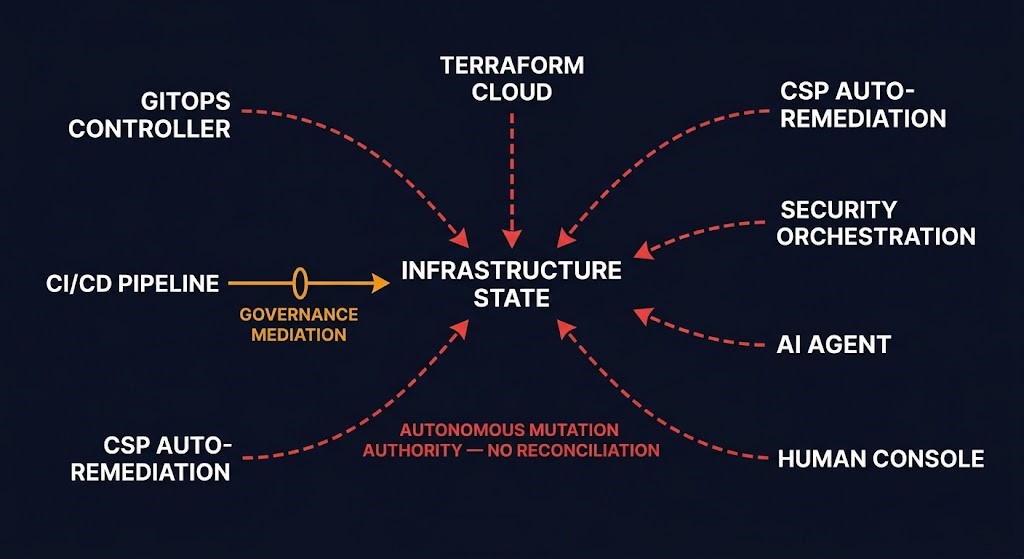
Infrastructure mutations are increasingly performed by systems operating entirely outside the declared governance path — at machine speed, without human review, continuously. The problem is not automation. Automation with governance mediation is precisely what the CI/CD control plane is designed to provide. The problem is autonomous mutation authority without reconciliation or intent validation.
Flux and ArgoCD operate continuous reconciliation loops. When declared state diverges from governance intent, the controller enforces the repository — not the intent. The governance gap is upstream of the controller, not within it.
Runs triggered outside the pipeline path, with production credentials, by individuals or integrations that bypass the branch protection and approval workflow the pipeline enforces.
AWS Config rules, Azure Policy remediations, and GCP Security Command Center automated responses write to infrastructure state governed by the CSP’s policy engine — not the organization’s declared change authority model.
SOAR workflows that respond to detections by modifying infrastructure — blocking IPs, rotating credentials, isolating segments — operate outside the pipeline entirely. The change is correct. The governance path is absent.
The most significant emerging category. An agent that can invoke cloud APIs, execute Terraform, or modify network configuration holds infrastructure mutation authority at inference speed — without governance mediation, intent validation, or reconciliation requirement. The same ungoverned execution authority that accumulates through console drift now accumulates through inference routing layers, agent orchestration runtimes, and observability pipelines that teams deploy as invisible AI infrastructure — a shadow control plane that operates at the inference layer with no defined ownership model.
The network layer is the next surface in this category. As inference workloads distribute across substrates, routing policy and east-west traffic governance begin making infrastructure decisions at machine speed outside any declared governance path — the same ungoverned execution authority pattern, one layer down. The network is becoming the AI control plane as placement authority and policy enforcement converge at the fabric layer.
The distinction that matters is not whether automation is present. It is whether the automation operates within or outside governance mediation. At the inference layer, the same gap is now structural — covered in Sovereign AI Requires a Sovereign Control Plane: when AI systems become the execution path, governance mediation cannot be retrofitted after deployment. It has to be designed into the control plane before the first request routes.
Most organizations have mapped the first category. Almost none have mapped the full surface area of the second.
What changes that trajectory is not governance tooling — it is infrastructure maturity. Autonomous operations require a specific infrastructure foundation — observable, governed, and recoverable at runtime — before autonomous execution authority can be anything other than a new class of ungoverned shadow path operating at machine speed.
The external pressure compounds this further. Vendors are actively absorbing policy, identity, observability, and automation authority into unified control surfaces — contesting the same governance layer that machine-scale shadow paths already operate outside of. The Infrastructure Control Plane Is Consolidating maps that consolidation in detail. The internal governance gap and the external consolidation dynamic are now running simultaneously.
The Audit Trail Is Not the Approval Trail
Most organizations point to CloudTrail, Azure Activity Logs, or GCP Audit Logs as evidence of infrastructure governance. This is the audit trail illusion, and it is one of the most consequential misunderstandings in infrastructure operations.
Forensics is not governance.
Audit logs record who changed something. They do not record:
- Why the change was made
- Under what authority the change was authorized
- Against what approved intent the change was validated
- What blast radius analysis preceded the change
- Whether the change was reconciled back into the declared state
The audit trail creates post-event visibility. Governance requires pre-change authority control. These are different properties of a different system at a different point in the change lifecycle. An organization that can reconstruct exactly what happened after a breach has a forensics capability. An organization that prevented unauthorized changes from reaching production has a governance capability. Audit logs support the first. They do not constitute the second.
This distinction matters because it changes what organizations invest in. Expanding log retention, improving log query tooling, and building incident reconstruction pipelines all improve forensics. None of them close the Execution Authority Gap. The console change that caused the outage is still in the audit log — the problem was that it could be made without governance mediation, not that it couldn’t be found afterward. At machine scale, the same gap applies to every agentic system operating outside the declared governance path — covered in the Agentic AI Control Plane post.
The Pipeline Became Documentation. The Console Became Operations.
This is the steady state for most organizations that have been operating long enough.
The IaC repository was supposed to be the authoritative representation of infrastructure state. For many teams, it has become something different: a record of intended state at the time the last deployment ran, which may or may not reflect what is actually running in production. The pipeline is still there. It still runs. But it runs against a declared state that has been progressively overtaken by console changes, emergency fixes, SaaS integrations, and auto-remediation events that were never reconciled.
The result is an organization that believes it operates through Infrastructure as Code while actually operating through a combination of IaC and accumulated console authority — with no clear boundary between the two, and no mechanism for knowing which one is governing which parts of the environment. The problem compounds when the engineers who understand where that boundary actually sits are concentrated in a small group — the infrastructure bus factor problem means the declared governance model becomes tribal knowledge, and the shadow path fills the gaps faster when those engineers are unavailable.
Platform teams often respond to this fragmentation by building an internal developer platform to reassert a single governed path — but centralizing the interface doesn’t automatically centralize the authority. IDPs Don’t Solve the Ownership Problem. They Defer It. covers why an abstraction layer without an assigned owner just moves the shadow control plane one level up the stack.
This is not a failure state that arrives suddenly. It accumulates. Each unreconciled console change adds one more divergence between declared state and actual state. Each emergency fix that stays in production adds one more dependency the IaC repository doesn’t know about. Each SaaS integration that writes to cloud APIs adds one more execution path outside governance mediation.
The IaC repository becomes increasingly dangerous to apply at full scope — because applying it would overwrite operational changes that production depends on. So teams begin scoping applies more narrowly, running targeted modules, avoiding full-environment plans. The declared control plane retreats. The shadow control plane advances. The organizations that resolve this trajectory by returning to private cloud are not making a workload economics decision — they are recovering a governance operating model that public cloud never absorbed.
This is not a Terraform problem, a pipeline design problem, or an operator discipline problem. It is the natural trajectory of any governance system that cannot operate at the speed of operational reality. The CI/CD Control Plane post covers the design properties that prevent this trajectory — what separates a deployment tool from a genuine authority layer.
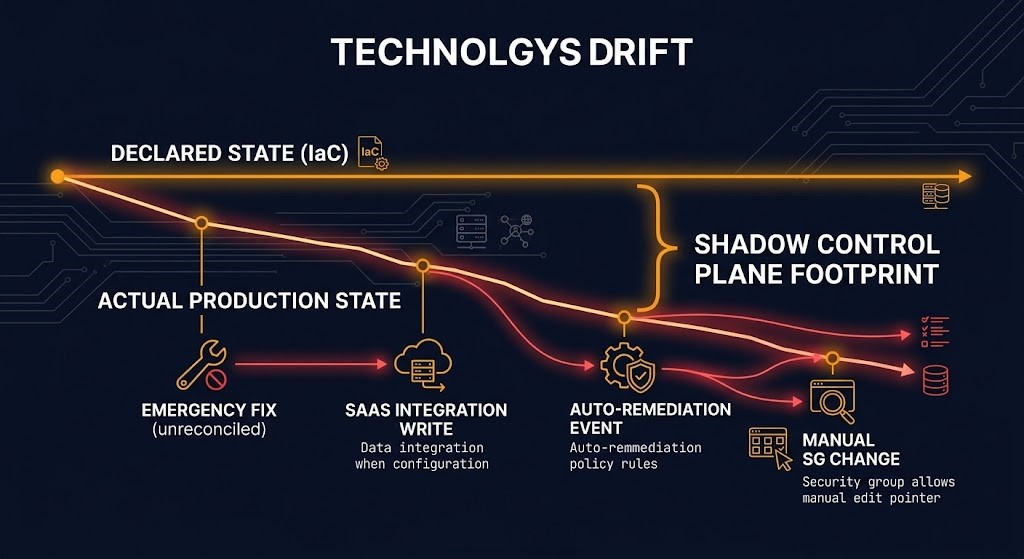
What Shadow Control Plane Activity Looks Like
Shadow control plane activity has a recognizable signature in every environment that has been running long enough. The key reframe: these are not random technical messes. They are authority artifacts — evidence of uncontrolled execution authority accumulated over time.
Roles and permissions created for specific operational needs and never removed. Each represents an authorization decision made outside the declared governance model. The policy boundary is now larger than anyone designed it to be.
Rules added during incidents or by console access, never reconciled into IaC. The effective network policy diverges progressively from the declared network policy. The rules blocking lateral movement may exist only in console state.
Console changes never reflected in IaC, pointing at infrastructure that no longer exists or whose ownership is unknown. DNS changes made via console leave records that persist indefinitely.
Route table entries, VPC peering connections, and transit gateway attachments added outside the pipeline path. Connectivity decisions that exist in production state but not in declared state.
NAT gateway configurations, internet gateway attachments, and service endpoint policies modified outside governance mediation. These appear in egress billing before they appear in architecture diagrams. The Egress Audit Framework covers systematic detection.
Resource-level policies, service control policies, and permission boundaries modified from their declared configuration. The effective policy environment is a composite of IaC-declared state and accumulated console modifications. The inverse failure — policies that are correctly declared and continuously reconciled but whose original justification has expired — is Policy Intent Drift: governance corruption that produces no console change, no drift signal, and no reconciliation failure.
All of these share the same root cause: execution authority that reached production without passing through the declared governance model. The Terraform Day 2 Operations Debt post documents the downstream operational consequence — the accumulated surface area of changes that make full-scope IaC application progressively more dangerous.
Reducing Uncontrolled Execution Authority
The goal is not to ban the console. The console is a legitimate operational tool. The goal is to reduce execution authority that reaches production without governance mediation.
The first principle: if governance is slower than operational recovery requirements, the shadow control plane will always win. Operations routes around governance systems that cannot operate at incident speed. Governance latency is an architecture problem, not a culture problem. Any solution that ignores this will fail — not because engineers are undisciplined, but because the system is rational.
REDUCING UNCONTROLLED EXECUTION AUTHORITY
01 — MAKE THE PIPELINE MANDATORY FOR CATEGORIES THAT MATTER
Tier changes by risk. Security group modifications, IAM changes, network topology changes, and credential rotations should be pipeline-mandatory with SCP and IAM permission boundary enforcement that makes console execution architecturally impossible for those categories. Match governance friction to change risk — not uniform friction to everything.
02 — SCPs AND IAM BOUNDARIES AS HARD ENFORCEMENT
Governance that depends on operator compliance is not governance — it is policy. SCPs at the AWS Organizations level, Azure Policy deny assignments, and GCP organization policies can make specific change categories impossible via console regardless of individual IAM permissions. This is the only mechanism that converts a governance recommendation into a governance constraint.
03 — RECONCILIATION SLAS
Emergency console changes are operationally legitimate. Permanent console changes are not. Define a reconciliation window — emergency changes must be reflected in IaC within a defined period, or they trigger a governance review. Making reconciliation an explicit operational obligation changes the organizational relationship with console usage.
04 — DRIFT MONITORING AS GOVERNANCE SIGNAL
Terraform plan output run on a schedule against production state surfaces the gap between declared state and actual state. The delta is the shadow control plane’s footprint. Each unreconciled divergence is a governance event, not a configuration note. Treat it as one.
The shadow control plane is not hidden from the organization. It is hidden from governance. CloudTrail shows every console change. The gap is not visibility — it is the absence of authority mediation before those changes could be made. The full governance model this post operates within is covered in the Modern Infrastructure & IaC Architecture pillar.
SERIES: THE AUTHORITY LAYER
Architect’s Verdict
The shadow control plane is not a byproduct of undisciplined operations. It is a rational response to a governance system that cannot operate at incident speed. Every organization that has been running infrastructure long enough has one — the question is not whether it exists, but how much production authority it has accumulated and whether anyone has mapped its scope.
The named framework — the Execution Authority Gap — is the delta between the governance model you declared and the execution authority that actually reaches production. Pipelines govern intent. Consoles govern capability. The gap between those two statements is where shadow control plane authority lives, accumulates, and compounds.
The shadow control plane is not temporary operational drift. It is an alternate infrastructure authority model.
Organizations that believe they operate through Infrastructure as Code often actually operate through Infrastructure as Exception. The same authority inversion applies at the AI layer — when inference pipelines, agents, and model routing decisions operate outside declared governance, the shadow control plane doesn’t just accumulate console changes. It accumulates model decisions. Sovereign AI Requires a Sovereign Control Plane maps what that governance architecture actually requires.
Additional Resources
View 12 more resources
Editorial Integrity & Security Protocol
This technical deep-dive adheres to the Rack2Cloud Deterministic Integrity Standard. All benchmarks and security audits are derived from zero-trust validation protocols within our isolated lab environments. No vendor influence.

R.M.
Senior Solutions Architect with 25+ years of experience in HCI, cloud strategy, and data resilience. As the lead behind Rack2Cloud, I focus on lab-verified guidance for complex enterprise transitions. View Credentials →
Get the Playbooks Vendors Won’t Publish
Choose the architecture problems you care about. Get field-tested playbooks and frameworks delivered to your inbox.
- > AI Infrastructure & Inference Economics
- > Cloud Strategy & Hidden Cost Models
- > Virtualization & Deterministic Migration
- > Kubernetes, IaC & Modern Infrastructure
- > Data Protection & Recovery Engineering
Zero spam. Includes The Dispatch weekly drop.
Need Architectural Guidance?
Independent review before major infrastructure decisions.
- > Validate assumptions
- > Identify hidden dependencies
- > Quantify migration risk
- > Challenge vendor narratives
Triage · Advisory · Fractional · Direct Hire