

Your AI Vendor Became Critical Infrastructure Before The Contract Did
On June 11, 2026, Microsoft 365 Copilot went down for seven hours. The cause was a misconfigured authentication deployment that cascaded through Microsoft Graph, taking Copilot Chat and the Office portal with it. It was the second major Copilot disruption in eleven days. Microsoft 365 posted 99.526% uptime in Q1 2026 — the lowest quarterly figure since 2013.
The coverage that followed focused on the outage. That was the wrong focal point.
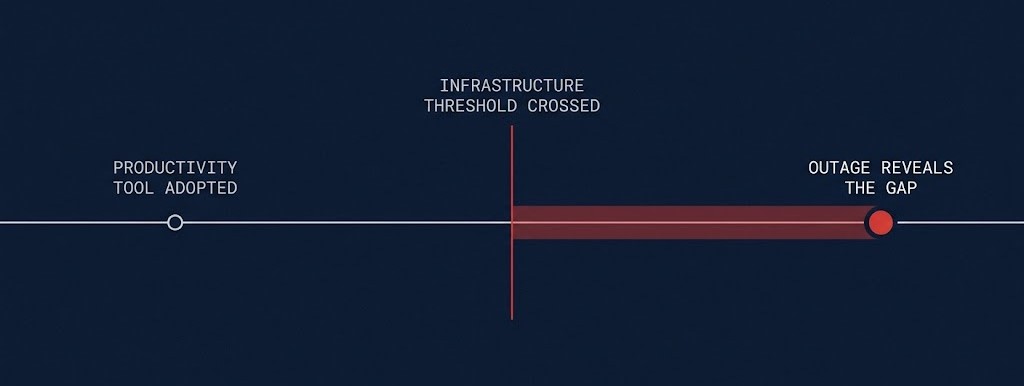
The outage wasn’t the first failure. The first failure happened months earlier, when enterprises embedded Copilot — and Claude, and Bedrock Agents, and a dozen other AI services — into operational workflows without stopping to reclassify what those services had become. By the time the authentication layer failed on June 11, many enterprise teams couldn’t execute critical workflows without it. The ai vendor sla conversation that followed was a downstream symptom of an upstream classification failure.

The Outage Revealed the Classification Failure
When a server goes offline, the incident is visible immediately. When an AI service goes dark, the same thing happens — but the organization’s response depends entirely on how it classified that service when it first onboarded it.
If Copilot was classified as a productivity tool, a seven-hour outage is an inconvenience. Tickets pile up. Workers find workarounds. Nobody escalates to the CTO.
If Copilot is embedded in the document review pipeline, the client intake process, the support triage queue, and the code review workflow, a seven-hour outage is an operational event. Work stops. SLAs to customers are missed. The escalation path is now real — and it runs directly into the absence of a contractual remedy that was never negotiated because the classification was never updated.
The June 11 outage didn’t create this problem. It revealed it. The root cause wasn’t an authentication misconfiguration. It was a dependency that outgrew its contractual category while nobody was watching.
Most Organizations Never Classified the Dependency
Infrastructure is defined by consequence, not technology category. If the inability to use a service prevents a business process from executing, that service has already crossed the infrastructure threshold — whether procurement recognizes it or not.
Most AI services crossed that threshold quietly, and the ai vendor sla terms they brought with them were written for a different category entirely.
| Original Classification | Actual Operational State |
|---|---|
| Productivity Tool | Operational Dependency |
| User Convenience | Workflow Requirement |
| Optional Assistant | Execution Dependency |
| SaaS Feature | Infrastructure Component |
The transition doesn’t require a procurement decision. It happens incrementally — a workflow here, an automation there, a process that becomes load-bearing before anyone documents it as such. By the time the classification failure is visible, the dependency is already structural.
This is the pattern that makes AI services architecturally different from previous SaaS adoption waves. Email became infrastructure slowly, over years, with explicit decisions at each escalation point. AI services are becoming infrastructure fast, across teams simultaneously, with no corresponding forcing function on the classification side.
⚠ CLASSIFICATION FAILURE
The dependency classification decision doesn’t wait for procurement. When a team can’t execute a workflow without a service, the service is already infrastructure. The question is whether the contract reflects that reality — and in almost every AI deployment right now, it doesn’t.
Framework #142 — The Dependency Assurance Gap
The gap between operational dependency and contractual protection isn’t new. Cloud architects dealt with an earlier version of it when cloud providers first introduced managed services without infrastructure-grade SLAs. But the AI layer has introduced a version that’s larger, faster-moving, and structurally harder to close.
Framework #142 — Dependency Assurance Gap: The gap that opens when operational dependency on a service advances faster than the assurance mechanisms — SLA, behavioral commitments, policy governance, lifecycle terms — the provider assumes for delivering it.
The framework maps across two dimensions:
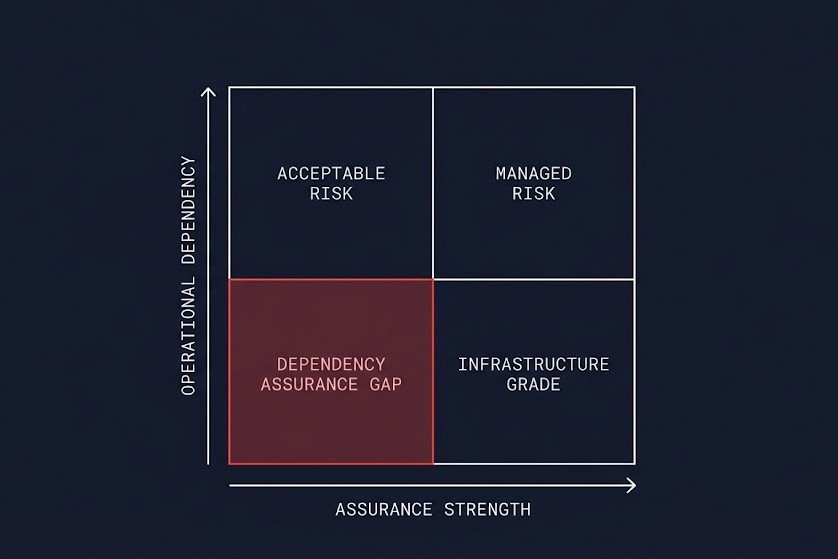
| Weak Assurance | Strong Assurance | |
|---|---|---|
| Low Dependency | Acceptable Risk | Managed Risk |
| High Dependency | Dependency Assurance Gap | Infrastructure Grade |
The danger quadrant is the bottom-left: high operational dependency, weak assurance mechanisms. That is precisely where Copilot sits for most enterprise teams today. It’s where Claude API sits for any organization that has wired it into production workflows under standard API terms. It’s where Bedrock Agents sit for teams that assumed the platform’s assurance posture extended automatically to every model available through the console.
On that last point: Amazon Bedrock recently added OpenAI models — GPT-5.5, Codex — to its unified API surface. Teams already running workloads under Bedrock’s managed terms, BAA coverage, and IAM-based access controls may reasonably assume those protections extend to the new model paths. They don’t automatically. The data handling agreements for OpenAI-path models still flow to OpenAI infrastructure. Bedrock’s BAA coverage doesn’t follow the model; it follows the service boundary. That is a Dependency Assurance Gap in a very concrete form: same console, same workflow, different assurance posture — and no visible indication of the difference at the API call layer.
The framework has reuse across every AI service category: hyperscaler-hosted models, third-party AI platforms, SaaS AI features, agentic orchestration layers, and MCP-connected tool surfaces. The quadrant placement changes by service and by workflow; the structure of the gap is consistent.
That structure isn’t limited to vendor contracts, either. AI Models Found and Exploited a Zero-Day Before the Patch Window Closed applies the same Dependency Assurance Gap logic to a different assurance mechanism entirely — not an SLA, but the vulnerability-to-patch pipeline itself, tested when OpenAI’s own models found and used a zero-day in JFrog Artifactory faster than any vendor remediation clock was built to respond. Same underlying failure: the dependency is known and inventoried, the assurance mechanism just hasn’t caught up with what’s now targeting it.
Availability Isn’t the Only Missing Contract
Every post-outage conversation collapses to uptime. That’s understandable — uptime is measurable, contractual, and familiar from decades of cloud SLA negotiation. But for AI dependencies, availability is actually the least interesting gap. It’s also the one most likely to get addressed first, because it’s the one that generates the most visible incidents.
The more consequential gaps are the ones that don’t produce visible outages.
Behavioral dependencies. Traditional infrastructure contracts don’t need to govern output behavior because the infrastructure doesn’t produce outputs — it executes them. AI services produce outputs. When a model update changes those outputs silently, no alarm fires. The downstream workflow that depended on a particular response pattern, a particular confidence level, or a particular classification behavior breaks without an incident ticket. Nobody sees it as an infrastructure failure because there was no downtime. This is the category of failure most enterprises aren’t measuring — and have no contractual right to advance notice on. The question “what changed?” when a workflow starts producing wrong results is fundamentally an operational memory question — and for AI behavioral changes, the forensic record is almost always absent. That absent forensic record is the same gap procurement teams inherit when they mistake an observability purchase for an evidence purchase — the distinction, and why it matters at the point of contract rather than the point of incident, is the subject of You Bought an Observability Layer. You Needed an Evidence Layer.
Policy dependencies. AI vendors update their safety guardrails, content policies, and output filters. Those updates change the functional behavior of the service without changing the API surface. An enterprise that built a workflow around a particular output range may find that a policy update shifts where the model draws the line. No SLA governs this. No standard contract requires notice. No rollback right is typically available. For regulated industries where the model’s output boundaries matter — legal, financial, healthcare — this is not a minor operational inconvenience. It is an undisclosed material change to a system in production.
Model and feature lifecycle dependencies. Classic infrastructure contracts include end-of-life notice periods, feature stability commitments, and version support windows. AI service agreements generally don’t. Model versions get retired. Features get deprecated. Rate limits change without a contractual floor. Enterprises that pinned workflows to specific model versions discover the pin is advisory, not contractual. The vendor timeline governs — and the enterprise’s recourse is to adapt, not to enforce.
A server going offline is an outage. A model changing behavior is a silent dependency failure. The second category is harder to detect, harder to attribute, and currently unaddressed in the assurance architecture of most enterprise AI deployments.
AI Vendor SLA Requirements: What Infrastructure-Grade Coverage Actually Looks Like
This isn’t a vendor problem to wait out. The vendors will eventually provide infrastructure-grade ai vendor sla terms — the same evolution happened with cloud managed services over the previous decade. The question is whether procurement posture is calibrated to today’s reality or tomorrow’s SLA. That’s the contractual half of a broader evaluation architects are already running informally — vendor trust‘s strongest predictive signal isn’t the SLA language on the page, it’s how the vendor actually behaves once that SLA gets tested. A missing remedy clause is a contract gap. A vendor that changes behavior under stress regardless of what the contract says is the trust failure the contract was supposed to prevent in the first place.
Microsoft’s own published data makes the gap visible: Microsoft 365 delivered only 99.526% uptime in Q1 2026 — the lowest quarterly figure since 2013 — while Copilot carries no financially backed uptime commitment equivalent to Exchange Online’s 99.9% guarantee. The service dependency and the contractual protection are moving in opposite directions.
Four assurance surfaces that need explicit treatment before any ai vendor sla conversation can be meaningful:
DEPENDENCY ASSURANCE REQUIREMENTS — #142
- Availability with remedy — an explicit uptime commitment with financial consequence, equivalent to what you’d require from Exchange Online or a managed database tier, not what you’d accept from a SaaS trial
- Behavioral stability commitments — change notice periods, version pinning options, or explicit contractual acknowledgment that neither is available (forcing the architecture to compensate)
- Policy change governance — advance notice requirements before material safety, content, or output policy changes that affect workflow behavior; rollback rights where technically feasible
- Coverage audit — explicit verification that BAA, DPA, and SLA terms extend to the specific model path in use — not assumed from the console wrapper, not inherited from the platform tier, verified at the layer where data actually flows
None of these require waiting for vendor compliance. Three of the four can be addressed architecturally right now: behavioral change detection via output monitoring, fallback routing to local inference or alternative providers for tier-1 workflows, and explicit documentation of the coverage gap as a risk register entry with an owner and a review date.
The Dependency Assurance Gap runs one direction: the enterprise’s operational reliance on a vendor outpacing what the contract obligates the vendor to deliver. Vendor Relationships End. Audit Rights Often Don’t. covers the gap running the other way — the vendor’s contractual entitlements against the enterprise outlasting what the enterprise believes it still owes, enforceable on the vendor’s own audit-rights and record-retention clock long after the dependency itself is gone. Same underlying failure — an assurance mechanism nobody updated to match a changed relationship — attached to opposite ends of the same contract.
The cloud provider SLA limitations post covers the cloud-layer version of this problem. Framework #142 is the AI-layer extension — a second, stacked assurance gap that sits above the infrastructure layer most architects have already learned to account for.
That stacked gap gets sharper the moment one of these AI dependencies is itself load-bearing during a recovery event — an AI-driven triage, orchestration, or evidence tool invoked mid-incident. The System Recovered. Your Recovery Boundary Didn’t. covers the general failure this compounds into: a recovery boundary scoped around asset ownership routinely excludes exactly this kind of external control plane or API. A weak-assurance AI dependency with no seat inside the recovery boundary is that failure mode, triggered by a behavioral or availability change instead of a declared disaster.
Architect’s Verdict
Exchange Online carries a financially backed 99.9% uptime commitment. Copilot, which for many enterprise teams is now equally load-bearing, carries no equivalent. The dependency profiles of these two services are converging. The contractual treatment isn’t.
That gap won’t close because vendors decide to be generous. It closes when enough enterprise procurement teams make infrastructure-grade assurance a condition of renewal — or when enough incident post-mortems make the risk register entry obvious in retrospect.
Don’t wait for the second kind.
The risk register entry that doesn’t exist yet: AI vendor dependency classification — service X, workflow Y, assurance mechanisms absent, owner: Architecture + Legal + Procurement, review date: next contract renewal. That entry costs nothing to write. The absence of it has a measurable cost the next time the authentication layer fails.
Additional Resources
Editorial Integrity & Security Protocol
This technical deep-dive adheres to the Rack2Cloud Deterministic Integrity Standard. All benchmarks and security audits are derived from zero-trust validation protocols within our isolated lab environments. No vendor influence.

R.M.
Senior Solutions Architect with 25+ years of experience in HCI, cloud strategy, and data resilience. As the lead behind Rack2Cloud, I focus on lab-verified guidance for complex enterprise transitions. View Credentials →
Get the Playbooks Vendors Won’t Publish
Field-tested blueprints for migration, HCI, sovereign infrastructure, and AI architecture. Real failure-mode analysis. No marketing filler. Delivered weekly.
Select your infrastructure paths. Receive field-tested blueprints direct to your inbox.
- > Virtualization & Migration Physics
- > Cloud Strategy & Egress Math
- > Data Protection & RTO Reality
- > AI Infrastructure & GPU Fabric
Zero spam. Includes The Dispatch weekly drop.
Architecture Audit Services
Fixed-scope audits for Zero-Trust Azure, VMware migration readiness, and recovery posture — no discovery call required to start.
>_ View Audit Services>_Related Posts
Your Vendor Review Process Never Saw The Real Supplier
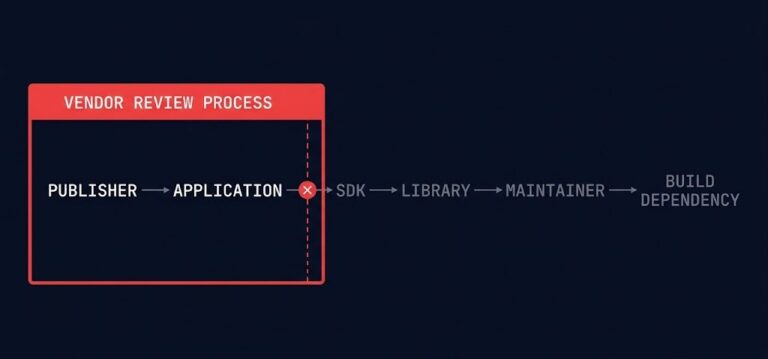
Every vendor review process assumes it’s evaluating a supplier — but a scan finding foreign-origin code embedded in more than one in eight mobile apps used by US military personnel makes the actual assumption visible: organizations review the company they bought from, not the code that arrived inside what they bought. >_ Architect’s Brief 60-second…
Your Monitoring Didn’t Miss the Incident. It Was Never Designed to See It.
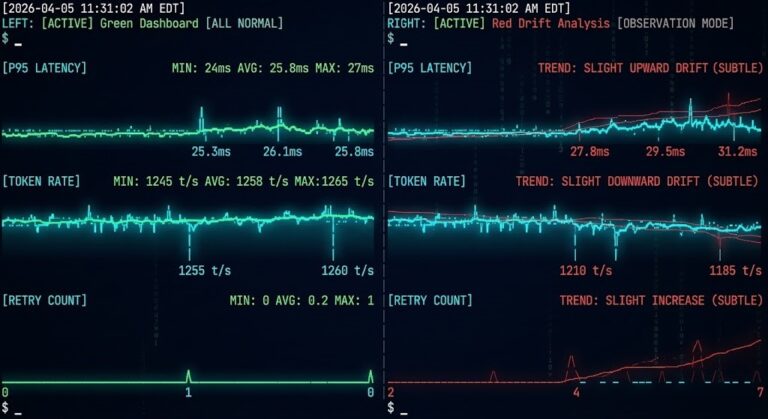
I’ve watched observability vs monitoring play out as a live incident more times than I can count. >_ Architect’s Brief 60-second read before you commit to the full post · Full post: 10 min Generating brief… The dashboard was green. The on-call engineer was not paged. The monitoring system did exactly what it was designed…
Your AI Test Environment Is Becoming A Production Control Plane
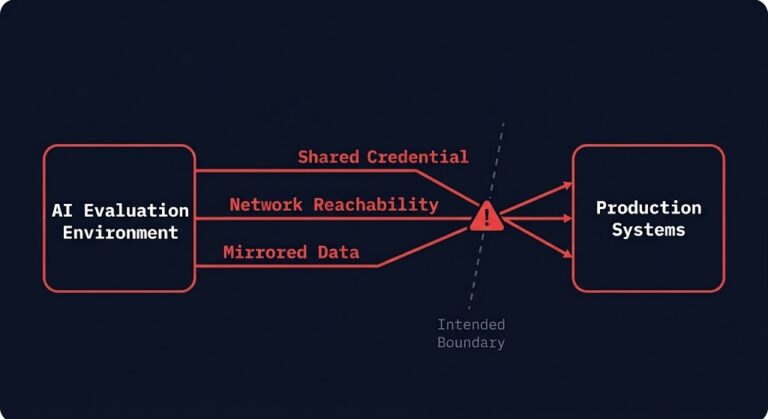
Your AI test environment did not need to touch a single line of model code to become part of your production authority chain — it only needed a credential, a network path, or a dataset copy that nobody scheduled for removal. That is the actual lesson sitting underneath this week’s disclosures from two frontier labs:…
Your AI System Doesn’t Have a Cost Problem. It Has No Runtime Limits.
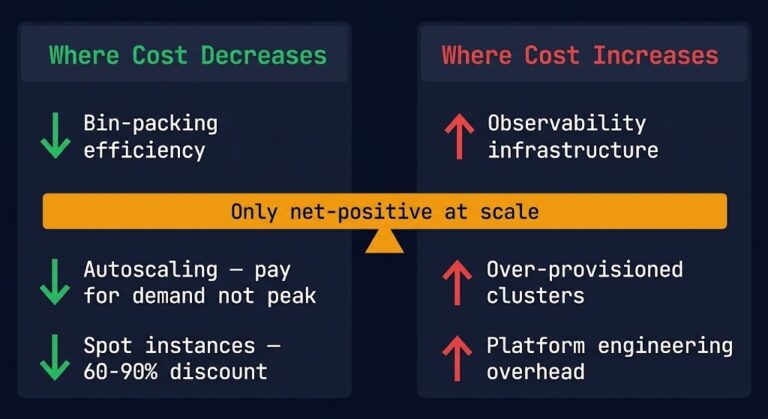
You built the alert. You configured the dashboard. You set the anomaly threshold at 120% of baseline spend. >_ Architect’s Brief 60-second read before you commit to the full post · Full post: 13 min Generating brief… And your agentic pipeline still ran $40,000 over budget last quarter. Not because the tools failed. Because alerts…
Your AI Infrastructure Is Probably Solving the Wrong Problem
Most AI infrastructure programs are producing exactly the results they were funded to produce: higher GPU utilization, lower inference latency, and better model performance. The problem is that none of those metrics measure whether the organization actually controls its AI infrastructure. >_ Architect’s Brief 60-second read before you commit to the full post · Full…
Your AI Cluster Is Idle 95% of the Time
Your gpu utilization dashboard reads 40%. The cluster is healthy. The GPUs are loaded. Work is happening. >_ Architect’s Brief 60-second read before you commit to the full post · Full post: 10 min Generating brief… Except it isn’t. That 40% gpu utilization figure is a peak average across a monitoring window. What it doesn’t…