

The Architecture Industry Is Quietly Replacing Optimization With Optionality
For twenty years, infrastructure architecture was rewarded for optimization — and the industry is only now starting to notice that architectural optionality has quietly become the thing it rewards instead. The dominant questions used to be: how do we reduce cost, how do we increase utilization, how do we consolidate platforms, how do we eliminate redundancy, how do we standardize. The best architecture was usually the most efficient architecture. That’s not the question being asked anymore.
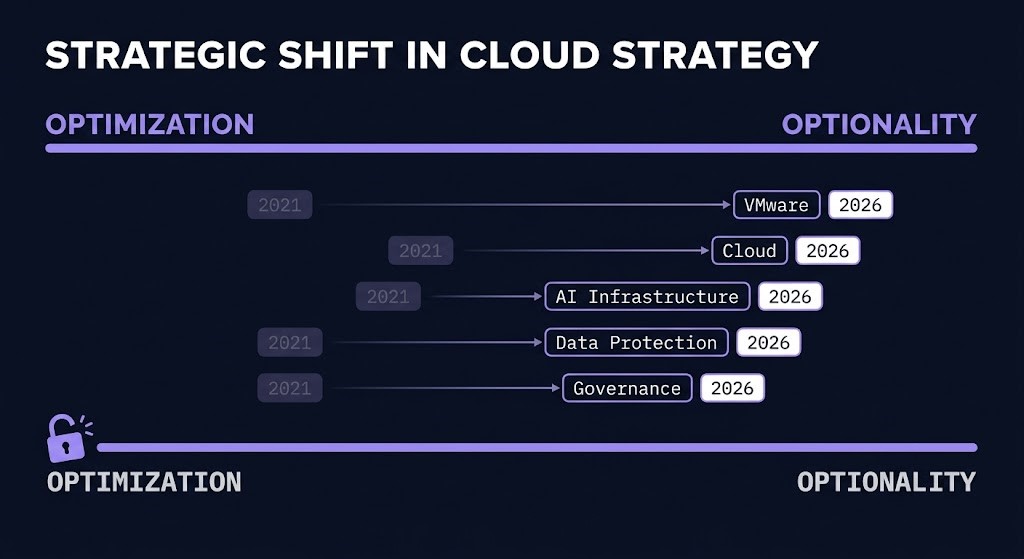
Twenty Years Of Optimization Questions
For most of the last two decades, the architect’s job was to remove waste. Every planning cycle, every platform decision, every budget review ran through the same five questions:
- How do we reduce cost?
- How do we increase utilization?
- How do we consolidate platforms?
- How do we eliminate redundancy?
- How do we standardize?
None of these questions were wrong. They built the discipline. Standardization killed snowflake infrastructure. Consolidation killed idle capacity. Redundancy elimination killed budget waste that nobody could defend in a review. For twenty years, the architect who could answer these questions most completely was, by definition, the best architect. Efficiency was the scoreboard.
The Shift Toward Architectural Optionality
The dominant architectural question today is a different one: how quickly can we change our mind? That’s architectural optionality — the deliberate preservation of the ability to reverse a decision — and it is often the direct opposite of optimization. Optimization asks what configuration performs best under current conditions. Optionality asks what configuration survives being wrong about those conditions later. Those are not the same question, and increasingly they don’t point to the same answer. A third axis sits alongside both: the predictability premium asks whether the same decision produces the same surprise-free outcome next year — a related but separate question from whether the decision can be reversed at all, which is why the two show up in the same renewal conversations without actually arguing the same thing. A fourth axis sits alongside all three: vendor trust asks whether the vendor who sold the platform is still the vendor operating it in three years — a question about the seller’s continuity, not the buyer’s ability to leave or the outcome’s variance, though renewal committees now price all three at once without bothering to separate them.
The strongest evidence that this shift is real isn’t coming from one domain. It’s appearing simultaneously across virtualization, cloud strategy, AI infrastructure, data protection, and governance.
The Same Pattern, Five Different Costumes
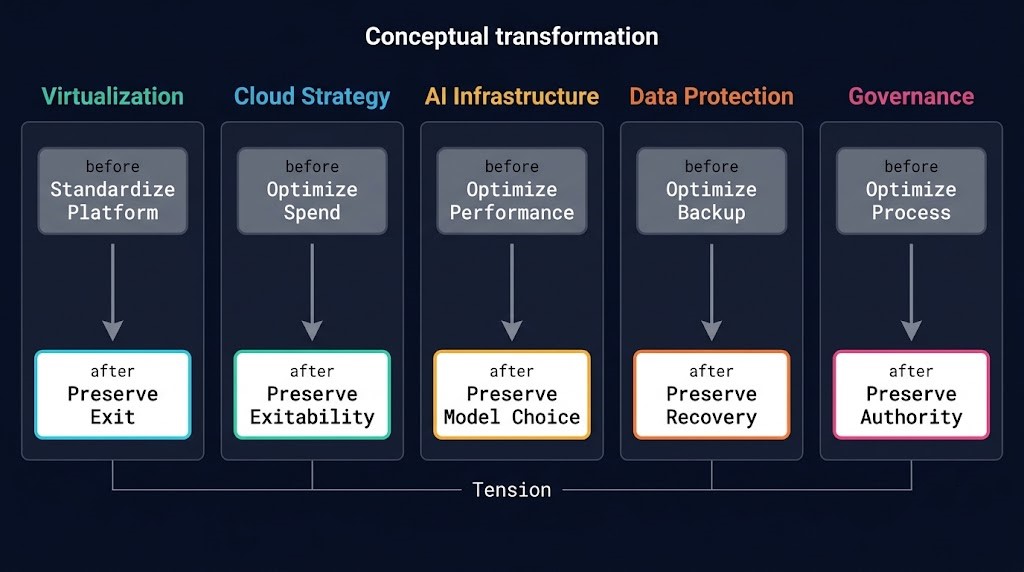
Five domains, five before-and-after pairs — and the pattern underneath all five is identical, even though nobody in any one of them would describe it that way.
01 — VMWARE EXIT
Old question: how do we standardize on one hypervisor platform? New question: how do we preserve the ability to leave it? Five years ago, the correct architectural answer to “which hypervisor” was whichever one consolidated the most workloads onto the fewest, most efficient hosts. Today, the correct answer increasingly starts with the exit clause, not the feature set — what does migration cost, what does the license actually lock down, how long does re-platforming take if the vendor relationship changes underneath you. The Broadcom acquisition didn’t just raise prices. It converted “which platform is most efficient” into “which platform can I leave” as the operative question for an entire installed base, and the VMware renewal decision itself is the clearest evidence that the renewal conversation has changed shape — the decision gets made on exitability terms, two years before the contract forces it.
02 — CLOUD STRATEGY
Old question: how do we optimize cloud spend? New question: how do we preserve cloud exitability? This is the question now sitting underneath most serious cloud architecture strategy conversations, whether or not it’s named directly. The first repatriation wave was a FinOps story — move workloads to wherever the unit economics were best, full stop. The current one isn’t — it now has a name of its own: see The New Cloud Repatriation Strategy Isn’t About Cost for the full cost-wave-versus-control-wave account this costume previews. Organizations are increasingly willing to accept a worse cost position today in exchange for a workload that can actually move if the provider relationship, the region, or the regulatory requirement changes. The first real exit test is the sharper version of this: architectures that were designed to look portable routinely fail it, because “portable” was validated as a design property, not as an executable capability. Optimization asks what the cloud bill looks like this quarter. Optionality asks what it costs to actually leave, and whether that number has been tested or just assumed.
03 — AI INFRASTRUCTURE
Old question: how do we optimize for model performance? New question: how do we preserve the ability to change models, providers, and deployment locations? Two years ago the entire architectural conversation was benchmark-driven — which model, which accelerator, which inference stack produced the best numbers. That conversation still happens, but it’s no longer the one that determines resilience. Your AI vendor became critical infrastructure before the contract did captures the real shift — the SLA and exit terms never caught up to that reality, and organizations that optimized hardest for a single model or provider are now the ones with the least room to move when pricing, availability, or capability shifts under them.
04 — DATA PROTECTION
Old question: how do we optimize backup efficiency? New question: how do we preserve recoverability under conditions we didn’t plan for? Deduplication ratios, backup windows, and storage tiering used to be the entire conversation — pure efficiency metrics, optimized against a known, stable threat model. That threat model stopped holding. The recoverability gap names the actual failure mode directly: a backup system can hit every efficiency target on the dashboard and still fail to produce a working recovery, because the thing that was optimized was the backup, not the option to actually restore under conditions nobody modeled for.
05 — GOVERNANCE
Reframed here as decision authority surviving disruption, not generic process. Old question: how do we optimize process? New question: does decision authority survive disruption? This is the most abstract of the five, and the most architectural. A governance process can be extremely efficient — fast approvals, clear delegation, minimal friction — and still collapse completely the moment the person or system holding that authority becomes unavailable. Disaster recovery authority is exactly this failure mode inside recovery planning specifically: the plan assumes the authority to execute it will still exist when the plan is needed, which is precisely the assumption that fails first in a real disruption. This is architectural optionality applied to authority itself — not “can the system recover” but “can someone still legitimately decide that it should.” It’s also the exact question the Cloud Architecture Learning Path’s Strategic Resilience stage is built around — its anchor framework is named Authority Survivability Boundary for precisely this reason.
All five costumes above describe the buyer’s side of the trade — preserving the ability to leave, not to build. The identical logic shows up on the vendor’s side too, just as clearly. Proxmox’s Arm64 Bet Runs On Lifecycle Parity, Not A Feature Release reads a hypervisor vendor’s own investment in full Arm64 lifecycle parity as the vendor-side version of this same shift: Proxmox funding a second CPU architecture at full support parity isn’t a feature release, it’s optionality purchased against its own dependency on a single hardware roadmap, years before market pressure would force the question. Same trade, same decay logic, run from the other side of the negotiating table.
The Reframe
Most architecture discussions still sound like “what’s the best platform?” The market increasingly behaves like “what’s the easiest platform to leave?” That’s a profound shift to have happened this quietly — most of the industry is still writing comparison matrices for the first question while making real decisions against the second.
Why This Is Happening
The industry got burned. Repeatedly, and in ways specific enough that “pick better next time” stopped being a sufficient lesson.
VMware/Broadcom. Public cloud cost surprises. AI vendor lock-in. Regulatory shifts. Sovereignty requirements. Licensing changes. Platform discontinuations. Vendor lock-in happens through networking, not APIs is a useful correction here — the lock-in that actually bites usually isn’t the API surface everyone worries about during procurement, it’s the networking layer nobody audits until the exit is already underway.
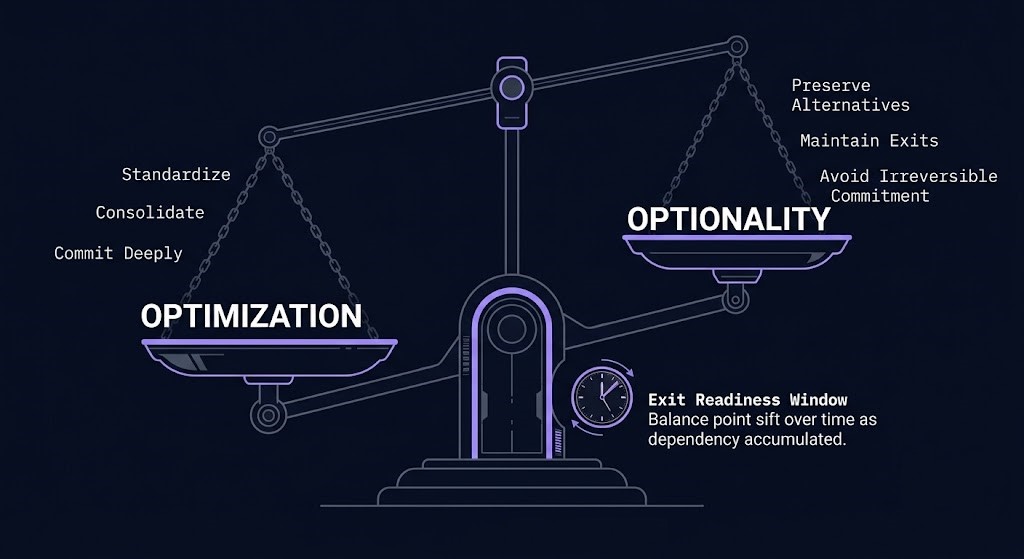
What every one of these events actually taught was the same lesson: the industry learned that optionality decays. It doesn’t sit still waiting to be used. Framework #104, Exit Readiness Window, names this directly — an exit remains executable only for as long as it remains executable at acceptable cost, and that window closes as dependency accumulates, whether or not anyone’s watching it close. That’s the mechanism behind every one of the five patterns above. Nobody loses their exit option in a single event. They lose it one integration, one custom pipeline, one convenient shortcut at a time, until the window that was open two years ago has quietly shut — and exit cost is the number that makes the closing window concrete rather than theoretical.
The July 16 CloudFront outage is a sixth costume of the same pattern, compressed into a single feature instead of a multi-year platform relationship. VPC Origins was adopted for a real, defensible reason — fewer exposed endpoints — and the adoption review never priced what got given up: the fallback path a public-origin configuration would have retained. That’s optionality spent at checkbox speed rather than over a multi-year lock-in accumulation, but it’s the same trade the five costumes above describe at platform scale — efficiency purchased now, reversibility quietly gone.
The Tension Nobody Names
The most interesting part of this pattern isn’t optionality itself. It’s that optionality is expensive.
Optimization and optionality pull in opposite directions, and the pull is structural, not incidental:
| Optimization | Optionality |
|---|---|
| Standardize | Preserve alternatives |
| Consolidate | Maintain exits |
| Remove redundancy | Keep redundancy |
| Maximize efficiency | Maximize flexibility |
| Commit deeply | Avoid irreversible commitment |
You can’t maximize both. Every architecture now sits somewhere on that spectrum, whether or not the team building it has ever named the spectrum out loud. Optionality is not free. It is a deliberate decision to accept inefficiency today in exchange for freedom tomorrow — and against the backdrop of Framework #104’s decay mechanism, that trade only gets more expensive the longer it’s deferred. The exit that costs 10% of budget to preserve this year costs considerably more once three more systems have quietly integrated against the assumption that it will never be exercised.
Architect’s Verdict — What The Industry Rewards Now
The architecture industry didn’t stop caring about optimization. It stopped treating optimization as the highest goal. The best architect used to be the person who could remove options and create efficiency. Increasingly, the best architect is the person who knows which options must remain available — and who can say, specifically, what it would cost to exercise them.
For two decades, architecture was measured by how efficiently it could commit. Increasingly, it is measured by how safely it can change course.
Additional Resources
View 10 more resources
Editorial Integrity & Security Protocol
This technical deep-dive adheres to the Rack2Cloud Deterministic Integrity Standard. All benchmarks and security audits are derived from zero-trust validation protocols within our isolated lab environments. No vendor influence.

R.M.
Senior Solutions Architect with 25+ years of experience in HCI, cloud strategy, and data resilience. As the lead behind Rack2Cloud, I focus on lab-verified guidance for complex enterprise transitions. View Credentials →
Get the Playbooks Vendors Won’t Publish
Choose the architecture problems you care about. Get field-tested playbooks and frameworks delivered to your inbox.
- > AI Infrastructure & Inference Economics
- > Cloud Strategy & Hidden Cost Models
- > Virtualization & Deterministic Migration
- > Kubernetes, IaC & Modern Infrastructure
- > Data Protection & Recovery Engineering
Zero spam. Includes The Dispatch weekly drop.
Need Architectural Guidance?
Independent review before major infrastructure decisions.
- > Validate assumptions
- > Identify hidden dependencies
- > Quantify migration risk
- > Challenge vendor narratives
Triage · Advisory · Fractional · Direct Hire