

Your Disaster Recovery Plan Has a Continuity Execution Boundary
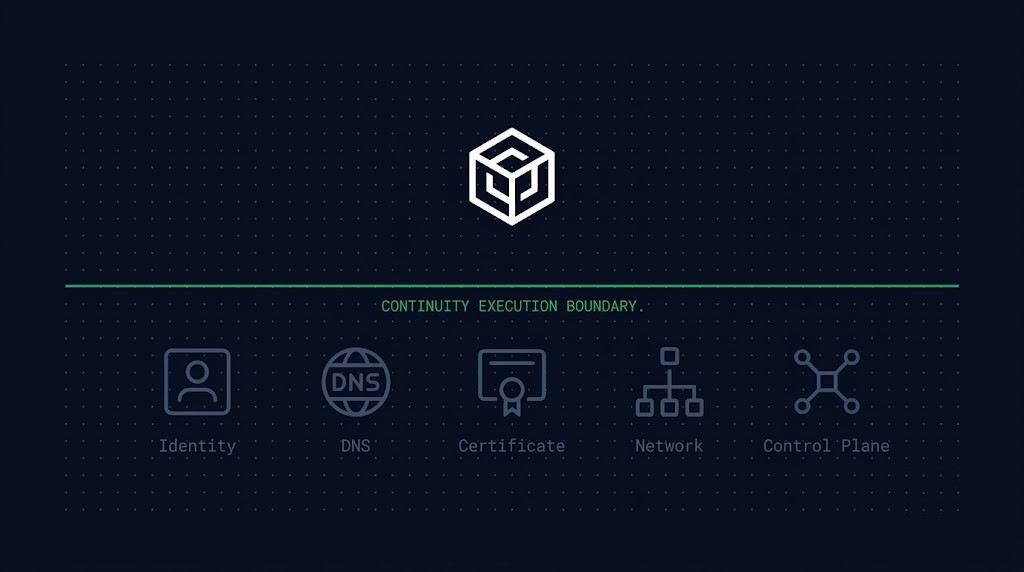
Every disaster recovery plan has a continuity execution boundary: the point at which infrastructure recovery succeeds and business continuity is still, independently, an open question. Most DR programs never test for it, because most DR programs never separate the two claims in the first place. A workload fails over. The dashboard goes green. Nobody asks whether the identity provider, the DNS resolution path, or the certificate chain the application depends on failed over with it — or whether the person responsible for declaring the incident over even knows the failover happened. That failover exists at all because someone priced the concentration exposure it was built to close — a separate, earlier decision this boundary doesn’t retest and doesn’t assume.
The Distinction D4 Doesn’t Test
Ransomware survival architecture asks whether recovery survives the same compromise that made recovery necessary — identity, credential, and control-plane authority tested against an adversary who moved against them deliberately. That’s a real and difficult question in data protection architecture, and an organization that answers it correctly has done serious work. It has also answered a narrower question than it thinks.
D4’s authority chain surviving compromise says nothing about whether the business is operating once that chain has held. A region fails over cleanly. The recovery platform executes without adversarial interference. Every system D4 tested comes back healthy. And the business is still down, because the DNS record pointing at the new region takes forty minutes to propagate through a resolver nobody remembered depends on the old one, or because the TLS certificate provisioned for the primary environment was never mirrored to the failover environment, or because three different teams each assumed someone else had the authority to declare the cutover complete.
None of that is a compromise. None of it is ransomware. It’s infrastructure doing exactly what it was built to do, and continuity failing anyway. That’s the boundary this framework names.
NHTSA’s Engineering Analysis of GM’s eBoost brake system draws the same line at the hardware layer. GM’s documented sequence has antilock brakes, traction control, and stability control remaining functional through the ABS event — the system doing exactly what the design says it should do. What field reports are raising isn’t a design failure; it’s the same continuity-versus-recovery distinction this framework names — whether the specific claim under test (functional through the event, controlled degrade after) actually held, independent of whether the component behaved as designed in the abstract. GM’s Brake-by-Wire Investigation Is a Verification Story covers the mechanism directly.
The gap isn’t hypothetical. On August 1, 2026, a wildfire forced full evacuation of a 46-bed VA medical center outside Spokane — every clinical system inside it stayed healthy; the location containing them was unavailable for ten days regardless. Geographic redundancy is the same boundary named at the physical layer: recovery capacity has to exist outside the location it’s protecting, or it was never independently tested at all.
The Fairlife ransomware incident ran the mirror image of that case. Nothing in Coca-Cola’s disclosures establishes that plant-floor machinery was damaged or encrypted; U.S. production was suspended after production-related systems were affected. That is the same boundary approached from upstream — not whether the business resumes once recovery succeeds, but whether it can keep operating before recovery is even in play. A ransomware production shutdown is what that gap looks like when physical operations have inherited the availability requirements of their digital coordination layer.
Blast radius is the pre-incident form of the same blind spot. #163 names what happens when recovery is validated as executable while the dependencies that actually determine business continuity go untested. The same gap shows up before any incident starts: four structurally unrelated failures at AWS and Azure, each producing identical full-surface customer impact, because blast radius — not root cause — was never separately architected for. One names the gap recovery leaves open. The other names the gap that was already there.
Introducing the Continuity Execution Boundary
Continuity Execution Boundary — the point at which infrastructure recovery has been validated as executable and survivable, but the dependencies and ownership decisions required for the business to actually resume operating have not been separately tested. Below the boundary, recovery succeeding is treated as evidence that continuity succeeded. Above it, continuity is evaluated as its own architectural claim — dependent on, but not identical to, the recovery that precedes it.
This framework anchors the Disaster Recovery & Failover Architecture stage of the Data Protection & Resiliency Learning Path — five continuity domains, from dependency survival through recovery authority, built directly on the boundary named here.
FRAMEWORK #163 — CONTINUITY EXECUTION BOUNDARY
The point at which infrastructure recovery has been validated as executable and survivable, but the dependencies and ownership decisions required for the business to actually resume operating have not been separately tested.
When the boundary isn’t tested independently, a technically perfect recovery still leaves the business down — discovered live, during the incident meant to prove the plan worked. The same discovery happens to organizations whose recovery plan quietly assumed paying a ransom would still be an option if the other six domains all failed — a seventh continuity dependency, untested for the same reason the first six usually are: nobody classified it as one.
Architectural Relationships
Why It Connects
Governs — continuity survival is only a meaningful evaluation once adversarial recovery survival is already confirmed closed; testing continuity against an authority chain that hasn’t itself survived compromise answers a question without a stable foundation.
Explore Framework →Why It Connects
Sits downstream — Recovery Evidence Boundary evaluates whether recovery and continuity claims are independently validated, which presupposes this framework’s continuity claim has already been established, not merely asserted.
Explore Framework →Infrastructure Pipeline Survivability Boundary
Why It Connects
Sits upstream — #164 asks whether the pipeline that would execute recovery can reconstruct itself when the environment it depends on is unavailable; this framework assumes that reconstruction has already happened and tests whether continuity holds once it has.
Explore Framework →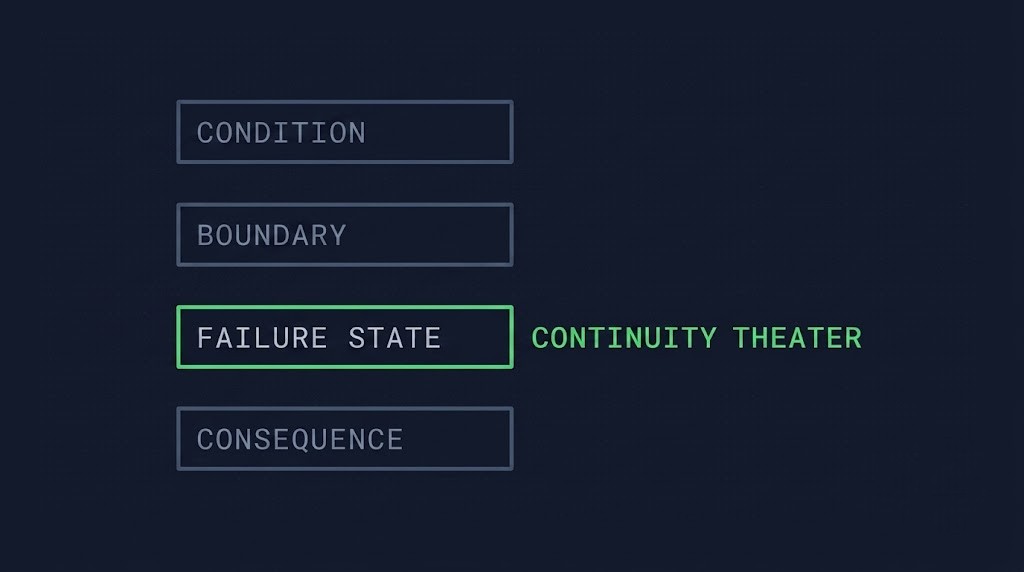
Where the Boundary Actually Sits
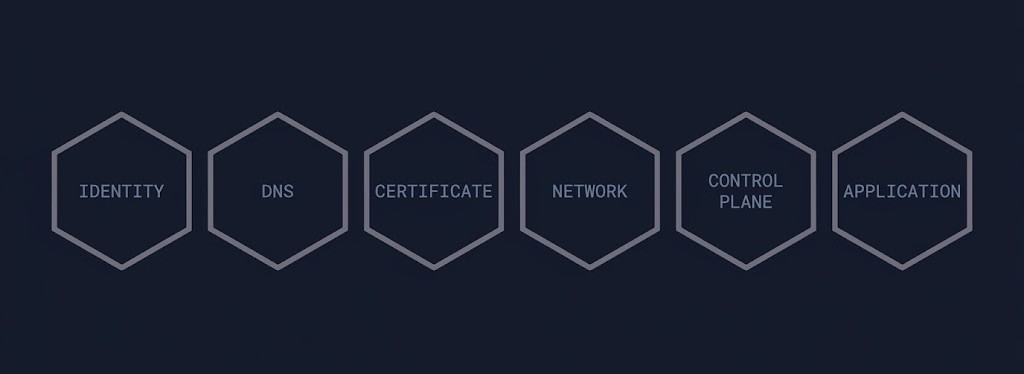
The boundary isn’t abstract. It sits at six specific dependency and ownership domains, and a recovery architecture can be flawless on all four D1–D4 stages while any one of these fails silently:
THE SIX CONTINUITY DOMAINS
- Identity Continuity — does the identity provider itself survive the failover, or does the recovered environment depend on an identity system that’s still pointed at the primary region?
- DNS Continuity — does resolution actually redirect traffic, or does a cached record, a slow TTL, or a forgotten CNAME keep routing users to a location that no longer exists?
- Certificate Continuity — is a valid certificate provisioned and trusted in the failover environment, or does the recovered application come up and immediately fail TLS handshakes?
- Network Continuity — do the routing paths, firewall rules, and peering connections the failover environment needs actually exist, or were they scoped only for steady-state operation?
- Control Plane Continuity — is there a single, unambiguous owner authorized to execute and confirm the continuity decision, or does execution stall while three teams each wait for someone else to act? (This is where control-plane ownership — the same authority-ambiguity problem Cloud Strategy’s Control Plane Ownership Boundary names at CS4 — reappears as a continuity-specific failure.)
- Application Continuity — does the application itself degrade gracefully under partial failover conditions, or does it fail in ways nobody modeled because every prior test assumed a clean, complete cutover?
Most DR programs test the first domain that shows up in a runbook — usually the infrastructure layer — and stop. The other five are exactly the dependencies a recovery plan forgets, because they’re rarely owned by the same team that owns the failover itself.
Recovery-Continuity Gap: The Symptom, Not the Framework
When an organization has closed the Recoverability Gap (#148) — D4’s authority chain survives compromise — but hasn’t crossed the Continuity Execution Boundary, the visible symptom is what shows up in incident reviews as the Recovery-Continuity Gap: recovery objectives were met on paper, and the business was still unavailable. It’s tempting to treat that as a new framework in its own right. It isn’t. It’s the observable consequence of #148 being closed while #163 hasn’t yet been crossed — the same relationship D3’s Isolation Survivability Boundary has to D4’s Recoverability Gap, one stage earlier in this path.
Framework relationship: Depends on #148 Recoverability Gap (strong) — continuity survival is only a meaningful evaluation once adversarial recovery survival is already confirmed closed; testing continuity against an authority chain that hasn’t itself survived compromise answers a question that doesn’t have a stable foundation yet. It also sits downstream of #158, the Deterministic Recovery Model — Sequence, Dependency, Authority, and Validation all holding constant is what makes a recovery outcome repeatable, but repeatable is not the same claim as continuous. A recovery that produces the identical result every time can still leave the business down if the six continuity domains above were never engineered to fail over with it.
Even where all six domains hold and continuity is confirmed rather than assumed, that confirmation is still a claim made by the same team that built the recovery architecture — which is exactly the layer the Recovery Evidence Boundary (#167) addresses: whether anyone structurally independent from that team has the standing to validate it. Continuity execution boundary settles whether the business resumes operating. Recovery evidence boundary settles whether anyone besides the team that built it is required to agree.
Architect’s Verdict
A recovery plan that has never separated “the infrastructure came back” from “the business is operating” isn’t wrong. It’s answering a question nobody actually asked in the incident review.
The real failure isn’t a missing DNS record or an unmirrored certificate. It’s an architecture that never drew the line between recovery and continuity in the first place — so every dependency that lives on the continuity side of that line gets discovered for the first time during the incident that was supposed to prove the plan worked.
Recovery restores systems. Continuity is a separate, testable claim about whether the business kept operating while that restoration happened. Until an organization tests for the second claim independently of the first, every clean failover is an unverified assumption wearing a passing grade.
Additional Resources
View 14 more resources
Editorial Integrity & Security Protocol
This technical deep-dive adheres to the Rack2Cloud Deterministic Integrity Standard. All benchmarks and security audits are derived from zero-trust validation protocols within our isolated lab environments. No vendor influence.

R.M.
Senior Solutions Architect with 25+ years of experience in HCI, cloud strategy, and data resilience. As the lead behind Rack2Cloud, I focus on lab-verified guidance for complex enterprise transitions. View Credentials →
Get the Playbooks Vendors Won’t Publish
Choose the architecture problems you care about. Get field-tested playbooks and frameworks delivered to your inbox.
- > AI Infrastructure & Inference Economics
- > Cloud Strategy & Hidden Cost Models
- > Virtualization & Deterministic Migration
- > Kubernetes, IaC & Modern Infrastructure
- > Data Protection & Recovery Engineering
Zero spam. Includes The Dispatch weekly drop.
Need Architectural Guidance?
Independent review before major infrastructure decisions.
- > Validate assumptions
- > Identify hidden dependencies
- > Quantify migration risk
- > Challenge vendor narratives
Triage · Advisory · Fractional · Direct Hire