

AI Infrastructure Is Repeating The Virtualization Consolidation Cycle
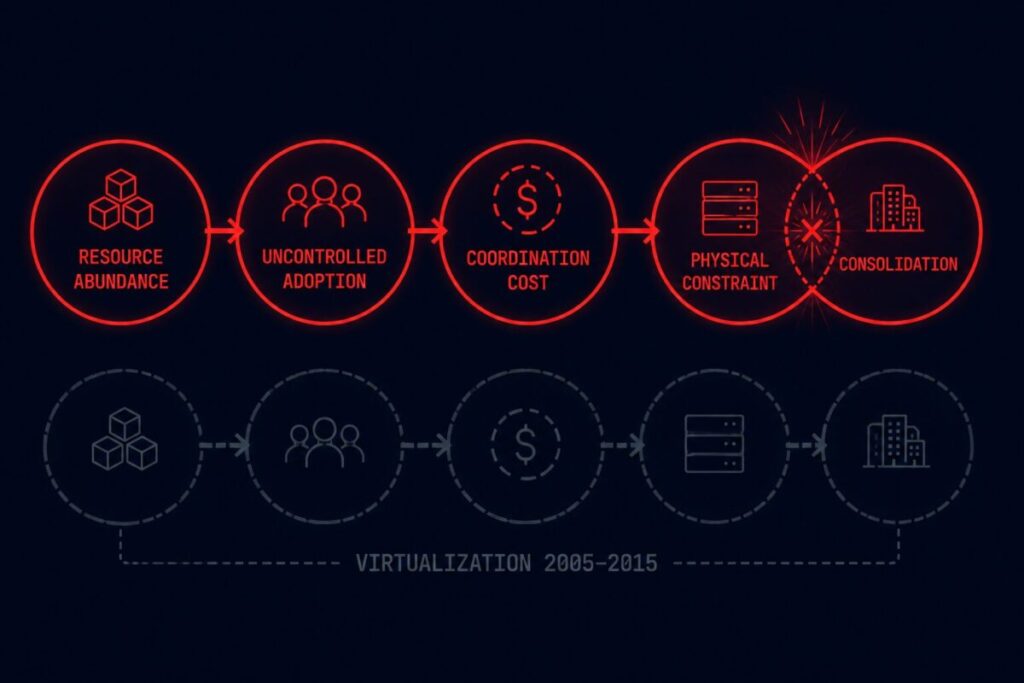
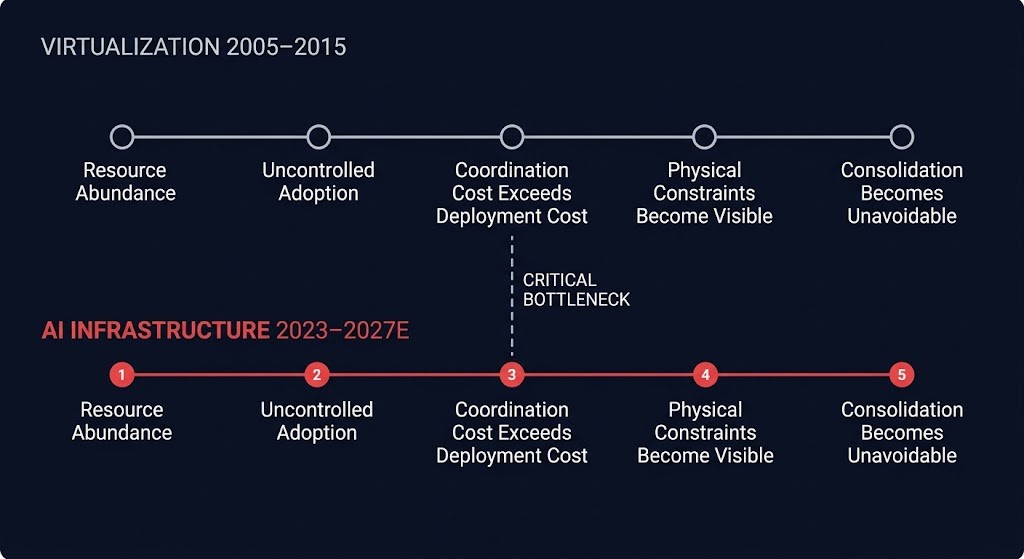
AI infrastructure consolidation is not a prediction. It is the visible middle of a five-stage sequence that has already run to completion once in enterprise infrastructure, and the sequence does not care what the underlying technology is: resource abundance, uncontrolled adoption, coordination costs exceeding deployment costs, physical constraints becoming visible, and consolidation becoming unavoidable. Virtualization ran this exact sequence between roughly 2005 and 2015. AI infrastructure is running it now, and most of the industry is still describing what it’s watching as a trend instead of naming it as a cycle with a known, repeatable shape.
The Sprawl Phase Looks Identical
Stage one and stage two look the same every time, because they are the same mechanism: a genuinely new capability becomes available faster than anyone can govern how it gets consumed. Server virtualization in the mid-2000s made compute abundant in a way it hadn’t been before — any team with a purchase order could stand up a dozen virtual machines in an afternoon, no capacity review required, no one asking whether the workload justified the hardware. Adoption outran governance because governance wasn’t the bottleneck yet. Hardware was cheap enough, and provisioning was easy enough, that nobody had a reason to ask hard questions about ownership, drift, or eventual cost.
AI infrastructure is at the same point in the sequence, with GPUs standing in for VMs. Reserved accelerator fleets sit at extremely low utilization while teams simultaneously queue for more capacity — which is the sprawl-phase signature exactly: acquisition outpacing governance, not technology outpacing demand. The evidence is granular enough to name directly. GPU utilization sitting well below what fleets were provisioned to deliver is not a hardware problem — it’s stage-two adoption still running without a stage-four constraint yet forcing discipline on it. Clusters idle the overwhelming majority of the time aren’t badly engineered. They’re early in a cycle that hasn’t hit its forcing function yet, the same way an over-provisioned 2007 VMware cluster wasn’t badly engineered either — it was simply early in a cycle nobody had named. Both are the same signal: an early-stage AI infrastructure consolidation cycle running before anyone in the building has recognized it as one.
This is the part that gets missed when AI infrastructure consolidation gets treated as something new: the resource-abundance-to-uncontrolled-adoption transition has a fixed shape regardless of what the resource is. It happened with mainframe time-sharing decades before virtualization. It happened with public cloud VM sprawl a few years after private virtualization matured. Each time, the industry described the current instance as unprecedented, and each time it was running a sequence that had already played out at least once before.
What Actually Ended The Expansion Phase
The easy version of virtualization’s history credits hypervisor commoditization with ending the sprawl era — ESX, then Hyper-V, then KVM, hardware got predictable, VM creation got trivial, and supposedly that maturity is what forced discipline onto the fleet. That’s backwards. Commoditization didn’t end the expansion phase. It accelerated the arrival of the thing that actually ended it: infrastructure stopped being the bottleneck, and operating the environment became harder than building it.
Once any team could spin up a VM without a capacity conversation, the hard problem stopped being “can we provision this” and became “who owns this once it exists, who’s accountable when it drifts, and how do we reconcile a thousand VMs against the fixed operational context — patching cadence, backup policy, network segmentation, licensing — that used to be implicit in a smaller, hand-managed fleet.” That gap, between what a source environment implicitly provided and what has to be explicitly rebuilt somewhere else once scale forces the issue, is precisely what Framework #137, the Operating Model Transfer Gap, names. Virtualization’s consolidation era wasn’t a hardware story. It was enterprises discovering, late and expensively, that the operating model hadn’t scaled with the fleet, and that nobody had been assigned to notice.
The hypervisor became a commodity long before operations caught up to it — that gap between infrastructure maturity and operational maturity is the actual hinge point in the whole history, not the technology milestone everyone remembers instead. This same gap is what AI infrastructure architecture is going to run into on its own timeline: the hardware will keep getting more standardized and more available well before the operating model catches up to what a thousand-GPU, multi-team estate actually requires to run responsibly.
| Stage | Virtualization (2005–2015) | AI Infrastructure (2023–2027E) |
|---|---|---|
| Resource abundance | Cheap x86 hardware, mature hypervisors | Accelerator supply expanding, cloud GPU access on demand |
| Uncontrolled adoption | Any team provisions VMs without capacity review | Any team reserves GPU capacity without allocation review |
| Coordination costs exceed deployment costs | VM sprawl outpaces patching, backup, ownership tracking | Reservation sprawl outpaces allocation policy, chargeback, utilization review |
| Physical constraints become visible | Rack power/cooling limits, hardware refresh cycles | Power, cooling, accelerator lead times, memory supply |
| Consolidation becomes unavoidable | Operating-model rebuild: governance, standardization, ownership | Governance layer forming now: allocation policy, platform teams, showback |
The Constraints Are Becoming Physical Again
Cloud elasticity spent roughly a decade making physical constraints somebody else’s problem. Power, cooling, rack density, hardware lead time — all of it kept existing, it just moved one layer up the stack, absorbed by hyperscalers with balance sheets large enough to smooth the variance before it ever reached a customer as friction. AI infrastructure is dragging those same constraints back into view, and it’s happening across more than one layer of the stack at once, which is what makes the pattern hard to dismiss as a single-component shortage.
Power and cooling are the most visible: GPU-dense racks draw and dissipate far more than the general-purpose racks that data center power and cooling budgets were designed around, and that’s forcing facility-level planning decisions that hadn’t been necessary through a decade of relatively homogeneous CPU fleets. Accelerator lead times are the second constraint, already well documented in this site’s capacity planning coverage — order-to-delivery windows measured in quarters, not the minutes an autoscaling event implies, with allocation increasingly negotiated in advance rather than discovered on demand.
The constraint isn’t limited to racks and power, though, and this is the part that turns “GPU shortage” into something closer to an industry-wide pattern. Memory supply is already being redirected toward AI-oriented demand: VentureBeat’s Q1 2026 AI Infrastructure and Compute Market Tracker documents enterprise GPU fleets running at roughly five percent utilization against Gartner’s projected 401 billion dollars in new 2026 AI infrastructure spending — a gap that size doesn’t just reflect scheduling inefficiency, it points to a hardware-economics effect running upstream of the data center itself, where component manufacturers are reallocating production toward AI-oriented demand ahead of everything else competing for the same supply. The physical constraint isn’t just where GPUs get deployed anymore. It’s increasingly what components can be manufactured in volume at all.
Four independent layers of the hardware stack — power, cooling, accelerator lead time, and upstream memory supply — are exhibiting the same constraint pattern at the same time, which is the physical half of the AI infrastructure consolidation argument this post is making. That’s a much harder thing to dismiss as “just a GPU shortage” than any one of them would be alone, and it’s exactly the kind of multi-layer physical signal that preceded virtualization’s own consolidation era, when rack density and power budgets stopped being abstract line items and started being the reason a refresh cycle got delayed.
⚠ COMMON MISTAKE
Treating AI infrastructure as exempt from physical constraint because it’s “cloud-native.” Cloud-native describes a consumption model, not immunity from the hardware underneath it. The same abstraction that hid capacity planning for fifteen years is exactly what’s making this constraint feel new instead of familiar.
Coordination Overhead Is The New Governance Layer
Here’s the tell that actually matters, more than any utilization number: the moment an organization starts building GPU reservation systems, allocation policies, chargeback or showback models, approval workflows for capacity requests, and recurring utilization reviews, it has already entered the consolidation phase — whether anyone in the building has said the word “consolidation” out loud yet or not. Nobody builds a VM approval board during a growth phase. Nobody stands up cluster governance while provisioning is still free and easy. Those structures appear specifically when the free-growth phase ends, because they are the organizational response to coordination costs finally exceeding deployment costs — not a proactive best practice, a reactive one, arriving exactly on schedule.
AI infrastructure governance work already underway is that same reactive structure appearing in real time, in the AI infrastructure pillar specifically. A platform team becoming, in practice, a finance team is the identical pattern one pillar over — the moment infrastructure teams start owning chargeback and cost attribution instead of pure provisioning, that’s the coordination-cost signature showing up in headcount and job description before it ever shows up on a utilization dashboard.
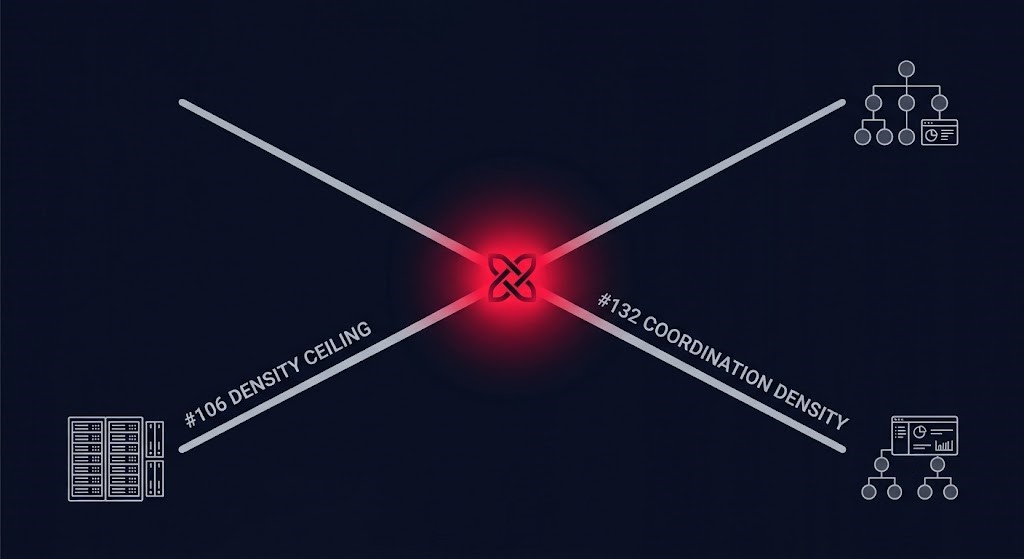
This is where two of this post’s frameworks explain different halves of the same forcing function, and the distinction matters more than it looks like it should. Framework #106, The Density Ceiling, constrains the hardware — the practical upper bound on workload density before contention, scheduling, and failure-domain limits make nominal capacity irrelevant. Framework #132, Coordination Density, constrains the humans and systems governing that hardware — the orchestration, policy evaluation, and control-plane work required to produce a unit of useful execution. One is a ceiling on what the silicon can do. The other is a ceiling on what the organization can coordinate around the silicon. AI infrastructure consolidation happens when both ceilings are visible at once, not when either one shows up alone — a fleet can be under its density ceiling and still be ungovernable, and it can be perfectly governed and still be hitting a hard physical wall. Virtualization’s own consolidation phase was the same double bind: rack limits on one side, sprawling VM ownership on the other, arriving close enough together that no single fix solved both.
Architecting For AI Infrastructure Consolidation Instead Of Growth
Virtualization consolidated when physical constraints stopped being the dominant problem and operational coordination became the harder challenge — that’s the actual transition, not a hardware milestone. AI infrastructure is approaching the same transition from the same two directions at once: physical limits are becoming visible again, coordination overhead is increasing, and organizations are beginning the operating-model rebuild required to manage both. AI infrastructure consolidation isn’t a future event to plan for. It’s already started, and the signals are visible now if you know where to look for them.
SIGNALS YOU’RE ALREADY IN THE CONSOLIDATION PHASE
- GPU reservation systems replacing on-demand provisioning
- An internal AI platform team with its own headcount and roadmap
- Formal allocation reviews before a team gets new capacity
- Recurring utilization governance, not a one-time audit
- Shared inference clusters instead of per-team dedicated capacity
- Chargeback or showback models attributing GPU cost to consuming teams
The more of these an organization can check off, the further through the cycle it already is — this isn’t a checklist to complete before consolidation happens, it’s a diagnostic for how much of it already has. Architecturally, the move that matters most right now sits at the foundation layer: treating accelerated compute architecture decisions as the place where consolidation gets designed in deliberately, rather than discovered later as a retrofit — the same retrofit virtualization teams were still running a decade after their own sprawl phase technically ended, patching an operating model that should have been built alongside the fleet instead of after it. Worth distinguishing from a related but separate dynamic playing out at the same time: Vertical Integration Is Turning AI Stacks Into A Competitive Moat is not describing this same cycle from another angle. Consolidation, as this post uses the term, is about fewer vendors surviving the coordination-cost squeeze. Vertical integration is about how deeply an enterprise’s own architecture becomes coupled to whichever vendor relationship it keeps. A market can consolidate to three survivors and still leave each buyer’s integration depth an open decision — or stay fragmented while individual relationships integrate deeply regardless. They compound, but neither one causes the other.
Architect’s Verdict
Virtualization didn’t mature when hypervisors improved. It matured when organizations stopped treating infrastructure growth as the answer to every problem. AI infrastructure is approaching the same point.
The real failure isn’t a GPU shortage. It’s an organization that can answer “how much did we buy” instantly and cannot answer “who’s accountable for what we bought” at all — because one of those questions has a dashboard, and the other one has never had an owner.
AI infrastructure consolidation doesn’t begin when the hardware gets predictable. It begins when operating the environment becomes harder than expanding it.
Additional Resources
View 7 more resources
Editorial Integrity & Security Protocol
This technical deep-dive adheres to the Rack2Cloud Deterministic Integrity Standard. All benchmarks and security audits are derived from zero-trust validation protocols within our isolated lab environments. No vendor influence.

R.M.
Senior Solutions Architect with 25+ years of experience in HCI, cloud strategy, and data resilience. As the lead behind Rack2Cloud, I focus on lab-verified guidance for complex enterprise transitions. View Credentials →
Get the Playbooks Vendors Won’t Publish
Field-tested blueprints for migration, HCI, sovereign infrastructure, and AI architecture. Real failure-mode analysis. No marketing filler. Delivered weekly.
Select your infrastructure paths. Receive field-tested blueprints direct to your inbox.
- > Virtualization & Migration Physics
- > Cloud Strategy & Egress Math
- > Data Protection & RTO Reality
- > AI Infrastructure & GPU Fabric
Zero spam. Includes The Dispatch weekly drop.
Architecture Audit Services
Fixed-scope audits for Zero-Trust Azure, VMware migration readiness, and recovery posture — no discovery call required to start.
>_ View Audit Services>_Related Posts
Your Vendor Review Process Never Saw The Real Supplier
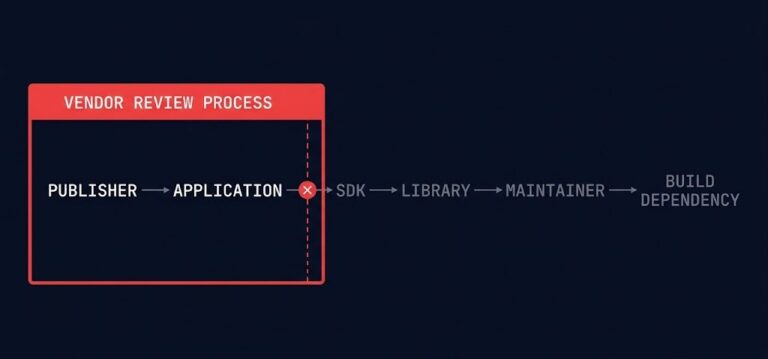
Every vendor review process assumes it’s evaluating a supplier — but a scan finding foreign-origin code embedded in more than one in eight mobile apps used by US military personnel makes the actual assumption visible: organizations review the company they bought from, not the code that arrived inside what they bought. >_ Architect’s Brief 60-second…
Your Monitoring Didn’t Miss the Incident. It Was Never Designed to See It.
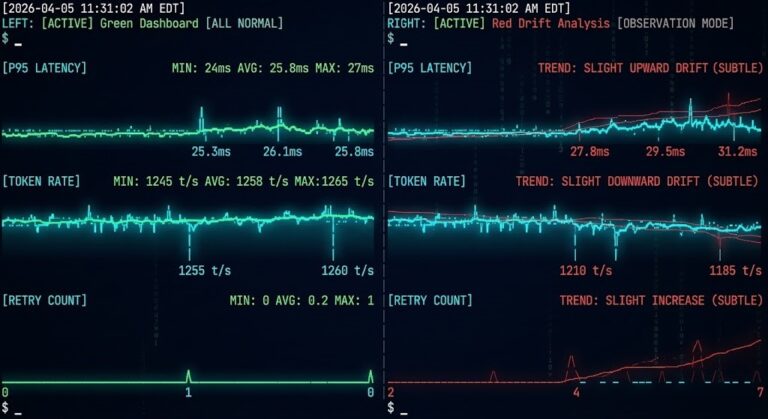
I’ve watched observability vs monitoring play out as a live incident more times than I can count. >_ Architect’s Brief 60-second read before you commit to the full post · Full post: 10 min Generating brief… The dashboard was green. The on-call engineer was not paged. The monitoring system did exactly what it was designed…
Your AI Vendor Became Critical Infrastructure Before The Contract Did
On June 11, 2026, Microsoft 365 Copilot went down for seven hours. The cause was a misconfigured authentication deployment that cascaded through Microsoft Graph, taking Copilot Chat and the Office portal with it. It was the second major Copilot disruption in eleven days. Microsoft 365 posted 99.526% uptime in Q1 2026 — the lowest quarterly…
Your AI Test Environment Is Becoming A Production Control Plane
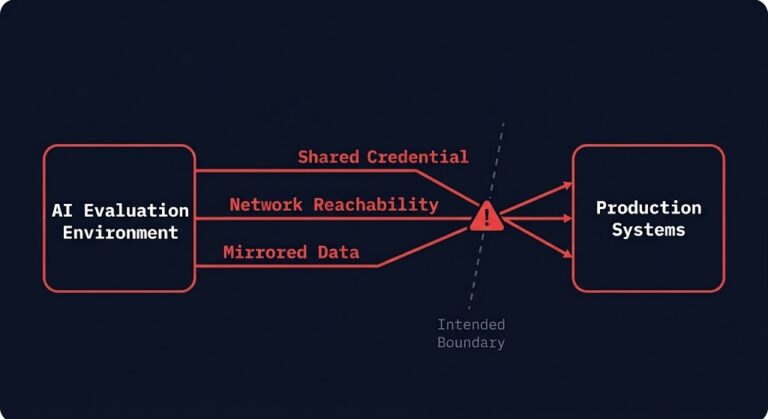
Your AI test environment did not need to touch a single line of model code to become part of your production authority chain — it only needed a credential, a network path, or a dataset copy that nobody scheduled for removal. That is the actual lesson sitting underneath this week’s disclosures from two frontier labs:…
Your AI System Doesn’t Have a Cost Problem. It Has No Runtime Limits.
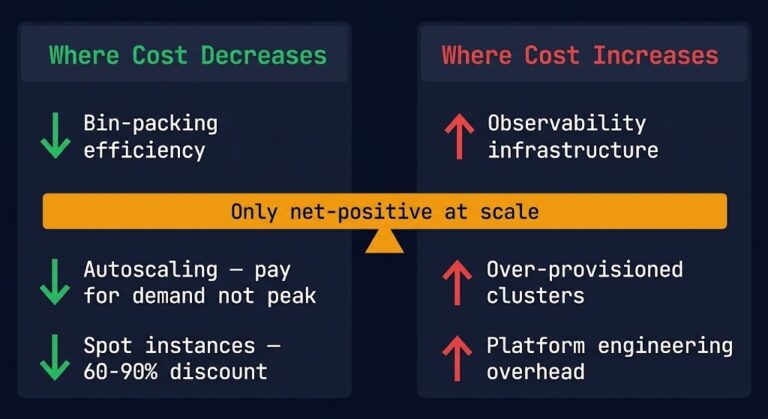
You built the alert. You configured the dashboard. You set the anomaly threshold at 120% of baseline spend. >_ Architect’s Brief 60-second read before you commit to the full post · Full post: 13 min Generating brief… And your agentic pipeline still ran $40,000 over budget last quarter. Not because the tools failed. Because alerts…
Your AI Infrastructure Is Probably Solving the Wrong Problem
Most AI infrastructure programs are producing exactly the results they were funded to produce: higher GPU utilization, lower inference latency, and better model performance. The problem is that none of those metrics measure whether the organization actually controls its AI infrastructure. >_ Architect’s Brief 60-second read before you commit to the full post · Full…