

Infrastructure Standards Without Enforcement Become Documentation Debt
Documentation debt isn’t a writing problem — it’s what’s left when a standard exists on paper but nobody can prove it still matches deployed reality. Six months after rollout, a security review asks a simple question: is the naming convention in the wiki still what’s actually running in production? Nobody can answer with evidence. Everybody answers with belief.
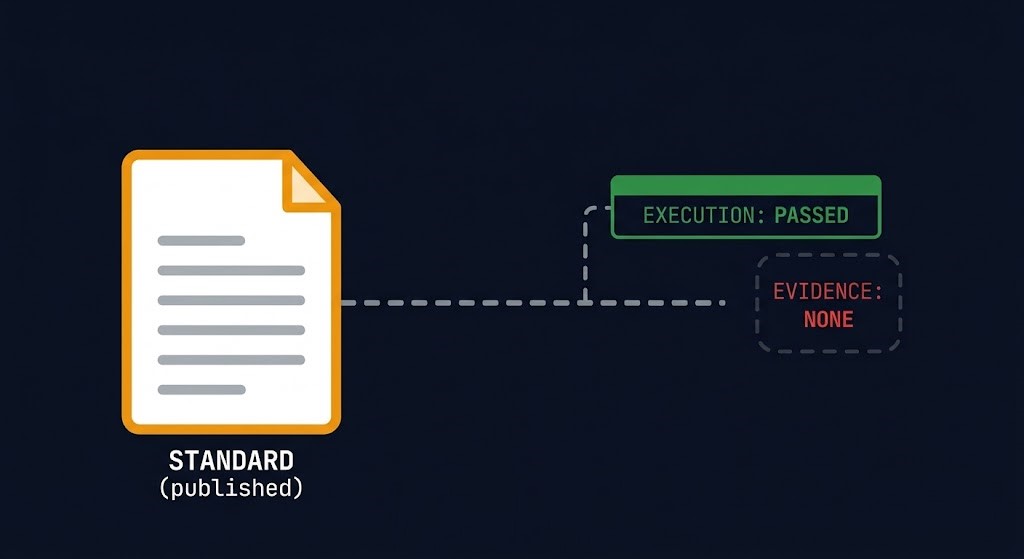
That gap — between what an organization believes about its own infrastructure and what it can actually prove — is where documentation debt lives. It doesn’t show up as a missing document. It shows up as a document nobody trusts anymore, sitting next to a system nobody can confirm still matches it.
A Document Is Not a Standard
Most organizations believe they have infrastructure standards because they have infrastructure documentation. A wiki page describes the approved VPC layout. A style guide defines naming conventions. A reference architecture shows the golden path for provisioning a new service. All of it looks like governance. None of it is a standard, in any operational sense, until something checks whether reality still agrees with it.
A standard is not a document. A standard is a claim about intended state — plus a mechanism that can tell you, at any point, whether that claim is still true. Remove the mechanism and what remains is a description of how things used to be, or how someone once hoped they’d stay. The document doesn’t change. The infrastructure does. Nothing connects the two after publication day.
This matters more in modern infrastructure and IaC environments than almost anywhere else in the stack, because IaC produces exactly the kind of clean, reproducible signal that gets mistaken for proof. A pipeline that runs green looks like compliance. It isn’t. It’s evidence that the pipeline executed — not evidence that what it executed still matches what the document says it should. That mismatch, left unaddressed long enough, is where documentation debt starts.
Three Layers: Standard, Enforcement, Evidence
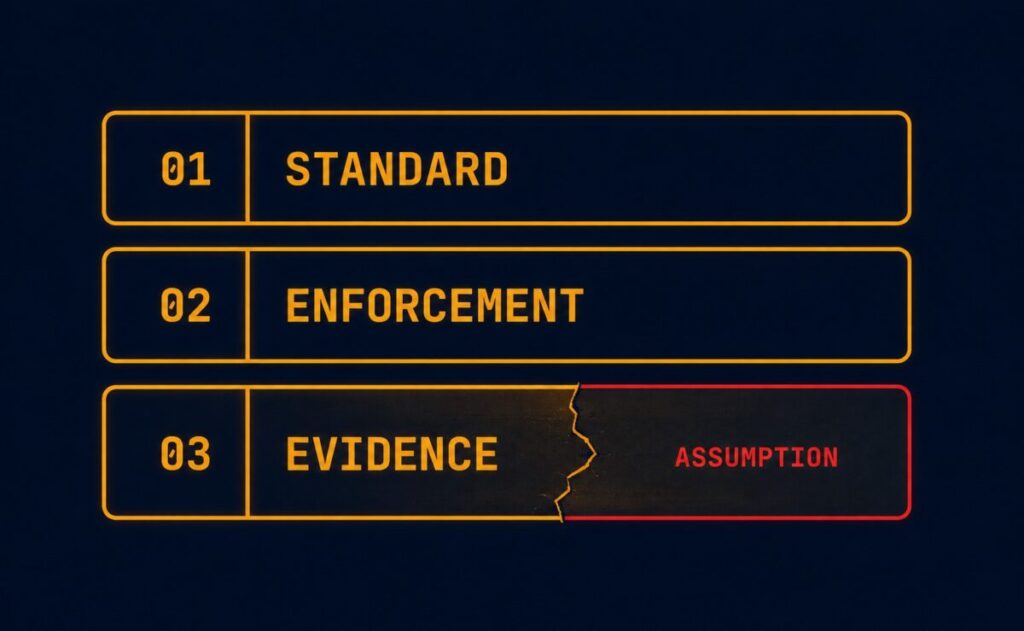
Once the document/standard distinction is on the table, the rest of the failure mode resolves into three separable layers. Most organizations only ever build the first one.
01 — STANDARD
Defines intended state. A naming convention, a network topology, a baseline configuration — the claim about how infrastructure should look. This is the layer almost every organization builds, because it’s the layer that produces a deliverable: a wiki page, a reference architecture, a style guide.
02 — ENFORCEMENT
Maintains intended state. A policy engine, an admission controller, a CI gate that rejects a plan violating the standard. This is the layer that keeps the standard true going forward — without it, the standard is only true at the moment it was written.
03 — EVIDENCE
Proves intended state still exists. Not “the pipeline ran” — a portable, externally-readable artifact connecting a specific execution back to the standard it was supposed to satisfy and the authorization that approved it. This is the layer almost nobody builds, because it doesn’t feel necessary until someone asks a question the first two layers can’t answer.
04 — WHAT REMAINS WITHOUT 02 OR 03
Assumption, dressed as governance. The organization continues to believe the standard is being followed because the document describing it still exists — not because anything has recently confirmed it.
Rack2Cloud already has a name for what happens when layer three is missing: Infrastructure Needs Auditability, Not Just Idempotency established the underlying claim — a pipeline can be green and fully reproducible while carrying zero externally-readable proof that its output was actually authorized under the policy reviewed at approval time. That’s Framework #151, Infrastructure Evidence Gap, and it’s the anchor for everything below.
FRAMEWORK #151
The structural absence of a chain-of-custody record linking an infrastructure change’s approved intent to its actual execution — a pipeline can reproduce an outcome but cannot prove the outcome was authorized under the policy state and plan artifact reviewed at approval time.
Architectural Relationships
Why It Connects
Governs the upstream condition — policy state must be governed before it can be snapshotted into an evidence artifact.
Explore Framework →Control Plane Ownership Boundary
Why It Connects
Governs the identity behind the evidence — authorization identity requires a defined ownership model before evidence can attribute it.
Explore Framework →Why It Connects
Extends the same principle to a different runtime — #149 addresses execution proof in AI systems, #151 addresses it in IaC pipelines. Same architectural failure, different domain.
Explore Framework →Why It Connects
Shares the same pattern — a system reports healthy according to its own instrumentation while reality disagrees.
Explore Framework →Infrastructure Pipeline Survivability Boundary
Why It Connects
Depends on this evidence chain — a pipeline can’t prove its own reconstruction was authorized without the chain-of-custody #151 establishes.
Explore Framework →Why It Connects
Constrains the same doctrinal territory in a different pillar — evidence produced and judged by the same party, expressed in Data Protection rather than Modern Infrastructure & IaC.
Explore Framework →When Enforcement Disappears, Drift Begins
This half of the failure is the well-covered one. When layer two — enforcement — goes missing, the standard stops being maintained and the infrastructure starts moving away from it, one exception at a time. Policy Drift Is the Real Day-2 Failure in GitOps already made this case at the reconciliation layer: a green pipeline is not the same claim as a correct policy, and GitOps solved state drift completely while leaving policy correctness almost entirely unmonitored. That post is about what happens once enforcement is gone. This one is about the layer underneath it — what happens once nobody can even prove enforcement existed in the first place. Left unresolved, enforcement-layer drift is the loud, early symptom of the same underlying condition documentation debt describes once it reaches the paper layer.
When Evidence Disappears, Documentation Debt Accumulates
Enforcement loss is visible, eventually — drift shows up somewhere, a scan flags it, an incident traces back to it. Evidence loss is quieter, and that’s what makes it worse. An organization can lose the ability to prove a standard was ever verified and not notice for years, because nothing about day-to-day operations changes. The pipeline still runs. The dashboards still stay green. The document still lives at the same wiki URL, unedited, looking exactly as authoritative as it did the day it was published.
The Architecture of Premature Closure names the general version of this trap at the recovery layer: success signals lie about system state when the checks generating those signals were never required to mean anything beyond “the last step didn’t error.” A checklist-complete recovery plan and a checklist-complete standard fail the same way — both produce confidence that outpaces what was actually verified. Documentation debt is what that gap looks like once it’s had time to compound: not a missing document, but a document nobody can trust, because nothing connects it back to what’s currently deployed.
Security Drift Is the New Configuration Drift makes the identical point one domain over: idempotency guarantees infrastructure reproduces, not that it stays secure. Declared state and actual state can match perfectly on every single pipeline run while the real posture underneath quietly gets worse — reconciliation tooling was never built to catch that gap, because reconciliation only checks against the declaration, and the declaration is exactly the thing evidence debt leaves unverified.
| Layer | Purpose | Failure Mode | What Remains When It’s Gone |
|---|---|---|---|
| Standard | Defines intended state | Never adopted, or adopted once and abandoned | A document describing a past intention |
| Enforcement | Maintains intended state | Drift accumulates uncorrected | A standard that was once true |
| Evidence | Proves intended state still exists | Assumption replaces verification | A document nobody can trust and nobody can disprove |
The third column is the one worth sitting with. An unenforced standard eventually gets caught — drift is loud enough to surface on its own, sooner or later. An unevidenced standard doesn’t get caught. It just gets believed, indefinitely, right up until the moment someone needs proof and discovers there isn’t any.
Case Pattern: Terraform, Admission Controllers, Baselines, Golden Images
This isn’t abstract. It’s the default state of most IaC estates once you look for it instead of past it.
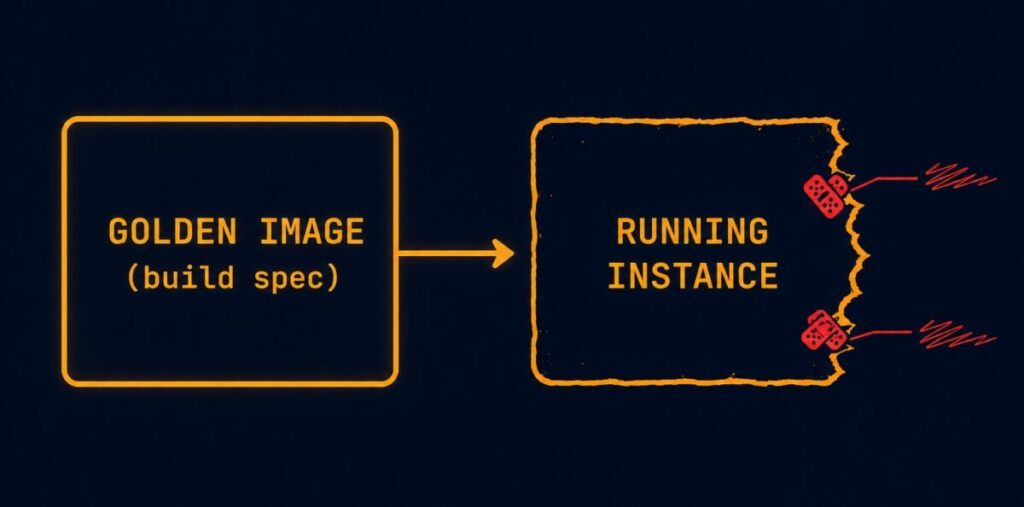
Terraform standards nobody checks — a module convention documented in a README, with no tflint rule or CI gate that would ever fail a PR for violating it. Kubernetes admission policies that exist as a design doc but were never actually deployed as an OPA/Gatekeeper constraint, so any manifest that would have violated them simply applies. Security baselines validated once, at rollout, with no recurring re-check against what’s actually running six or twelve months later. Naming standards that hold for the first quarter after publication and then quietly stop holding, because nothing was ever wired to notice. Golden images that drift from their own build spec the moment a team starts hand-patching running instances instead of rebuilding from the pipeline.
Why Configuration Standards Fail During Emergency Changes documents the sharpest version of this pattern — the moment a break-glass change bypasses the normal control path, and the standard’s enforcement mechanism (not just the standard itself) needs to have an emergency-change reconciliation story or the exception becomes permanent by default. Your Identity Controls Passed. Your Authorization Chain Failed. makes the identical argument one layer over: idempotency proves a system reached a state, not that the change which got it there was authorized. Different domain, same structural gap.
Each pattern above is documentation debt in miniature — a standard nobody has re-verified since the day it was written, still treated as current because nothing ever forced the question.
⚠ COMMON MISTAKE
Treating a passing pipeline as evidence of compliance. A passed pipeline is evidence of execution — that a specific plan ran without erroring. It says nothing about whether that plan was the one that was reviewed, whether the policy it ran against was still current, or whether anyone with authority actually approved it. Those are three separate claims, and green only proves the first.
The Fix Is Enforcement Backed by Evidence
None of this argues against documentation. It argues against stopping there. A standard needs all three layers to function as an actual control rather than a historical record: the intended state written down, a mechanism that maintains it going forward, and a mechanism that can prove, on demand, that the first two are still true.
The tooling for layers two and three already exists in most Modern Infrastructure & IaC estates, usually half-deployed. OPA and Gatekeeper enforce admission-time policy. Azure Policy and AWS SCPs enforce account- and subscription-level guardrails. tflint and Sentinel enforce plan-time policy before anything reaches an apply. None of these tools are new, and none of them are the hard part. The hard part is treating their output as the evidence layer — capturing and retaining what they checked, when, against what policy version, and tying that record back to the specific change it governed — rather than treating a clean run as self-evidently sufficient. Skipping that step is exactly how documentation debt accumulates even inside teams that take enforcement seriously. Infrastructure Needs Auditability, Not Just Idempotency works through what that evidence chain actually requires; the Governance & Drift stage of the Modern Infrastructure & IaC Learning Path builds out the full model this post anchors to.
University mail servers are the sharpest recent instance of exactly this gap: the patch existed, the advisory existed, proof of active exploitation existed — and none of it reached infrastructure that was never claimed by either central IT or the department running it. The standard technically existed. Nobody was verifying it still held.
An organization that gets this right stops asking “do we have a standard for this?” — almost everyone already does — and starts asking a harder question: when was it last verified, against what, and can we prove it?
Architect’s Verdict
A standard without enforcement is a hope. A standard without evidence is a belief that hasn’t been checked recently. Neither one is governance, no matter how well the document describing it was written or how many people reviewed it before publication.
What most organizations miss is that documentation debt doesn’t announce itself the way state drift does. Drift eventually shows up in a scan, an incident, or an audit finding — it’s loud once someone looks. Evidence debt stays silent, because nothing about daily operations changes when it accumulates. The pipeline still runs. The dashboard still shows green. The document still sits at the same URL, unedited, looking exactly as authoritative as the day it was written — right up until someone needs proof it was still true, and discovers that proof was never being generated in the first place.
The same shape shows up one layer down the stack, on the accountability side rather than the paper side: Compatibility Is Not The Same Thing As Support describes a platform that keeps executing an architecture long after the organization behind it stopped being responsible for it — “still works” is exactly as unreliable a signal there as “still published” is here.
Documentation isn’t the artifact that fails here. It’s the artifact everyone keeps checking instead of checking reality.
Additional Resources
View 4 more resources
Editorial Integrity & Security Protocol
This technical deep-dive adheres to the Rack2Cloud Deterministic Integrity Standard. All benchmarks and security audits are derived from zero-trust validation protocols within our isolated lab environments. No vendor influence.

R.M.
Senior Solutions Architect with 25+ years of experience in HCI, cloud strategy, and data resilience. As the lead behind Rack2Cloud, I focus on lab-verified guidance for complex enterprise transitions. View Credentials →
Get the Playbooks Vendors Won’t Publish
Choose the architecture problems you care about. Get field-tested playbooks and frameworks delivered to your inbox.
- > AI Infrastructure & Inference Economics
- > Cloud Strategy & Hidden Cost Models
- > Virtualization & Deterministic Migration
- > Kubernetes, IaC & Modern Infrastructure
- > Data Protection & Recovery Engineering
Zero spam. Includes The Dispatch weekly drop.
Need Architectural Guidance?
Independent review before major infrastructure decisions.
- > Validate assumptions
- > Identify hidden dependencies
- > Quantify migration risk
- > Challenge vendor narratives
Triage · Advisory · Fractional · Direct Hire