

Governance Cost Inversion: When the Approval Chain Costs More Than the Risk It Prevents
Governance cost inversion is what happens when a control built to reduce risk keeps costing more than the risk it protects against — not because anyone did governance badly, but because nobody ever asked the control to prove it was still worth what it charges. Approval workflows, review gates, and compliance sign-offs get added to automated change paths for good reasons, and those reasons are usually sound at the moment the control is introduced. What isn’t sound is a common assumption: that per-change governance burden should keep pace with change volume, while the actual risk differential of any given change class is measured — if it’s measured at all — once, at the start, and never again.
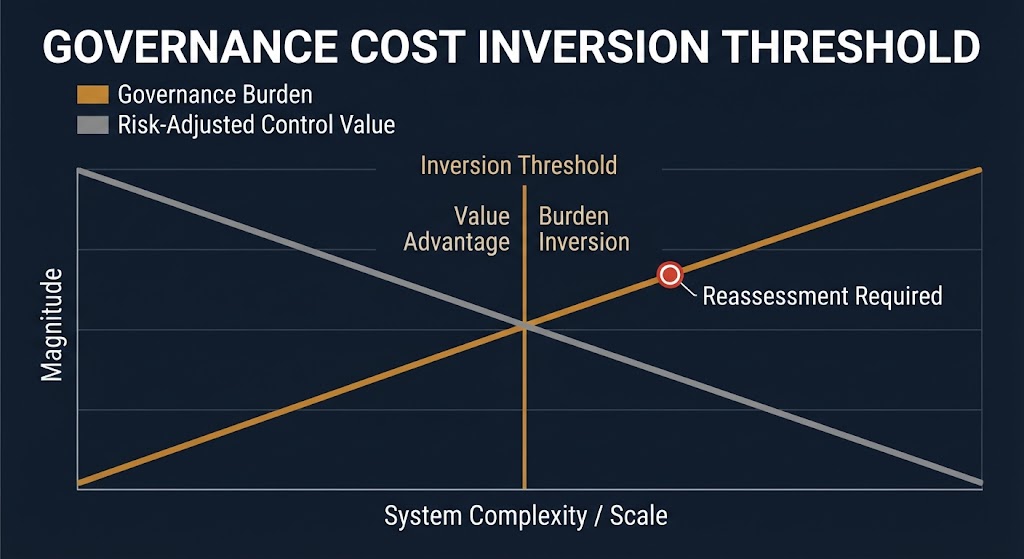
That’s the gap this framework names. Not “governance is expensive.” Not “approvals are annoying.” A specific, measurable crossover point: the moment a control’s recurring cost — in engineering hours, in approval latency, in the interruption of everything waiting behind the signature — exceeds the risk-adjusted value of the harm it’s still preventing, for that class of change specifically.
Change Classes Aren’t Risk-Equivalent, Even When Your Approval Chain Treats Them That Way
A governance system can be internally consistent — every rule followed, every gate enforced exactly as written — and still be economically irrational, because it applies the same approval burden to changes whose failure consequences are nothing alike. A one-line config change to a canary environment and a production database schema migration can sit behind the identical three-signature approval chain, not because someone decided they carry equivalent risk, but because the chain was built once, for the riskiest class of change anyone could imagine at the time, and then applied uniformly as change volume scaled past what anyone was still individually evaluating.
This is the architectural failure the rest of this piece exposes: not that any single approval was wrong, but that the system has no mechanism for noticing when a control it built for one risk profile is now being charged against a different one — repeatedly, silently, at scale.
What Governance Cost Inversion Actually Measures
This is where Modern Infrastructure & IaC architecture usually gets the definition half right. Governance Cost Inversion occurs when the recurring cost of applying a governance control to a class of changes exceeds the risk-adjusted value of the risk reduction that control actually provides.
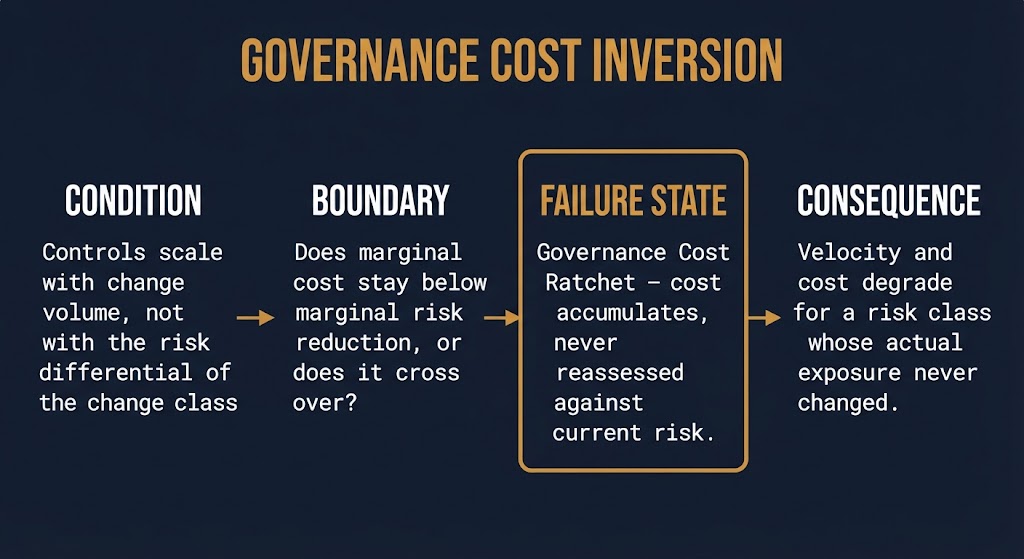
FRAMEWORK #174 — GOVERNANCE COST INVERSION
The point at which a governance control’s recurring cost exceeds the risk-adjusted value of the risk reduction it provides, independent of whether governance is executing correctly.
The framework doesn’t fail when governance becomes expensive to operate. It fails when no mechanism exists to reassess a control’s cost against its measured risk-reduction value once the risk profile it was built for has changed at scale.
Architectural Relationships
Why It Connects
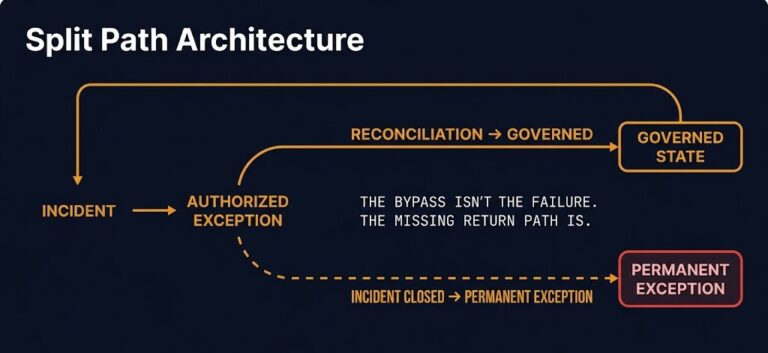
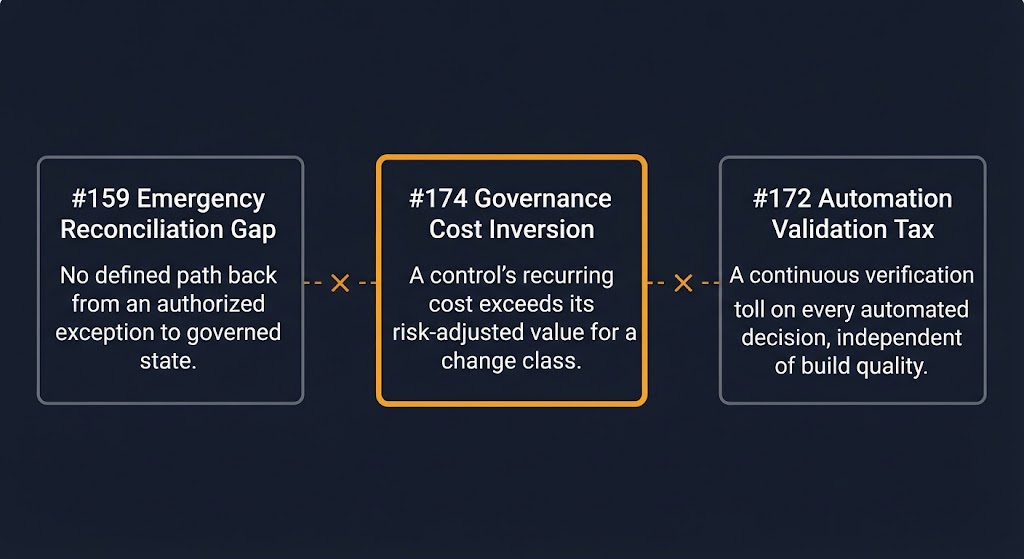
Constrains a distinct governance-failure surface — #159 requires a structural absence (no defined path back from an authorized exception to governed state); this framework requires no structural failure at all.
Explore Framework →Why It Connects
Defines the adjacent MI5 automation-economics axis — #172 measures the cost of confirming output correctness; this framework measures the cost of the approval layer regardless of whether correctness is even in question.
Explore Framework →Why It Connects
#139 measures pipeline and maintenance burden inside automation; this framework measures the governance-layer cost imposed on changes passing through that automation.
Explore Framework →It’s worth being precise about what does not trigger it. The framework isn’t invoked because approvals take too long, because engineers complain about bureaucracy, because a change advisory board is expensive to staff, or because automation could technically remove a human signature. Every one of those can be true of a control that is still correctly priced against its risk. The inversion exists specifically at the point where marginal governance cost crosses marginal risk-reduction value for a defined change class — a comparison, not a complaint.
“Risk-adjusted value” is doing real work in that sentence, and it’s worth unpacking rather than treating as a black box. Three things matter, and all three have to hold before a control’s value can be assessed honestly. Consequence alone isn’t enough — a change class with a catastrophic worst case but vanishingly small probability of ever reaching it can have lower risk-adjusted value than a change class with a merely bad worst case that happens routinely; a control priced only against the scariest possible outcome, without weighting for how often that outcome actually occurs, will systematically overvalue rare-but-severe classes and undervalue common-but-moderate ones. The unit of analysis is the change class, not the environment — “production” isn’t a risk class; a config toggle in production and a schema migration in production are, and a control evaluated against “how risky is production in general” will misprice almost everything routed through it, because it’s answering a question at the wrong grain. And the same control can carry different risk-adjusted value for different classes running through the identical approval chain — which is exactly the condition that makes uniform governance burden a mispricing problem rather than a design choice. None of this requires a precise dollar figure to be useful. A directionally honest estimate — this class carries materially greater expected risk than that one — is enough to tell whether a shared control is proportionate to both, or only to one of them.
What this framework does not say: Governance Cost Inversion does not mean expensive governance is unnecessary, and it isn’t an argument for removing controls. It identifies the specific point at which a control’s recurring burden is no longer proportional to the risk reduction it provides for the change class it’s actually being charged against — a narrower and more falsifiable claim than “governance costs too much.” It’s also a narrower claim than trusting the approval signal itself. This framework assumes the approval that was granted is the approval that was actually exercised — a different, adjacent failure is when that assumption breaks, and the approval dialog shows one action while the system performs another. GhostApproval covers that failure mode in AI coding agents; Governance Cost Inversion is concerned with a control that works exactly as designed and still costs more than it’s worth, not one that misrepresents what it did.
The Four Indicators
The inversion isn’t a feeling about bureaucracy — it’s measured across four comparisons, each pairing a governance-side cost against a risk-side value for the same change class.
Approval-chain length compares governance effort per change class against the blast radius that change class actually carries. Time-to-approve compares approval latency against the actual incident rate observed for that change class — this comparison is a proportionality check, not a causal claim. A long delay for a change class with a very low observed incident rate is a directional signal to examine, not evidence that the delay is preventing something the class wasn’t already unlikely to experience. If incident rate stays high despite long latency, that’s a different problem entirely — the gate isn’t the risk-reducing mechanism it’s assumed to be, and delay alone isn’t compensating for anything. Auto-approvable-but-still-signed-off compares the share of changes that already qualify for automated approval under policy against those that still route through a human control adding no proportional risk reduction. Cost-per-approval-cycle compares labor hours times loaded rate per cycle against the expected loss associated with the incident class that approval is meant to prevent — using expected loss, not the worst case anyone remembers, since comparing approval cost to a single catastrophic dollar figure invites, and deserves, a challenge on probability weighting.
This distinction is consistent with DORA’s own treatment of change approval: its research discusses risk-based measurement of change approval and reports no evidence that more formal, external review was associated with lower change-failure rates. That doesn’t establish Governance Cost Inversion as a universal condition — it provides empirical context for testing whether approval burden is actually producing proportional risk reduction, rather than assuming it does by default.
Consider an illustrative estate where two change classes currently share the identical three-signature approval chain: a routine, reversible infrastructure configuration change — a resource tag update, a non-production autoscaling threshold — and a high-blast-radius production database schema migration.
For the configuration change: approval-chain length is high relative to blast radius, three signatures for a change that, if wrong, is corrected in minutes with no data loss. Time-to-approve running two business days shows no corresponding incident-rate justification — this class has produced few observed failures that the approval chain could plausibly have prevented, because the failure modes it can produce aren’t the kind three signatures screen for. The class is overwhelmingly eligible for automated approval under existing policy and nearly always still gets a human signature anyway. Cost-per-approval-cycle, at loaded engineering time for three reviewers across two days, comfortably exceeds the expected loss this class is realistically exposed to. On all four indicators, this control has crossed into inversion for this specific change class.
For the database migration: the same three-signature chain, the same two-day latency, the same near-total-but-still-manually-signed auto-approval eligibility — but blast radius is genuinely severe, incident rate for this class is materially non-zero across the fleet’s own history, and the expected loss from a bad migration — data loss, extended outage, downstream service failures — dwarfs the cost of the review cycle. None of the four indicators invert here. The identical control is proportionate for one class and inverted for the other, which is exactly the mispricing this framework exists to surface — not because the control changed, but because it was never priced per class to begin with.
The Inversion Threshold
Stated plainly: Governance Cost exceeds the Risk-Adjusted Value of the Control. That crossover, by itself, isn’t the failure — crossing the threshold is a signal to reassess the control, not an instruction to remove it. Costs shift, risk data updates, and a control can cross back the other way just as easily once conditions change again.
The actual failure state follows a specific chain, and it’s worth tracing the whole sequence rather than jumping straight to the outcome. A control gets built against an initial risk assessment. The underlying risk for that change class changes, often downward, as automation matures and the class’s actual failure rate becomes visible. Change volume for that class increases, because the automation that made the risk visible also made the change cheap to execute. Per-change governance burden accumulates across that growing volume, since the control itself never shrank even as the population of changes running through it grew. And no reassessment mechanism exists to catch any of this, because the control was designed to be applied, not re-priced. The inversion persists — not because it crossed the threshold once, but because nothing in the system is positioned to notice that it stayed crossed. That persistent, unexamined state is Governance Cost Ratchet, the framework’s named failure state: cost accumulates, is never reassessed against current risk data per change class, and the control has no path back to being right-sized.
DIAGNOSTIC QUESTION
“When was the last time this approval control was re-evaluated against the risk it was introduced to mitigate?”
This is also where the boundary with Automation Debt Curve is sharpest, and it’s worth stating without hedging. Engineering investment can reduce automation debt — better tests, better observability, better rollback tooling all pay down the pipeline-maintenance burden that framework measures, because that burden lives inside the automation itself. Engineering investment alone cannot retire an approval requirement whose authority exists outside the automation — no amount of better tooling removes a signature that a human, a policy, or a compliance obligation still requires. Debt Curve can, in principle, be paid down by whoever builds the pipeline. Governance Cost Ratchet can only be undone through an authorized governance decision that changes what the pipeline is required to ask permission for — a different kind of decision than the one that fixes the automation. A team can perfect its CI/CD pipeline indefinitely and never once touch the governance layer sitting on top of it.
The same cadence problem shows up one layer over in reconciliation systems: GitOps Policy Drift is what happens when a review cadence exists and still only verifies convergence, not whether the policy being converged toward is still the right one. Governance Cost Ratchet is the cost-side version of the same blind spot — a mechanism that keeps running exactly as designed while nothing checks whether it should still be running that way.
If the honest answer to when a control was last re-evaluated is “at the moment we built it, and never since,” the control isn’t necessarily wrong — it’s unverified. That’s the inversion risk, whether or not it’s currently realized.
This Isn’t Emergency Reconciliation Gap, and It Isn’t Automation Validation Tax
Three frameworks now sit adjacent in the Modern Infrastructure & IaC governance space, and they measure three different things.
| Framework | Primary Mechanism |
|---|---|
| #174 Governance Cost Inversion | Governance cost exceeds the risk-adjusted value of the control, independent of correctness |
| #159 Emergency Reconciliation Gap | No defined path back from an authorized exception to governed state |
| #172 Automation Validation Tax | A continuous verification toll on every automated decision, independent of build quality — not a paydown-able debt |
Automation Validation Tax (#172) measures a continuous verification toll on every automated decision, independent of build quality — one that, unlike governance cost, cannot be paid down at all, only paid or silently skipped. A change can pass every validation check it measures and still be cost-inverted by approval overhead that has nothing to do with correctness. A system can have a perfectly resolvable emergency-exception process — no #159 gap at all — and still be paying an economically irrational governance tax on routine changes. None of the three collapse into each other, and none of them require the other two to be present.
What a Control Retirement Path Would Require
A control retirement path isn’t a product, and it isn’t a rewrite of your approval tooling — it’s three required conditions, each of which has to be established for the retirement path to hold, and each of which fails in its own distinct way if skipped.
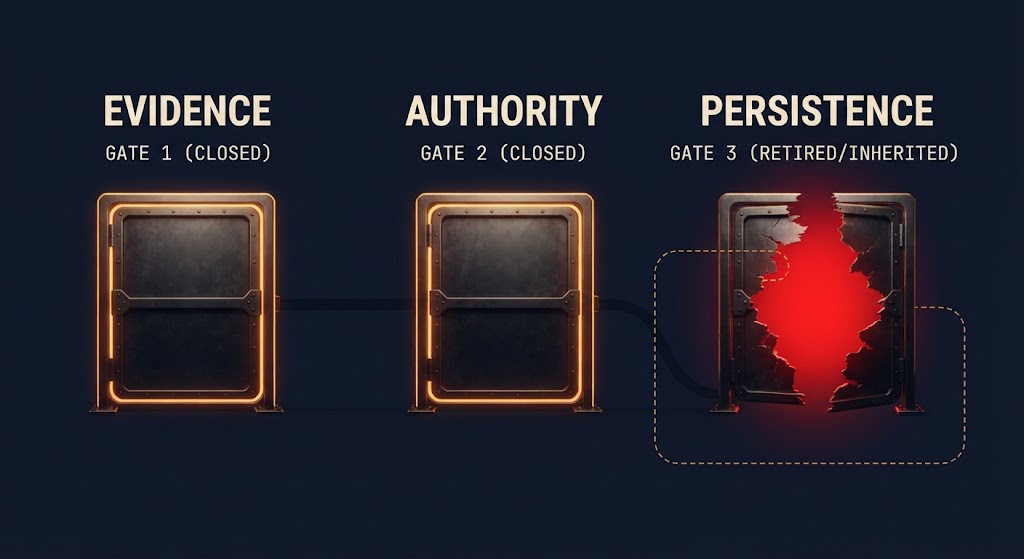
Evidence comes first: what would actually demonstrate that this specific control’s risk-reduction value no longer justifies its cost for this change class? Not a general sense that a gate feels unnecessary — the same four indicators used to detect inversion are what qualify a control for retirement. A control can only be credibly narrowed or removed once someone has run the same measurement that flagged it as inverted in the first place; evidence gathered for detection is the same evidence required for the decision, which is what keeps retirement from becoming a subjective judgment call.
Authority is a separate condition, and it has to be a different question than who currently owns the approval workflow tool. The person or team who administers the CAB software, the pipeline gate, or the policy engine is frequently not the party with standing to decide that a given risk no longer warrants the control built to cover it — that decision usually belongs to whoever owns the risk itself: a security function, a compliance owner, a platform architecture group. Retirement paths fail here more often than at the evidence stage, because evidence can accumulate for months against a control nobody with actual authority has ever been asked to reconsider. A related but distinct version of this same authority gap shows up when GitOps environments fragment ownership across independently-built reconciliation loops — there, the problem is that no single party has arbitration authority at all; here, the authority typically exists, it has simply never been asked the question.
Persistence is the condition most retirement paths never satisfy, because the first two feel like completion. A control removed from one pipeline definition and still present in the module template everyone clones from hasn’t been retired — it’s been temporarily hidden, and it will reappear the next time someone provisions from that template, inherits that policy, or copies that automation rule forward. A working retirement path has to answer what actively prevents the retired control from returning through inheritance, not just confirm that it’s absent from wherever someone last looked. Without an answer to persistence, evidence and authority together produce a paperwork retirement — the control is gone from the record and still running in practice.
Architect’s Verdict
Governance Cost Inversion is not a claim that your CAB is too expensive, or that automation should be trusted more freely. It’s a claim that a control’s cost has to be re-justified against the risk it currently protects, not the risk it protected on the day someone stood it up, and that most governance systems have no mechanism for asking that question at all.
The real problem was never the existence of the control. It’s the absence of a retirement path: no owner, no evidence threshold, no defense against the control quietly reappearing through the templates and policies that outlive the decision to remove it. A governance system that can add controls but never subtract them isn’t conservative. It’s unaudited in one direction only.
Every approval chain was built by someone who was right, at the time, about the risk in front of them. The failure shows up later — quietly, at scale — when nobody ever asks if they still are.
Additional Resources
Editorial Integrity & Security Protocol
This technical deep-dive adheres to the Rack2Cloud Deterministic Integrity Standard. All benchmarks and security audits are derived from zero-trust validation protocols within our isolated lab environments. No vendor influence.

R.M.
Senior Solutions Architect with 25+ years of experience in HCI, cloud strategy, and data resilience. As the lead behind Rack2Cloud, I focus on lab-verified guidance for complex enterprise transitions. View Credentials →
Get the Playbooks Vendors Won’t Publish
Field-tested blueprints for migration, HCI, sovereign infrastructure, and AI architecture. Real failure-mode analysis. No marketing filler. Delivered weekly.
Select your infrastructure paths. Receive field-tested blueprints direct to your inbox.
- > Virtualization & Migration Physics
- > Cloud Strategy & Egress Math
- > Data Protection & RTO Reality
- > AI Infrastructure & GPU Fabric
Zero spam. Includes The Dispatch weekly drop.
Architecture Audit Services
Fixed-scope audits for Zero-Trust Azure, VMware migration readiness, and recovery posture — no discovery call required to start.
>_ View Audit Services>_Related Posts
ZFS vs Ceph vs NVMe-oF: Choosing the Right Storage Backend for Modern Virtualization
I still have nightmares about a storage migration I ran back in 2014. >_ Architect’s Brief 60-second read before you commit to the full post · Full post: 7 min Generating brief… We were moving off a monolithic SAN and onto an early “software-defined” storage platform. The sales engineers promised infinite scalability and self-healing magic….
Your Kubernetes Cluster Isn’t Out of CPU — The Scheduler Is Stuck
Compute Tier 1 Authority Cascades to ➔ >_ Architect’s Brief 60-second read before you commit to the full post · Full post: 9 min Generating brief… [Storage] [Network] 🚨 Failure Signature Detected Grafana shows cluster CPU utilization is under 50%, but pods are stuck in Pending. Events show: 0/10 nodes are available: 10 Insufficient cpu….
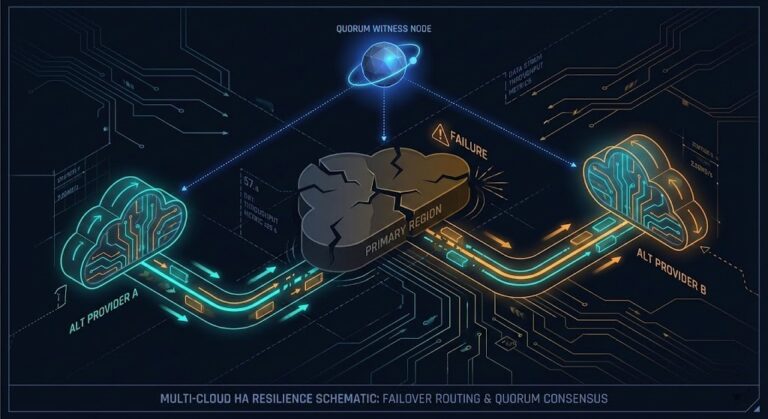
Your Cloud Provider Is Not Your HA Strategy
A Tactical Playbook for Architecting, Testing, and Automating Real Multi-Cloud & Multi-Region Resilience We’ve previously explored why cloud SLAs fail as guarantees in our deep dive, Cloud SLA Failure & Resilience Strategy. This article focuses on how to survive those failures in practice — architecturally, operationally, and financially. >_ Architect’s Brief 60-second read before you…
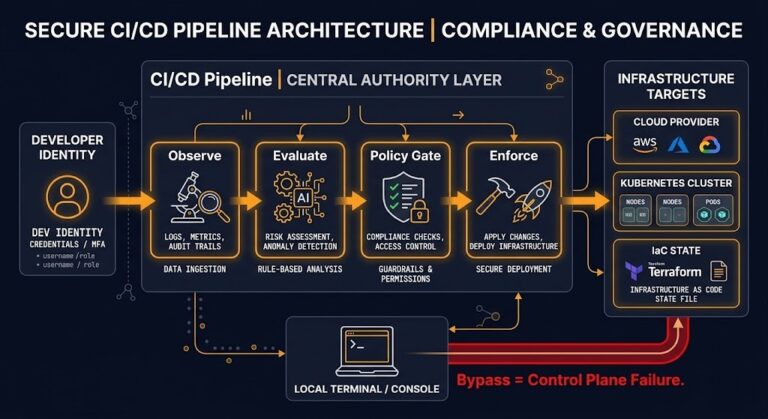
Your CI-CD Pipeline Is Your Real Infrastructure Control Plane
Terraform defines desired state. Kubernetes reconciles workload state. Cloud consoles expose state. None of those systems decides whether infrastructure state is allowed to change. The ci-cd control plane does — or more precisely, the CI-CD pipeline is the only system in most environments that can hold that authority. That distinction — between storing state and…
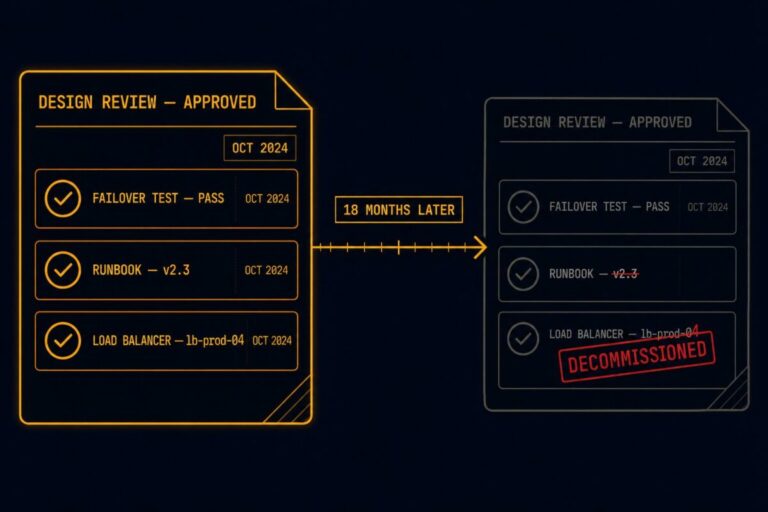
Why Infrastructure Survivability Fails After The Design Review
Infrastructure survivability is not something an architecture has. It’s something an organization keeps proving, on a schedule nobody wrote down, long after the design review that approved it has been forgotten. >_ Architect’s Brief 60-second read before you commit to the full post · Full post: 8 min Generating brief… That review happened. Redundancy was…
Why Configuration Standards Fail During Emergency Changes
Configuration standards emergency changes have one thing in common across every organization we’ve reviewed: the standard survives the incident, and quietly stops applying about ninety seconds into it. >_ Architect’s Brief 60-second read before you commit to the full post · Full post: 11 min Generating brief… It’s 2 a.m. A load balancer rule is…