

The VMware Renewal Decision Was Made Two Years Ago
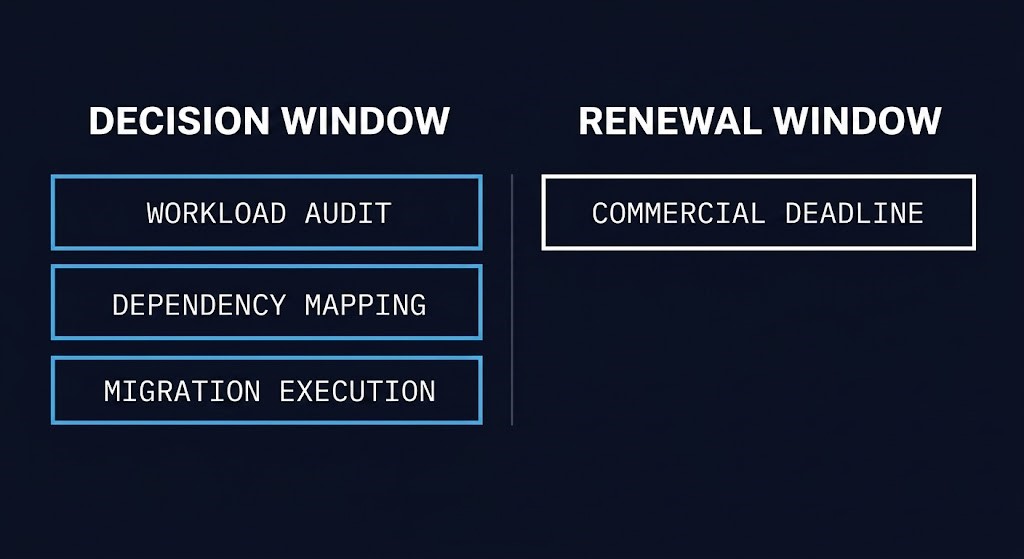
The vmware renewal decision most enterprise architects are facing in 2026 was not made at the renewal table. Most organizations approaching renewal aren’t choosing between renewing and migrating — they’re choosing between completing a migration they already started and accepting a price structure that validates the exit they delayed. The commercial deadline arrived. The architectural decision didn’t.
The Cohort That’s Hitting The VMware Renewal Decision Now
The 2023 Broadcom acquisition triggered a pricing shock that restructured every VMware commercial relationship. Enterprises that couldn’t exit on short notice did what procurement does under pressure: they signed 3-year ELAs to buy time and stabilize costs. That cohort is crossing renewal in 2026.
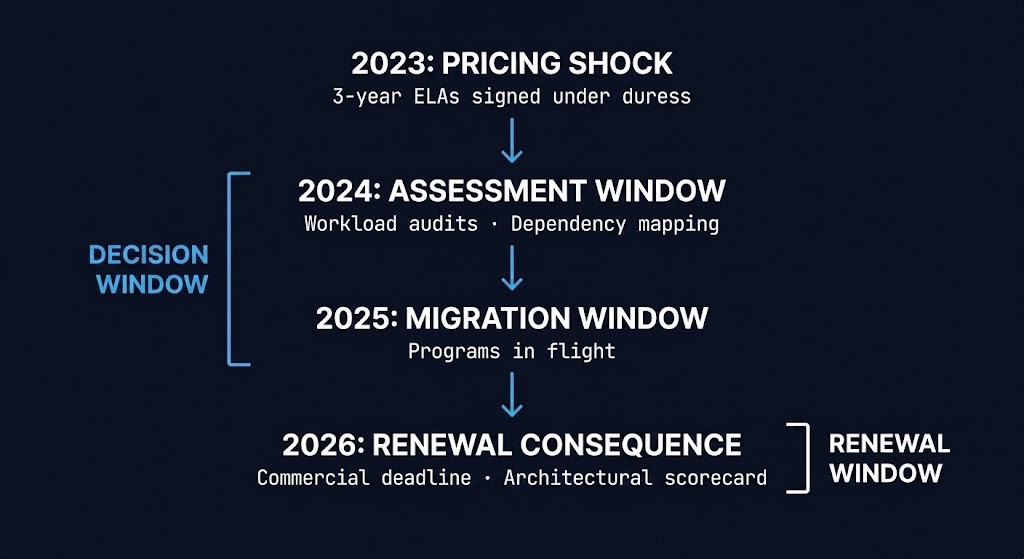
| Year | Reality |
|---|---|
| 2023 | Broadcom pricing shock — 3-year ELAs signed under duress to buy runway |
| 2024 | Assessment period — workload audits, dependency mapping, vendor evaluation |
| 2025 | Migration window — programs that started on time are completing or mid-flight |
| 2026 | Renewal consequence — the commercial deadline arrives; the architectural decision is already behind you |
Most organizations are treating 2026 as the decision point because it’s when the invoice arrives. Architecturally, it’s the scorecard.
What “Renewal” Actually Means in the Broadcom Model
Renewal in the Broadcom model is not a continuation of what you had. It is a forced migration to Broadcom’s SKU architecture.
The VVF/VCF distinction is the mechanism. VMware vSphere Foundation consolidates compute virtualization and basic management. VMware Cloud Foundation bundles the full stack — compute, storage, networking, lifecycle management — at a materially higher per-core price point. Enterprises renewing on VCF are buying into a stack they may not be operating. Many are pricing a product that requires operational capability they haven’t built.
The renewal quote is not a price for what you have. It’s a price for what Broadcom has decided you need. This is the commercial-continuity failure mode vendor trust as a purchasing criterion is built to name directly — the licensing terms buyers underwrote at signing didn’t survive the acquisition, and no amount of technical capability in the platform itself changes that the promise priced into the original deal stopped being the promise being kept. Understanding the actual VMware licensing cost exposure requires core-accurate modeling — and the gap between estimated and actual core counts is where most enterprises discover they misread their own environment. The VVF and VCF core calculation is the first place that precision breaks down.
The Decision Window Closed Before the Renewal Window Opened
This is the part that the renewal conversation consistently obscures.
Migration programs at enterprise scale require 18 to 36 months of execution time. That’s not a conservative estimate — it’s the operational reality of dependency mapping, workload classification, platform validation, runbook conversion, and cutover sequencing at scale. Workload audits happen before migration starts. Dependency mapping happens before workload audits can be trusted. Both of those need to be complete before a migration program has a credible velocity.
Renewal arrives after all of those architectural decisions should already exist.
That sequencing is not a coincidence or a failure of planning. It’s the structure of the problem. An organization that signed a 3-year ELA in 2023 with genuine intent to migrate had, at most, 12 months of runway before the migration program needed to be operating at pace to land before the 2026 renewal. Most didn’t start in 2023. Most started the assessment in 2024. Which means the migration window and the renewal window are the same window — and the renewal is arriving first.
Renewal feels like a decision point because it’s the first commercial deadline. Architecturally, it’s one of the last.
The #112 Lifecycle Governance Horizon framework describes exactly this failure mode: organizations treat commercial deadlines as architectural triggers, when the architectural trigger needed to fire 18 months earlier. The governance horizon isn’t the renewal date. It was the date by which the workload audit needed to be complete.
The Migration Calculation Has Already Shifted
In 2023, migration cost dominated the TCO comparison. The renewal quote was defensible against a fully-loaded migration — tooling, platform licensing, retraining, operational delta, and the inevitable surprises that emerge during cutover. That math made staying look rational.
In 2026, the renewal quote is the anchor. Three-year VCF pricing on a meaningful core count now rivals or exceeds the fully-loaded migration cost in many environments. The cost of staying has increased. The cost of migrating has decreased as tooling matured, operational playbooks accumulated, and the target platforms — Nutanix AHV, Proxmox, and others — added the enterprise features that were gaps in 2023.
The calculation changed while the decision was still in review. The Broadcom Year Two analysis documents what that shift looks like across a range of environment sizes. The migration survivability test — Framework #145 — is the operational gate that determines whether a migration program is ready to land, not just to start.
GOVERNANCE POSITION
Most organizations are treating renewal as a strategy decision. Renewal is an execution milestone. Strategy should have been decided two budget cycles earlier.
What Architecture Sees That Finance Doesn’t
Procurement sees a renewal quote. Architecture sees a dependency inventory. That’s the entire distinction.
The renewal conversation almost always lives in procurement until the number arrives — at which point finance escalates it and architecture is asked to validate a commercial decision that should have driven an architectural one. By that point, the dependency inventory either exists or it doesn’t. The workload classification is either done or it isn’t. The migration velocity is either established or it isn’t.
The architectural signals that defined the real renewal exposure were readable before the renewal quote arrived: which workloads completed migration versus which ones stalled and why; which teams still operate VMware-native runbooks with no equivalent in the target platform; which integrations — backup, DR, monitoring, identity — have no clean migration path documented. Those signals define the actual migration ceiling. And the migration ceiling is what the renewal quote is priced against, whether Broadcom makes that explicit or not.
The VMware dependency audit is the mechanism for surfacing what’s actually blocking migration. The vSphere lifecycle management governance framework (#112) is the model for why it should have happened before procurement received the first renewal quote. The operating model transfer problem is what the dependency audit exposes when the migration program has been treating the hypervisor as the target instead of the operating model.
The Three Renewal Positions
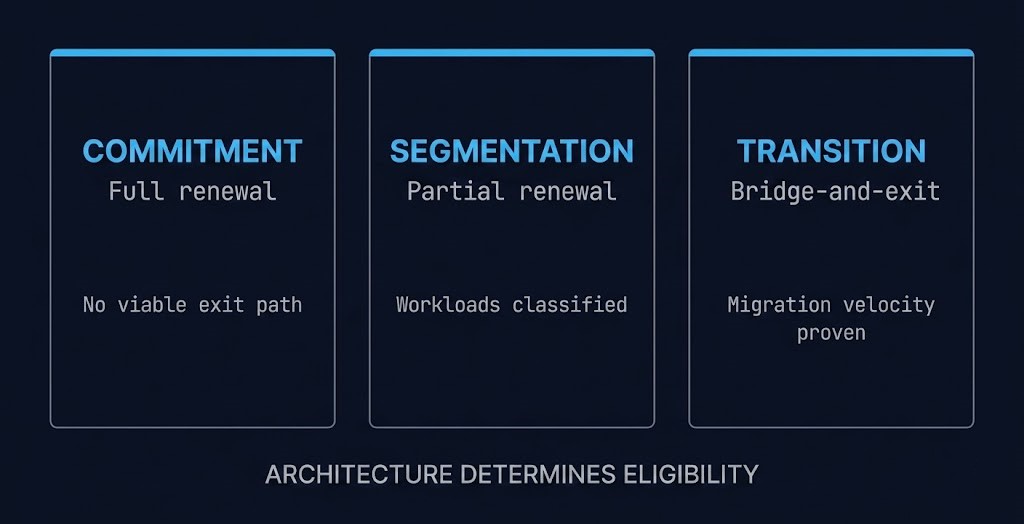
Every enterprise approaching VMware renewal will land in one of three positions. The names matter because they describe what each position requires architecturally, not what it looks like commercially.
That three-way split isn’t unique to renewal negotiations — it’s a compressed version of the same pattern now visible across the entire virtualization market, where the same Consolidator / Replacer / Absorber logic plays out at the level of an organization’s overall platform strategy rather than a single contract.
01 — COMMITMENT
Full renewal on Broadcom’s current SKU structure. You’re committing to Broadcom’s operating model for the next term. This is a defensible position if the workload audit says migration cost exceeds the renewal delta, the dependency map has no clean exit path within the term, and the organization has decided that VMware operational continuity is preferable to migration disruption. That preference is no longer an outlier decision — The Next Virtualization Battle Is Operational Simplicity argues the market has started pricing operational continuity as the thing buyers actually want, not a fallback when migration looks too risky. The problem is that most enterprises landing here haven’t done that audit. They’re defaulting, not deciding. Commitment chosen without visibility into the dependency inventory is not a position — it’s deferred risk with a three-year timer.
02 — SEGMENTATION
Partial renewal. Tier down to VVF for non-critical workloads while accelerating migration for the remainder. This position compresses the renewal cost by reducing the scope of Commitment while maintaining the runway to complete migration for the workload cohort that genuinely needs it. Segmentation requires workload classification to already exist. If the classification hasn’t been done, Segmentation isn’t a negotiating position — it’s an aspiration. You cannot selectively renew a subset of your environment without knowing which subset that is, what it depends on, and whether the migration cohort can actually land within the renewal term.
03 — TRANSITION
Minimum viable renewal term structured explicitly to fund migration runway. The renewal is a bridge, not a commitment. Pricing is negotiated on that basis. Transition requires demonstrated migration velocity — not a plan, not an intent, a rate. How many workloads migrated per quarter in 2025? What does the pipeline look like? Which blockers were cleared, and which remain? The Migration Survivability Test (Framework #145) is the operational framework for validating whether Transition is a real option or a projection. Broadcom’s renewal teams understand this math. Organizations that can show actual velocity have more negotiating surface than organizations presenting migration roadmaps with no execution history behind them.
DIAGNOSTIC QUESTION
“If VMware disappeared from your environment eighteen months from now, which workloads would still be unable to move — and do you know why?”
That question tells you whether a workload audit exists in a form that’s useful for renewal. Most organizations can name what’s stuck. Far fewer can explain why — and the reason why is where the dependency inventory lives.
Architect’s Verdict
The renewal isn’t the decision. It’s the confirmation of whether the decision was made or deferred. Enterprises that completed workload classification, dependency mapping, and migration sequencing in 2024 and 2025 arrive at renewal with a position. They know which workloads are in Commitment, which are in Segmentation, and whether Transition is a real option or an aspiration. That visibility is negotiating leverage.
Everyone else is confirming what Broadcom already priced in: an environment without a completed workload audit, without demonstrated migration velocity, and without a dependency map that would allow Segmentation. The renewal quote reflects that.
Broadcom isn’t discovering whether you can leave. They’re pricing against whether you’ve already proven that you can.
The same test applies outside virtualization entirely. Windows 10 ESU’s procurement decision runs on identical logic: the renewal invoice — or in that case, the ESU purchase order — isn’t the decision point, it’s the scorecard for whether a migration date was ever actually set. An organization that can’t name the date its ESU coverage ends hasn’t bought a bridge any more than an organization renewing VMware without a workload audit has bought stability. Both are pricing the absence of a decision, not the presence of one.
The mechanism behind that pricing pressure isn’t Broadcom-specific. Virtualization’s own consolidation era ran on the same physics: a resource gets abundant, adoption outruns governance, and eventually the bill for deferred coordination comes due all at once, disguised as a single commercial deadline. AI infrastructure hasn’t reached its renewal-notice moment yet. The organizations building allocation governance now are the ones making sure they never get cornered by one.
Additional Resources
View 9 more resources
Editorial Integrity & Security Protocol
This technical deep-dive adheres to the Rack2Cloud Deterministic Integrity Standard. All benchmarks and security audits are derived from zero-trust validation protocols within our isolated lab environments. No vendor influence.

R.M.
Senior Solutions Architect with 25+ years of experience in HCI, cloud strategy, and data resilience. As the lead behind Rack2Cloud, I focus on lab-verified guidance for complex enterprise transitions. View Credentials →
Get the Playbooks Vendors Won’t Publish
Choose the architecture problems you care about. Get field-tested playbooks and frameworks delivered to your inbox.
- > AI Infrastructure & Inference Economics
- > Cloud Strategy & Hidden Cost Models
- > Virtualization & Deterministic Migration
- > Kubernetes, IaC & Modern Infrastructure
- > Data Protection & Recovery Engineering
Zero spam. Includes The Dispatch weekly drop.
Need Architectural Guidance?
Independent review before major infrastructure decisions.
- > Validate assumptions
- > Identify hidden dependencies
- > Quantify migration risk
- > Challenge vendor narratives
Triage · Advisory · Fractional · Direct Hire