

Cloud Governance Is Replacing Cloud Architecture
Cloud governance is no longer the layer that gets bolted on after the architecture diagram is approved — it has become the constraint the diagram gets approved against. Cloud architecture is not disappearing. Governance is becoming the dominant constraint acting upon it. That distinction matters, because it’s the difference between a healthy shift in where the hard decisions live and an obituary for architectural discipline. This is the former. But if you sit on a review board, or run one, you’ve probably already felt the shift without naming it.
The Shift Nobody Named
Pull up the last three architecture reviews you sat through. Not the ones from five years ago — the ones from this quarter. Notice what the questions actually were.
| Then | Now |
|---|---|
| Can this scale? | Who can approve it? |
| Is latency acceptable? | What happens if authority disappears? |
| Is the topology resilient? | Can this decision survive audit? |
Nobody scheduled a meeting to announce this change. There was no migration project, no vendor RFP, no line item. The questions just moved, one review cycle at a time, until the design questions were still being asked — they’d just stopped being the ones that decided anything. A topology that scales fine gets sent back because nobody can say who owns the approval to change it under load. A latency number that’s well within budget doesn’t matter if the system can’t prove, six months later, that the decision to accept that number was made by someone with the authority to make it.
That’s the shift. Not architecture-is-dead. Architecture-decisions-now-clear-a-different-bar — and the bar is cloud governance.
What Architecture Used to Mean
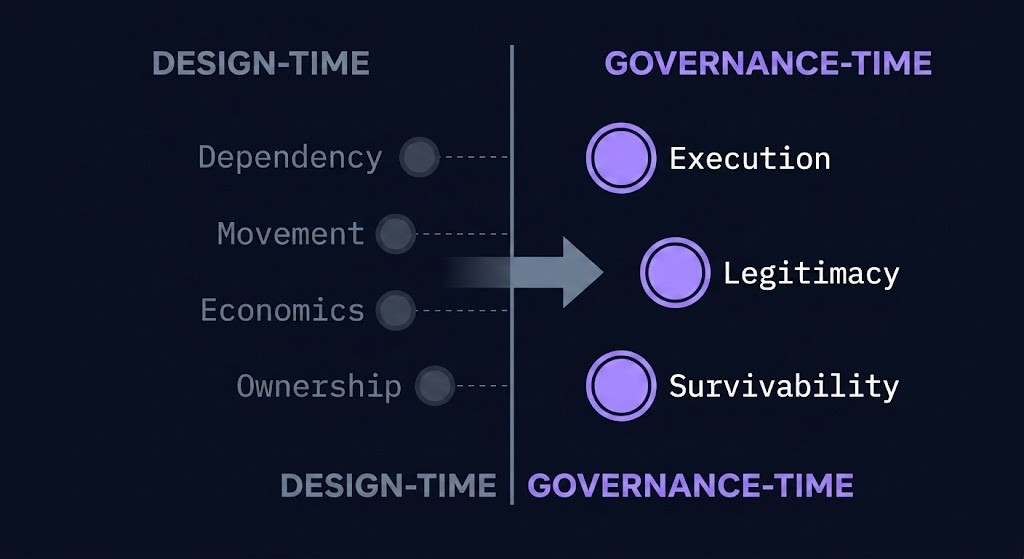
For most of the last decade, the hard cloud architecture decisions lived in a predictable place: dependency mapping, workload movement, cost modeling, ownership boundaries. Where does this system depend on that one. What happens when we move it. What does it cost to run versus to leave. Who owns it once it’s built. These are design-time questions — you answer them once, mostly, at the point where the system takes shape, and the answer holds until the next major redesign.
None of that has gone away. It’s still the entry price for competent cloud architecture, and a team that can’t answer those four questions cleanly has bigger problems than this post is about. But it’s stopped being where the interesting failures happen. The interesting failures — the ones that actually take down a migration, blow up an audit, or turn a clean design into a six-month remediation project — have moved downstream, into a set of questions design-time thinking was never built to answer.
Where the Weight Actually Sits Now
The downstream questions cluster around three things: whether authority defined on paper actually reaches the systems doing the work, whether that authority can be audited and revoked rather than just asserted, and whether the architecture keeps functioning when the authority governing it disappears entirely. Three separate, sequential failure conditions — and Cloud Strategy has spent the last several sessions mapping exactly this territory as Operational Authority Boundary, Governance Legitimacy Boundary, and Authority Survivability Boundary — the CS5, CS6, and CS7 stages of the cloud architecture doctrine, in order.
Treat those three as the evidence, not the argument. Operational Authority Boundary names the gap between authority that’s defined and authority that actually reaches the scheduler, the pipeline, the service mesh policy — the condition where governance looks correct on paper and does nothing at runtime. Governance Legitimacy Boundary goes one layer further: authority can execute and still not be legitimate, if nobody can produce an audit result, a challenge, or a revocation for it — the named failure state there is Governance Theater, compliant-looking and functionally empty. Authority Survivability Boundary asks the question underneath both: what happens when the authority disappears — the IdP goes down, the cloud provider’s control plane has an outage, the platform team dissolves — and whether the architecture keeps running anyway.
| Design-time decision | Governance-time decision |
|---|---|
| Where does this depend | Who can approve a change to it |
| What does moving it cost | Can that approval be audited later |
| Who owns it | Does it survive if the owner disappears |
Three review-board questions, three architecture stages, all downstream of the four that used to matter most. That’s not a coincidence — it’s the actual shape of where cloud governance now sits relative to cloud architecture.
Governance Became The Critical Path. Architecture decisions happen once. Dependency gets mapped, a workload gets placed, an ownership boundary gets drawn — and then the system runs on that decision, mostly unchanged, for years. Governance decisions don’t work that way. Every deployment, every policy change, every access grant is a fresh governance event, evaluated against the authority model in real time. As systems get more distributed — more services, more accounts, more automated pipelines making changes without a human in the loop — the ratio shifts hard: governance events start outnumbering architecture events by orders of magnitude. The system that made ten architecture decisions at design time now generates ten thousand governance decisions a month just running. Why C-Suite Leaders Struggle With AI Consumption Pricing applies this same volume problem to spend specifically — cloud governance decisions and AI consumption costs now compound at the same pace, and almost none of the cost side was ever reviewed. That volume is why governance stopped being the thing that gets checked after architecture and became the thing architecture gets evaluated against.
The Surface Problem Underneath It
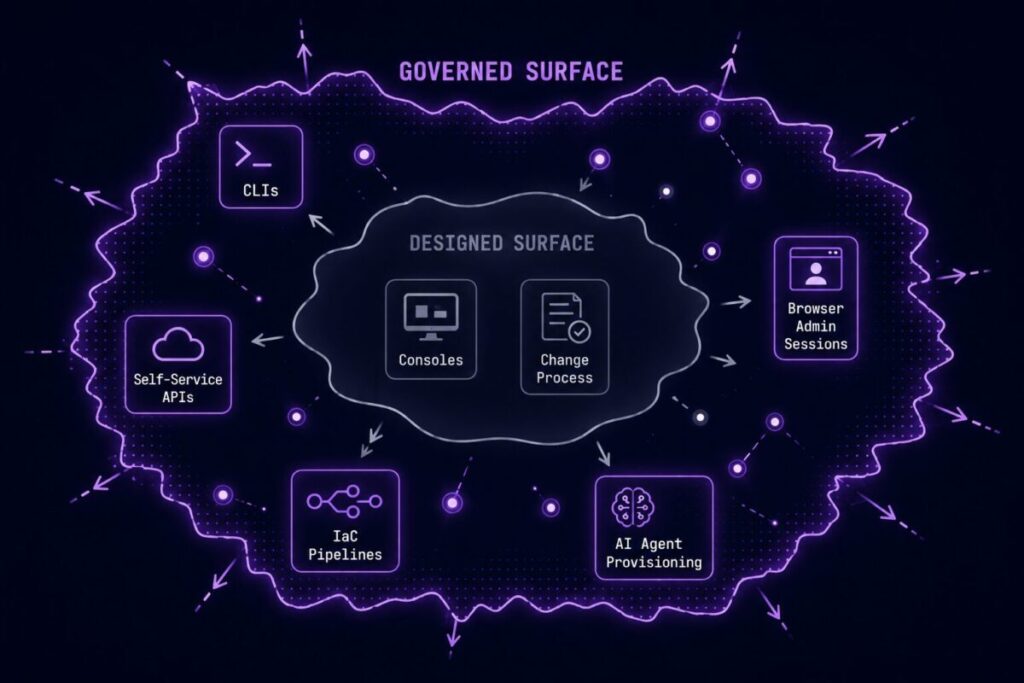
Here’s the mechanism, stated plainly: cloud governance did not replace architecture because governance became more important. Cloud governance replaced architecture because the governed surface expanded faster than the designed surface.
Every console, CLI, API, and browser session through which infrastructure can be changed is part of what has to be governed — call it Governance Surface Area, and it has never shrunk, only grown. A decade ago, the surface an architect had to govern was close to the surface they’d designed: a handful of consoles, a change-management process, a small number of people with keys to the kingdom. That symmetry is gone. Infrastructure-as-code pipelines, self-service platform APIs, AI agents making their own provisioning calls, browser-based admin consoles nobody centrally tracks — each one is a legitimate, sanctioned way to change production, and each one adds to the surface that has to be governed without adding anything to the surface that was actually designed.
That asymmetry is the whole story. When the governed surface grows faster than the designed surface, governance work grows faster than architecture work — not because someone decided governance mattered more, but because there’s simply more of it to do. The Flexera 2026 State of the Cloud Report found Cloud Center of Excellence adoption at 71% and dedicated FinOps teams at 63% this year, both up sharply — organizations aren’t adding cloud governance headcount because they got religion about compliance, they’re adding it because the surface outran what the original architecture team could hold in their heads.
Identity directories sit inside that governed surface too, and they’re a specific instance of the asymmetry this section names: the surface that’s grown fastest is write access — provisioning APIs, policy engines, deployment gates — because that’s the surface governance historically watched. Identity Directories Have Become An Unmonitored Intelligence Source names the piece nobody added to the inventory: bulk read access against the directory itself, expanding at the same pace as everything else on this list, with no governance boundary ever drawn around it.
Part of that expanding surface has already assembled itself into something that governs without anyone designing it to. The Rise of the Cloud Arbitration Layer — Framework #166 — traces the sharpest version of this: FinOps engines, compliance policies, and placement optimizers, each a legitimate piece of the governed surface this section describes, quietly forming an authority tier that decides workload placement before an architect ever reviews the outcome. It’s the same governance-outrunning-design mechanism argued here, just automated instead of organizational.
Why Cloud Governance Doesn’t Travel
Cloud governance built on top of one operating model is not portable to another — call it the Governance Portability Gap — and nowhere is that gap more expensive than in a successful migration.
Take the standard AWS-native governance stack: IAM assumptions baked into every automation script, tagging enforcement wired into CI/CD, Service Control Policies structuring what any given account can even attempt. It works. It’s not fragile within AWS. Then the workload moves — repatriation, a sovereign cloud requirement, a genuine multi-cloud initiative — and the workload itself lands fine. The compute runs. The data replicates. The application passes its smoke tests. And the governance is gone, because none of it was ever a property of the workload. It was a property of the platform underneath it, and the platform didn’t come along for the move.
This is exactly the mechanism behind why the current repatriation wave isn’t a cost story — organizations willing to spend more to preserve control are, in effect, paying to rebuild the governance layer they’re about to lose, not just to relocate compute. The workload migration succeeds. The governance migration is a separate project nobody scoped, and it’s usually the one that actually determines whether the move was worth it.
Cloud and AI Independently Reached the Same Conclusion
If this were purely a cloud-architecture phenomenon, it would be easy to dismiss as pillar-specific noise — a Cloud Strategy problem that happens to be having a moment. It isn’t. AI infrastructure arrived at the identical structural failure from a completely different starting point: Governance Investment Inversion, the pattern of building AI capability faster than the governance required to operate it, inverting the order those investments should have happened in.
Grant Thornton’s 2026 AI Impact Survey of roughly 950 business leaders found that 78% lack full confidence their organization could pass an independent AI governance audit within 90 days — not a hypothetical risk, a majority-case admission that the capability got built first and the governance is still catching up. Cloud teams didn’t get that finding from AI infrastructure and decide to worry about governance surface area. Two pillars, two independent buildouts, two completely different technology stacks, and the same failure signature that cloud governance is already living with: capability outruns the governance meant to control it, every time investment order gets inverted. That’s not a coincidence you can attribute to one bad platform decision. That’s a structural property of how organizations build under time pressure, and it shows up wherever the pattern repeats.
What Changes in How You Build
None of this means throwing out design-time discipline. It means budgeting differently for what happens after design is done.
WHAT ACTUALLY CHANGES
- Review boards need a standing governance-legitimacy question, not just a design-quality one — can this decision be audited later, not just was it a good decision now
- Scoping a migration or a repatriation means scoping the governance rebuild as its own line item, not assuming it travels with the workload
- Staffing shifts from “architects who hand off to governance” toward architects who treat authority survivability as a first-class design input, the way they already treat cost and latency
- Platform teams need a real answer to what happens when the authority governing a system disappears — not a hypothetical, a tested one
⚠ COMMON MISTAKE
Treating governance as a downstream checkbox someone else owns after the design is approved. By the time it surfaces as someone else’s problem, it’s already an incident-time discovery instead of a design-time decision — and incident time is the most expensive place in the entire system to learn that authority doesn’t reach where you assumed it did.
This is also exactly where FinOps has already been quietly moving the goalposts on what gets built in the first place, and where portability claims keep failing their first real exit test — both are the same governance-weight-shift showing up in adjacent problem layers. And it’s the same underlying move behind the industry’s broader shift from optimizing systems to preserving the option to change them — optionality and governance are answering the same underlying question about who gets to decide, later, when the current design stops fitting.
Architecture Still Matters
None of this is an argument that architecture has stopped mattering. It’s an argument that architecture now succeeds or fails on the quality of the governance built around it, rather than on the quality of the design in isolation.
A perfectly dependency-mapped, cost-modeled, cleanly-owned system that can’t prove who’s allowed to change it, can’t survive an audit of that authority, and stops working the moment the authority governing it disappears — that system will fail, and it will fail for governance reasons, regardless of how good the original design was. The architecture didn’t get worse. The bar it has to clear did.
Architect’s Verdict
Cloud governance is replacing cloud architecture in exactly one sense: it’s replacing architecture as the place where the decisions that determine success or failure actually get made. That is the whole claim — cloud governance decides the outcome now, architecture designs the starting condition. Design-time thinking hasn’t gotten worse and it hasn’t become optional — it’s just stopped being sufficient on its own.
What most people miss is that this isn’t a cloud problem with a cloud solution. The same inversion — capability outrunning the governance meant to control it — is showing up independently in AI infrastructure, in repatriation projects, in every system where the governed surface is allowed to grow faster than anyone’s actively governing it. The pattern doesn’t care which pillar it shows up in.
Architecture used to be judged by whether it worked. It’s now judged by whether it can prove, under audit, months after the fact, that it still works the way it was designed to — and whether it keeps working when the authority that built it is no longer in the room.
Additional Resources
View 1 more resource
Editorial Integrity & Security Protocol
This technical deep-dive adheres to the Rack2Cloud Deterministic Integrity Standard. All benchmarks and security audits are derived from zero-trust validation protocols within our isolated lab environments. No vendor influence.

R.M.
Senior Solutions Architect with 25+ years of experience in HCI, cloud strategy, and data resilience. As the lead behind Rack2Cloud, I focus on lab-verified guidance for complex enterprise transitions. View Credentials →
Get the Playbooks Vendors Won’t Publish
Choose the architecture problems you care about. Get field-tested playbooks and frameworks delivered to your inbox.
- > AI Infrastructure & Inference Economics
- > Cloud Strategy & Hidden Cost Models
- > Virtualization & Deterministic Migration
- > Kubernetes, IaC & Modern Infrastructure
- > Data Protection & Recovery Engineering
Zero spam. Includes The Dispatch weekly drop.
Need Architectural Guidance?
Independent review before major infrastructure decisions.
- > Validate assumptions
- > Identify hidden dependencies
- > Quantify migration risk
- > Challenge vendor narratives
Triage · Advisory · Fractional · Direct Hire