

Your Recovery Architecture Has A Bus Factor Problem
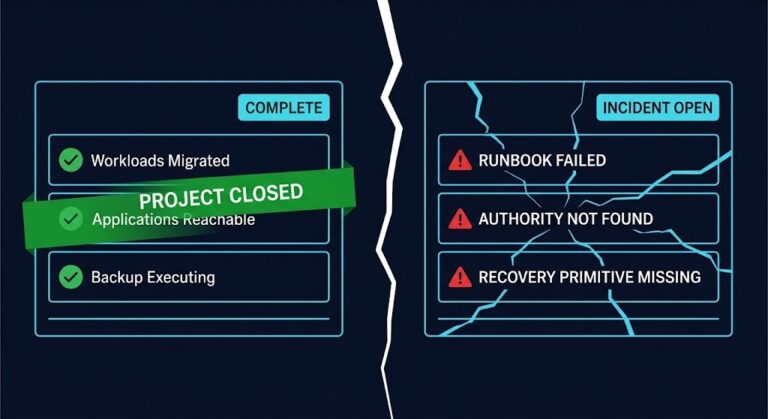
Recovery bus factor is the gap between a recovery plan that has been tested, documented, and signed off — and a recovery plan that can actually be executed when the one or two people who know how to run it aren’t in the room. The recovery program had passed everything that mattered on paper: RTO and RPO both inside target, the runbook current, the authority model clean enough to survive a DRAA-style audit without a single flagged gap. It still would have failed at 2 a.m. on a real incident, because the sequencing exceptions that make the runbook actually work only lived in the heads of two engineers, and neither of them was reachable.
Recovery Authority and Recovery Execution Are Separate Architectural Dependencies
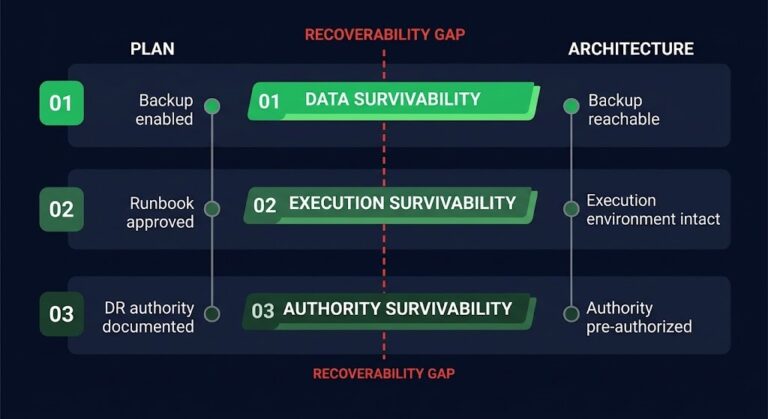
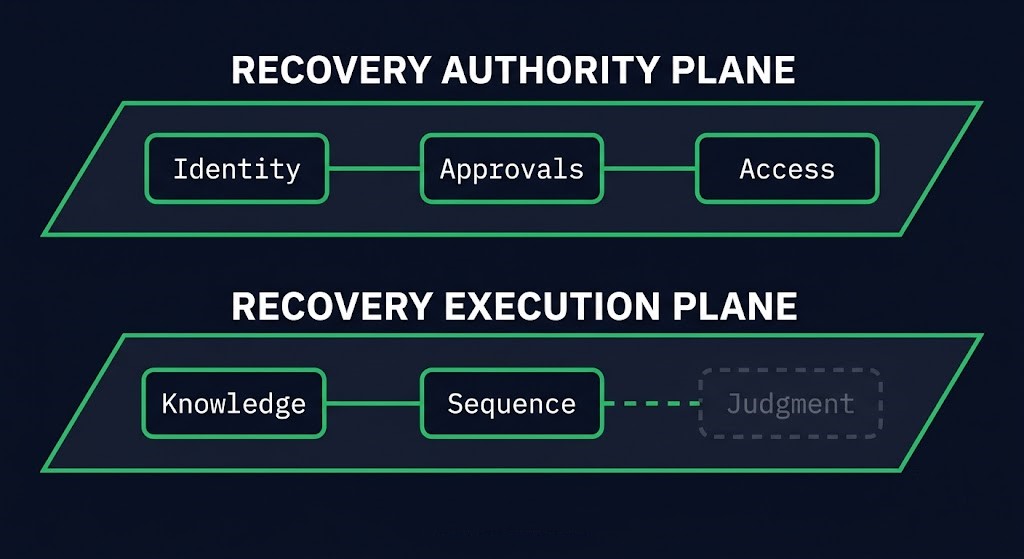
Most recovery programs are built to answer one question: does the right person have standing to approve and execute recovery when the incident hits? That’s an important question, and it’s the one Recovery Authority Fragmentation was built to answer — whether the credentials, approvals, and operational standing required to execute recovery actually survive the same failure conditions that trigger it. A clean answer there means authority holds. It does not mean execution holds.
| Authority | Execution | |
|---|---|---|
| Question | Can someone approve and access recovery? | Can someone successfully perform recovery? |
| Failure | Nobody can authorize | Nobody knows how |
| Architecture domain | Identity / governance | Operational resilience |
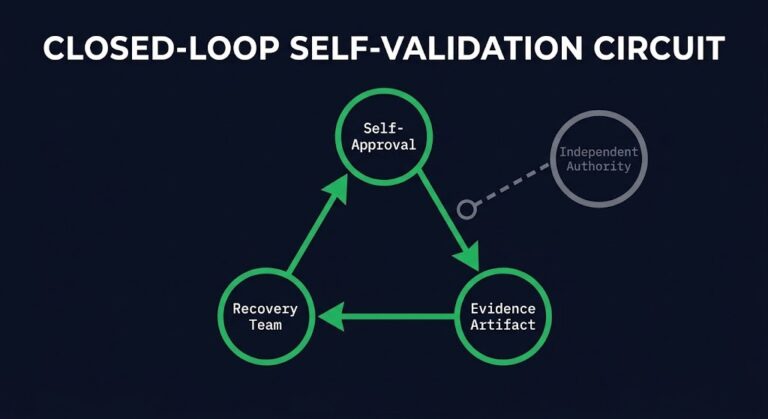
Recovery authority and recovery execution are separate architectural dependencies. An organization can pass every authority check — credentials provisioned, approval chain intact, access surviving the incident — and still fail completely, because the people with standing to execute recovery are not the same as the people who can actually execute it well. That second failure is what this post is about, and it compounds with authority fragmentation rather than duplicating it: an incident that fragments authority and concentrates execution knowledge in the same one or two people is the worst version of both problems arriving together.
A third dependency sits alongside both, and it fails differently again: even a recovery plan with clean authority and available execution expertise can still fail if the boundary it was scoped against was never the service’s real dependency boundary. The System Recovered. Your Recovery Boundary Didn’t. covers that scoping failure directly — the asset comes back, but identity, licensing, or a cloud control plane sitting outside the recovery boundary keeps the service from functioning regardless of who’s in the room.
Recovery platform architecture is the maturity path where this boundary becomes operationalized — the D2 stage of the Data Protection & Resiliency Learning Path is where authority and execution capability both get evaluated against the platform doing the recovering, not just the people around it.
What Recovery Bus Factor Actually Means
Bus factor, borrowed from software engineering, names the number of people who could become unavailable before a project stalls entirely. Applied to recovery architecture, the recovery bus factor is the number of people who could be unreachable, terminated, or simply on vacation before a documented, tested, authority-clean recovery plan stops being executable. Most organizations have never measured it, because nothing in a standard DR audit asks the question. RTO and RPO measure the plan. Authority reviews measure standing. Nothing measures whether the plan survives the absence of its most experienced operator.
Recovery Bus Factor Is Not A Staffing Ratio
A 500-person infrastructure organization can still have a recovery bus factor of one. Headcount and redundancy are not the same measurement, and conflating them is the single most common reason this problem goes undetected. Picture an enterprise with 200 infrastructure engineers, 20 security engineers, and 10 platform engineers on staff — a well-resourced organization by any reasonable standard. Inside that organization, only one person understands the actual restore dependency order for the ERP environment. Only one person knows which automation steps are safe to skip under time pressure and which ones will silently corrupt state if skipped. Only one person has the vendor escalation contact who picks up the phone at 3 a.m. The organization has staffing. It does not have recovery redundancy.
Recovery bus factor is not reduced by adding more people to an organization; it is reduced by removing the dependency between recovery success and specific individuals.
This is the disaster-recovery-specific instance of a broader pattern — The Infrastructure Team Is the Real Single Point of Failure names the same concentration risk across the full operational authority surface: credentials, network topology, vendor relationships, exception context. Recovery bus factor narrows that argument to one domain — DR and restore execution specifically — where the concentration risk is sharpest because it surfaces exactly when the rest of the organization is already degraded.
DIAGNOSTIC QUESTION
“If your two most senior recovery engineers were both unreachable right now, would this incident resolve in hours, or days?”
The Documentation Trap: Why Runbooks Don’t Fix This
The instinctive fix is to write it down. Most recovery programs already have — a current runbook, reviewed on schedule, sitting in the same repository as the DR plan it supports. Documentation and executability are not the same property. A runbook captures the steps someone remembers to write down. It does not capture the judgment calls made in real time: which alert to ignore, which dependency to check first, which “obviously fine” system state is actually a warning sign specific to this environment. We thought the runbook solved this. It didn’t — because a written procedure and a practiced one produce identical audit results and completely different incident outcomes.
The same gap shows up from the testing side, not just the documentation side: restore testing that only validates the procedure will pass cleanly even when the organization running it has a bus factor of one, because the person running the test is usually the same person who wrote it.
Where Recovery Capability Becomes Concentrated
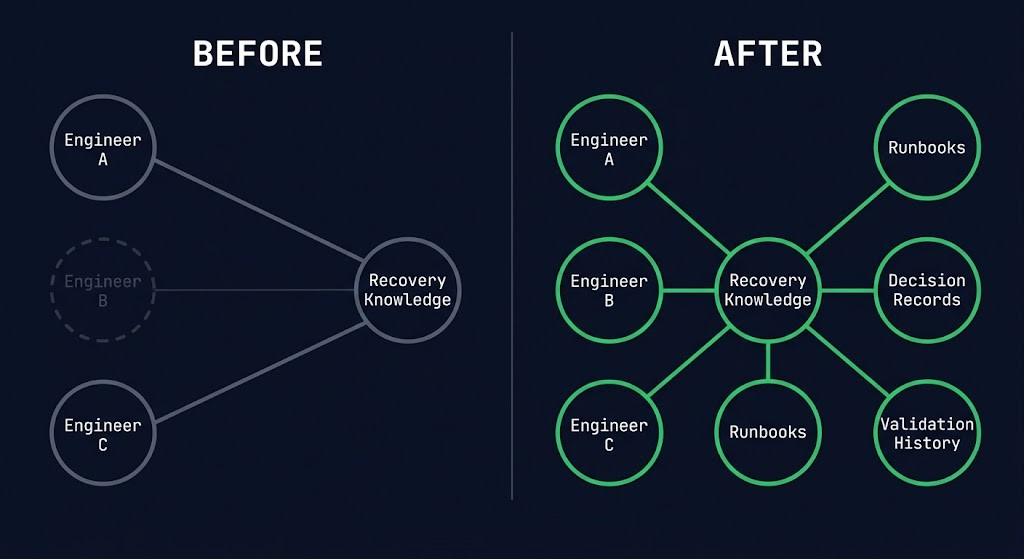
Recovery capability doesn’t concentrate because anyone decided it should. It drifts there, one convenient shortcut at a time, until nobody notices the architecture has a single point of failure that was never on any diagram.
WHERE IT CONCENTRATES
- Undocumented restore sequencing exceptions that only get applied by the person who’s hit them before
- Vendor escalation paths that live in one person’s contacts, not in the runbook
- Tacit knowledge of which automation steps are safe to skip under time pressure and which aren’t
- Informal dependency knowledge — what actually depends on what — that never made it into the CMDB
- Single-operator familiarity with a legacy recovery tool nobody else has touched in two years
Each of these looks like a minor efficiency in normal operations. Under incident pressure, each one is a single point of failure that a clean authority model does nothing to catch, because Recovery Authority Fragmentation was never designed to test for it — it tests whether the right people can get in, not whether the people who get in know what to do once they’re there. The same undesigned-space problem shows up one layer over in Restore Design Gap: recovery programs that fully design data recovery and simply assume the rest — platform, identity, dependency, and validation recovery all inherit whatever knowledge happens to be standing when the incident hits.
Measuring Recovery Capability Before the Incident Finds It For You
Recovery bus factor is measurable before it becomes a postmortem finding. Start with a rotation audit: pull the last six months of actual recovery executions — real incidents and scheduled tests alike — and count how many distinct people ran them. A number at or near one is the finding, regardless of how many people are on the DR distribution list. Pair that with a decision-log review: does the runbook’s written procedure match what the operator actually did, step for step, or did they deviate from memory in ways nobody captured afterward? Deviations are where the real expertise lives, and they’re exactly what doesn’t survive when that operator isn’t available.
The distance between a plan that’s been validated and a plan that’s been validated against adversarial, non-cooperative conditions is the same distance Recoverability Gap measures on the platform-and-identity side — recovery capability concentration is the personnel-side expression of the same underlying problem: a plan that works when everything, including the person running it, behaves the way it did in the last successful test.
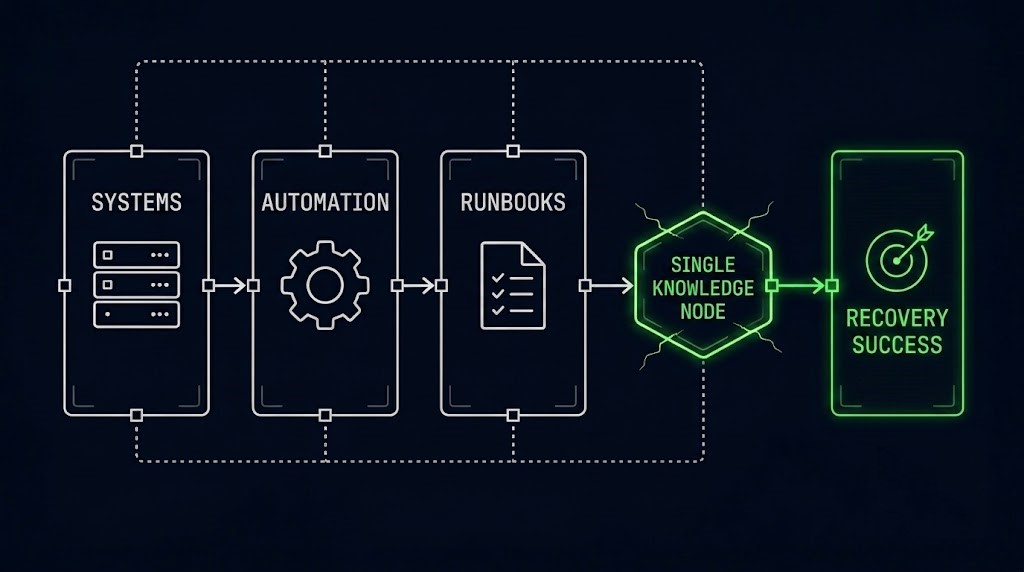
Recovery readiness reviews rarely test for this directly, which is exactly why it survives audit after audit.
Architect’s Verdict
Recovery architecture that depends on two specific people surviving an incident is not recovery architecture. It’s a documented hope, wearing the paperwork of a real plan.
The industry has spent a decade building authority models, immutability layers, and ransomware-survivability scoring — all necessary, none of it sufficient — while treating recovery execution as something that simply happens once the right person logs in. It doesn’t. Some recovery plans go a step further and quietly depend on a criminal counterparty’s cooperation if execution knowledge and everything else fails — the same undesigned-dependency shape as a bus factor of one, aimed at a party the organization has even less standing to rely on. Recovery capability is embodied knowledge until someone deliberately architects it out of specific individuals and into the system itself: captured decisions, cross-trained operators, runbooks that record judgment calls instead of just steps. Recovery capability must exist independently of the individuals who currently hold it, or the plan only works on the one incident where they show up.
The next incident doesn’t check who’s on call before it decides who’s needed.
Additional Resources
View 2 more resources
Editorial Integrity & Security Protocol
This technical deep-dive adheres to the Rack2Cloud Deterministic Integrity Standard. All benchmarks and security audits are derived from zero-trust validation protocols within our isolated lab environments. No vendor influence.

R.M.
Senior Solutions Architect with 25+ years of experience in HCI, cloud strategy, and data resilience. As the lead behind Rack2Cloud, I focus on lab-verified guidance for complex enterprise transitions. View Credentials →
Get the Playbooks Vendors Won’t Publish
Field-tested blueprints for migration, HCI, sovereign infrastructure, and AI architecture. Real failure-mode analysis. No marketing filler. Delivered weekly.
Select your infrastructure paths. Receive field-tested blueprints direct to your inbox.
- > Virtualization & Migration Physics
- > Cloud Strategy & Egress Math
- > Data Protection & RTO Reality
- > AI Infrastructure & GPU Fabric
Zero spam. Includes The Dispatch weekly drop.
Architecture Audit Services
Fixed-scope audits for Zero-Trust Azure, VMware migration readiness, and recovery posture — no discovery call required to start.
>_ View Audit Services>_Related Posts
Your VMware Exit Was Successful. The First Incident Will Tell You If That’s True.
VMware exit survivability is the question your migration project never formally scheduled — and the first production incident on the new platform will answer it whether you are ready or not. The cutover completed. The workloads are running. The project closed green. None of that tells you whether the operating model, runbooks, authority structures, and…
Your Recovery Program Has a Recovery Evidence Boundary
Recovery evidence boundary is the point where a recovery program stops being an engineering question and starts being a governance one — and most organizations cross it without ever finding out, because everything on the way there still looks like success. The backups completed. The DR test passed. The tabletop went well. Somebody wrote a…
Your Ransomware Recovery Plan Has a Recoverability Gap
The recoverability gap is the structural distance between what your recovery plan assumes and what your infrastructure can actually deliver under failure conditions. Most organizations don’t discover it during planning. They discover it on day three of an incident. >_ Architect’s Brief 60-second read before you commit to the full post · Full post: 13…
Your Ransomware Plan Is Fiction: 5 Recovery Metrics Nutanix, Cohesity, Rubrik & Pure Can’t Hide
Ransomware recovery metrics are the only thing standing between your recovery plan and a PowerPoint. Every vendor demo shows a single VM booting in 60 seconds. Every real ransomware recovery looks like this: the backups are intact, the ransomware is neutralized, the executives are on the bridge — and nothing is coming back online. >_…
Your Migration Succeeded. The Identity Chain Didn’t.
Identity chain continuity is the thing every migration runbook assumes and almost none of them prove. A migration dashboard can go fully green — compute online, storage attached, network reachable — while the identity chain underneath it is already broken, and nothing in that dashboard will tell you. >_ Architect’s Brief 60-second read before you…
Your Logs Are Not Evidence If The Infrastructure That Produces Them Can Rewrite The Record
The evidence layer is not a byproduct of your infrastructure — it is infrastructure, and on August 30, Sygnia documented what happens when the evidence layer is captured along with everything else. Fire Ant, a China-nexus threat actor Sygnia has tracked since 2025, spent this year moving past the VMware hypervisors it was previously known…