

The SaaS Control Plane Problem
Most organizations do not have a SaaS governance problem. They have a SaaS authority problem — and the distinction matters because governance problems have vendors selling solutions to them. Authority problems do not surface until an audit, a contract renewal, or an incident reveals that a set of workflow tools your infrastructure team approved individually are now collectively making infrastructure decisions nobody explicitly authorized them to make.
Operational authority moves to a new layer before the organization decides who owns it. In the previous parts of this series, that layer was the CI/CD pipeline, the cloud console, the cost governance platform, and the AI inference runtime. The current layer is SaaS — and the accumulation pattern is faster, harder to see, and embedded in contracts rather than configuration.
THE AUTHORITY LAYER
The Integration That Runs Your Infrastructure
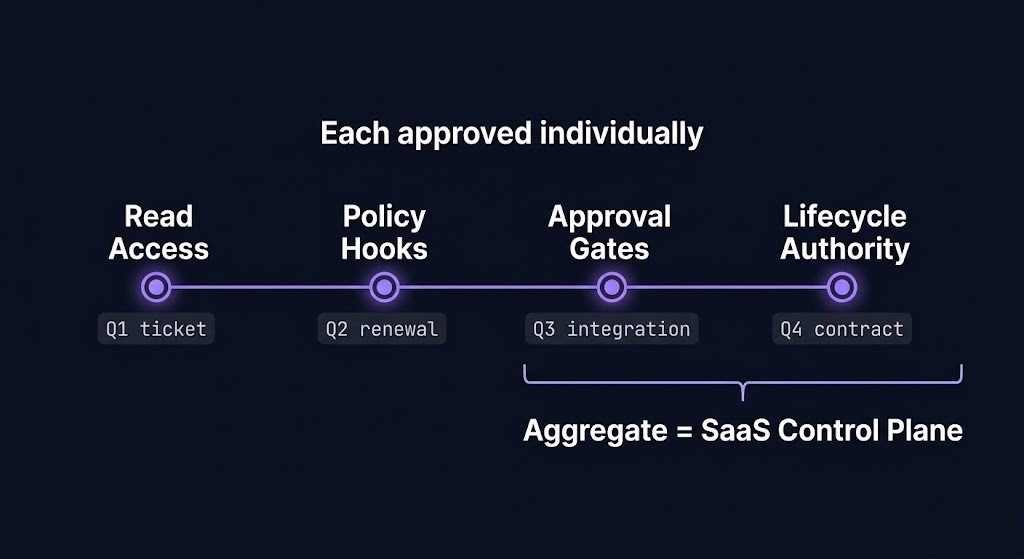
The entry point is never a strategic decision. It is a specific pattern repeated across quarters and teams: one integration to pull cloud spend data into a FinOps dashboard, one to route change approval requests through a workflow tool, one to enforce resource tagging policy via an external platform, one to synchronize identity provisioning with the HR system. Each request is evaluated independently. Each one is approved because it solves a real operational problem. No single integration is the SaaS control plane.
The aggregate is.
By the time the pattern becomes visible, the SaaS stack has accumulated authority over infrastructure deployment approvals, cost control gates, identity provisioning, policy enforcement, and change management — all without a single architecture review that treated the combination as a control plane decision. The infrastructure control plane consolidation pattern describes how vendors accumulate authority at the platform layer. The SaaS coordination layer does the same thing one service desk ticket at a time. The enterprise browser is running the identical accumulation pattern at the access layer — a rendering surface absorbing conditional access, session isolation, and DLP enforcement that used to live in dedicated infrastructure, with no equivalent architecture review ever convened.
Infrastructure Teams Outsourced Coordination
Understanding why this happened requires going back one step. Infrastructure teams used to coordinate decisions internally. Change Advisory Boards reviewed deployment requests. Architecture review boards evaluated new integrations. Manual provisioning workflows enforced sequencing. Ticket queues captured approvals. The process was slow, inconsistent, and entirely team-owned — but the authority remained inside the infrastructure boundary.
SaaS products solved the coordination problem. Workflow engines replaced CAB processes. Approval routing platforms replaced email chains. Automation triggers replaced manual provisioning queues. Policy enforcement tools replaced manual tagging reviews. Identity synchronization platforms replaced helpdesk provisioning tickets. The efficiency gain was real and measurable. The authority transfer was invisible and unmeasured.
Over time the coordination layer became the authority layer. Nobody decided this would happen. The shift occurred because each SaaS adoption improved operations — and operational improvement is the only metric that coordination decisions were being evaluated against. That is the bridge between “we adopted SaaS for workflow efficiency” and “SaaS now governs infrastructure decisions.”
THE COORDINATION-TO-AUTHORITY SHIFT
- CAB approvals → workflow engine routes the request and enforces the gate
- Architecture review boards → policy platform evaluates compliance automatically
- Manual provisioning workflows → identity synchronization platform owns the provisioning event
- Email approval chains → spend governance platform holds the authorization key
- Ticket queue sequencing → automation trigger determines what fires and when
The pattern is identical to what the console accumulated when the governed change management path was too slow, and what the platform team accumulated when cloud cost optimization migrated authority to finance. Different technology. Same failure mode.
How SaaS Platforms Accumulate Authority
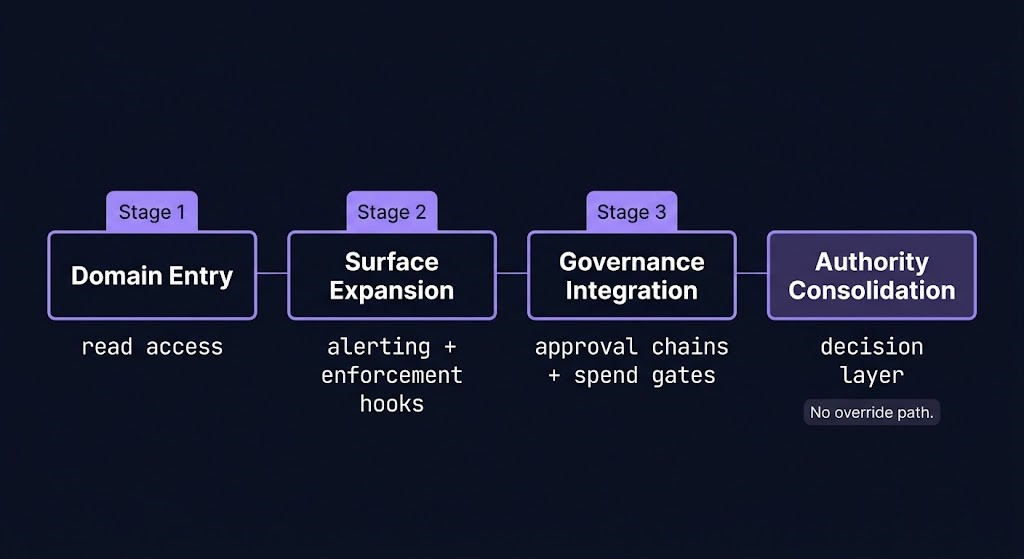
The infrastructure control plane consolidation post introduced Control Plane Capture (#115) — the four-stage progression by which a domain-specific platform expands into governance authority. Applied to the SaaS coordination layer, the stages are recognizable.
01 — DOMAIN ENTRY
Read access and dashboards. The platform pulls data — cloud spend, infrastructure inventory, change logs. It observes but does not act. The integration is low-risk. The approval is straightforward.
02 — SURFACE EXPANSION
Alerting, policy enforcement hooks, and automation triggers are enabled. The platform can now act on what it observes — flagging violations, triggering remediation workflows, blocking non-compliant requests. The change feels incremental. The authority shift is not.
03 — GOVERNANCE INTEGRATION
Approval chains, spend gates, and identity routing run through the platform. Infrastructure changes require the platform’s sign-off. Cost exceptions route through its workflow. Identity events are provisioned on its schedule. The platform is now in the critical path for infrastructure decisions.
04 — AUTHORITY CONSOLIDATION
The platform is the decision layer. The infrastructure team routes through it, not around it. Bypassing the platform requires either a policy exception or a manual override that itself requires approval. No single architectural grant gave the platform this authority. Renewal cycles, integration requests, and service desk tickets did.
The critical observation is where the authority accumulation happens: not in architecture reviews, not in procurement evaluations, not in infrastructure change management — in renewal cycles, integration requests, and service desk tickets. The same channels that approved the original read-only integration approved each subsequent expansion. No single approval granted control plane authority. The aggregate did. When a SaaS platform reaches Stage 04 — Authority Consolidation — the movement implications compound: identity systems governing approval chains and deployment authorization create Authority Friction that must be re-architected before any provider exit is viable. That classification belongs to Movement Architecture, the Operational stage of the Cloud Strategy Architecture Learning Path.
The same endpoint can also be reached in one step instead of many. BYOC Isn’t a Deployment Decision. It’s a Control-Plane Delegation Nobody Scoped. reads the install-time grant in the Redpanda, Databricks and Aiven bring-your-own-cloud offerings, where the vendor control plane receives its authority at deployment rather than through renewals and tickets. In the offerings reviewed, how wide that grant is comes down to the variant chosen at install. Both routes end with a vendor-side system acting inside the estate. Only the install-time route has a single moment at which the scope could have been read.
The Authority Nobody Audited
The test is specific: audit what decisions your SaaS stack makes that your infrastructure team cannot override without a vendor call, a policy exception, or a contract negotiation. Not what the platform could override — what it currently overrides as part of normal operations.
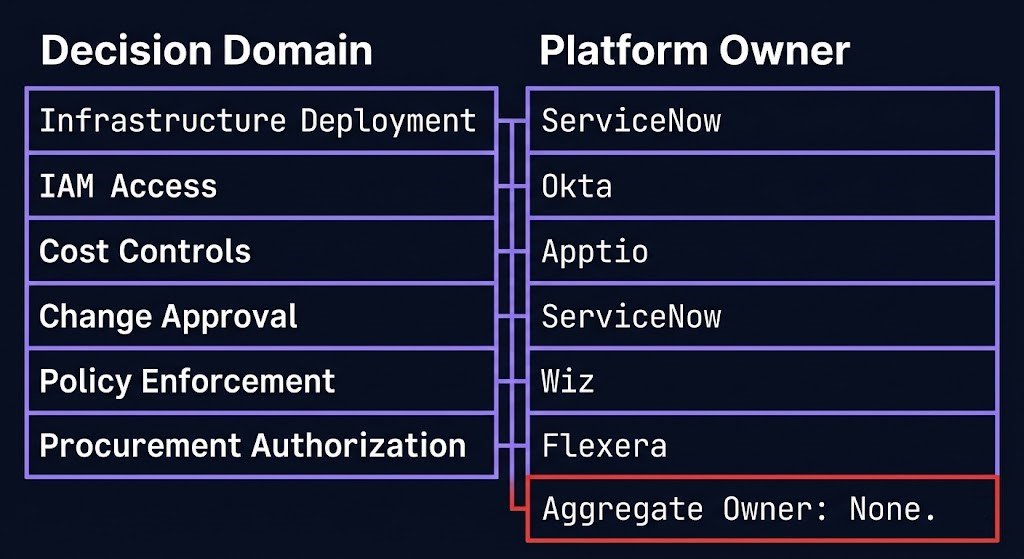
The decision domain table makes the scope concrete:
| Decision Type | Typical Owner | How SaaS Acquires Authority |
|---|---|---|
| Infrastructure deployment | Platform team | Change approval workflow gates the deployment trigger |
| IAM access | Security | Identity synchronization platform owns the provisioning event |
| Cost controls | FinOps | Spend governance platform holds the authorization key for exceptions |
| Change approval | Operations | Workflow engine routes the request and enforces the gate |
| Policy enforcement | Governance | Compliance platform evaluates and blocks non-compliant resources |
| Procurement authorization | Finance / Platform | ITAM / FinOps platform controls resource lifecycle and capacity authorization |
A single enterprise SaaS stack commonly touches all six decision domains simultaneously — not through a single platform, but through a set of platforms whose authority domains overlap at the infrastructure layer. ServiceNow routes the change. Apptio gates the spend. Okta provisions the identity. Wiz enforces the policy. Each platform was procured to solve a specific operational problem. Together they form a distributed control plane over infrastructure decisions that no architecture review was ever asked to evaluate as a unit.
This is governance surface exactly as tool sprawl’s cost model defines it — a new place credentials live, a new system that has to be included in the next compliance review — except here it’s compounding through vendor contracts and integration requests instead of a procurement invoice. The mechanism is identical: no single tool adoption looks like a governance decision, and the aggregate becomes one anyway.
That is the condition this series names: SaaS Authority Fragmentation — the condition where operational authority is distributed across multiple SaaS platforms, each governing a portion of infrastructure behavior, with no single architectural owner responsible for the aggregate authority model.
NAMED FAILURE STATE: SAAS AUTHORITY FRAGMENTATION
“The condition where operational authority is distributed across multiple SaaS platforms, each governing a portion of infrastructure behavior, with no single architectural owner responsible for the aggregate authority model.”
SaaS Authority Fragmentation is the SaaS-layer equivalent of the Shadow Control Plane, the Runtime Authority Vacuum, and the Governance Investment Inversion from earlier parts of this series. Different technology surface. Same structural failure: partial ownership of a governance domain, distributed across multiple vendors, with no defined escalation path when the aggregate authority model produces a conflict.
It’s worth naming the inverse case rather than folding it into the same list: SaaS Authority Fragmentation is many owners with no aggregation. VMware Private AI Cloud Doesn’t Eliminate Fragmented Control Planes — It Creates an Authority Relay covers the opposite shape — one apparent owner, VCF Operations, coordinating every domain through a single console — that turns out not to hold adjudicating authority over any of them once they disagree. Same absence of a real accountable owner. Opposite presentation.
What the Consolidation Actually Looks Like
The signals are operational, not architectural. They surface in the specific moments when the infrastructure team tries to act and discovers that the decision requires a vendor platform to authorize it first.
Change approval has migrated when a deployment cannot proceed until a ServiceNow ticket clears a workflow stage that the infrastructure team does not control. The gate is reasonable in isolation. The problem is that the infrastructure team’s ability to act under incident conditions now depends on a SaaS workflow platform’s availability and configuration.
Spend governance has migrated when a capacity exception requires Apptio or CloudHealth to generate an authorization token before the platform team can provision additional resources. FinOps tooling determining resource lifecycle and capacity authorization is the spend governance equivalent of the platform team becoming a finance team. The ITAM and FinOps platforms — Apptio, Flexera, ServiceNow ITAM, CloudHealth — commonly hold procurement authority over spending approvals, resource lifecycle, and capacity authorization in environments where FinOps has matured into a gating function rather than an advisory one.
Identity decisions have migrated when Okta or a similar platform’s provisioning delay becomes the critical path for access to production infrastructure. The identity synchronization platform owns the provisioning event — which means it owns the latency, the failure modes, and the recovery path for access under incident conditions.
That provisioning authority cuts a second way this series hasn’t named yet: identity synchronization platforms don’t just gate who gets access — they typically hold standing read access to the entire tenant directory to do that job. Identity Directories Have Become An Unmonitored Intelligence Source names the risk on that side: the same platform trusted by design for provisioning is exactly the account whose bulk reads nobody rate-limits or scores against a baseline, because the trust that got it consolidated in the first place is also what keeps its read volume unaudited.
Policy enforcement has migrated when a Wiz or Prisma Cloud finding blocks a deployment that the infrastructure team has reviewed and approved. The policy platform’s authority to block supersedes the infrastructure team’s authority to ship. That inversion is intentional when the policy is correct. It is an authority problem when the policy platform’s taxonomy is updated by the vendor without a corresponding review by the infrastructure team.
⚠ AUTHORITY FRAGMENTATION SIGNAL
When your infrastructure team needs to call a vendor to resolve an infrastructure decision under incident conditions, the authority model has already fragmented. The vendor platform owns the gate. Your team owns the accountability without the authority to match it.
Recovering Operational Authority
The recovery path is not SaaS elimination. Most of the platforms holding authority in the scenarios above are genuinely useful — the coordination problems they solved were real. The question is whether the authority structure is intentional or accidental, and whether the infrastructure team can articulate the answer.
Operational authority moves to a new layer before the organization decides who owns it. Recovering it requires naming that layer, auditing what it governs, and assigning an owner to the aggregate model — not to each platform individually. Three specific actions advance that audit:
01 — MAP THE OVERRIDE BOUNDARY
For each SaaS platform that gates an infrastructure decision, document: what decisions it can block, what the override path is, and who owns the override authority. If the override requires a vendor call or a contract negotiation, the authority has left the building. Document it as an explicit dependency, not as a normal operational condition.
02 — AUDIT VENDOR-MUTABLE AUTHORITY
Identify which platform behaviors change when the vendor updates their product — taxonomy updates in policy platforms, workflow logic changes in approval engines, provisioning rule changes in identity platforms. Any authority that the vendor can change without triggering your change management process is vendor-held authority. Name it as such.
03 — ASSIGN AN AGGREGATE OWNER
The Authority Layer architecture requires every governance layer to have a named owner and a defined escalation path. SaaS platforms that hold control plane authority need to be in that map — not as individual platform owners, but as components of an aggregate authority model that has a single accountable team. If no team can answer the question “who owns the SaaS control plane?”, SaaS Authority Fragmentation is already the operational condition.
Assigning an aggregate owner is a governance-architecture decision, not a SaaS-procurement one. Strategic Governance is where that ownership model gets formalized — the accountable party for the combination, not any single platform in it.
DIAGNOSTIC QUESTION
“Which team in your organization is accountable for the aggregate authority model of your SaaS governance stack — not which team owns each platform, but who is responsible for the decisions the combination makes?”
The private cloud operating model built governance architecture before infrastructure deployment because governance retrofitted after the fact is negotiation, not design. The same principle applies here: the SaaS authority model needs to be mapped before the next renewal cycle embeds another governance dependency.
SERIES: THE AUTHORITY LAYER
Next → COMING SOON
Operational Memory Is InfrastructureArchitect’s Verdict
SaaS platforms don’t become control planes because anyone designed them that way. They become control planes because organizations continuously delegate decisions without mapping the authority that moved with them. The result isn’t loss of infrastructure ownership. It’s loss of visibility into who is making infrastructure decisions — and by the time that authority is visible, it is usually embedded in contracts, workflows, and integrations that are far harder to unwind than the technology itself.
This is not a new pattern. The CI/CD pipeline became the real infrastructure control plane because it was where deployment authority lived. The console became the shadow control plane because the governed path was too slow. The platform team became a finance team because cost governance authority migrated to whoever could measure it. AI infrastructure is solving the wrong problem because governance authority was never part of the infrastructure scope. Part 7 of this series is not a new problem. It is the same failure mode at a new layer — the SaaS coordination stack that replaced internal process with external authority.
Operational authority moves to a new layer before the organization decides who owns it. The question is not whether your SaaS stack is operationally effective. The question is whether anyone owns the decisions it is making collectively — and whether that ownership is documented anywhere other than the vendor contracts that define what each platform is allowed to do.
Additional Resources
View 5 more resources
Editorial Integrity & Security Protocol
This technical deep-dive adheres to the Rack2Cloud Deterministic Integrity Standard. All benchmarks and security audits are derived from zero-trust validation protocols within our isolated lab environments. No vendor influence.

R.M.
Senior Solutions Architect with 25+ years of experience in HCI, cloud strategy, and data resilience. As the lead behind Rack2Cloud, I focus on lab-verified guidance for complex enterprise transitions. View Credentials →
Get the Playbooks Vendors Won’t Publish
Choose the architecture problems you care about. Get field-tested playbooks and frameworks delivered to your inbox.
- > AI Infrastructure & Inference Economics
- > Cloud Strategy & Hidden Cost Models
- > Virtualization & Deterministic Migration
- > Kubernetes, IaC & Modern Infrastructure
- > Data Protection & Recovery Engineering
Zero spam. Includes The Dispatch weekly drop.
Need Architectural Guidance?
Independent review before major infrastructure decisions.
- > Validate assumptions
- > Identify hidden dependencies
- > Quantify migration risk
- > Challenge vendor narratives
Triage · Advisory · Fractional · Direct Hire