

Your Recovery Program Has a Recovery Evidence Boundary
Recovery evidence boundary is the point where a recovery program stops being an engineering question and starts being a governance one — and most organizations cross it without ever finding out, because everything on the way there still looks like success. The backups completed. The DR test passed. The tabletop went well. Somebody wrote a report. None of that proves what the organization thinks it proves.
The Six Questions Recovery Maturity Actually Asks
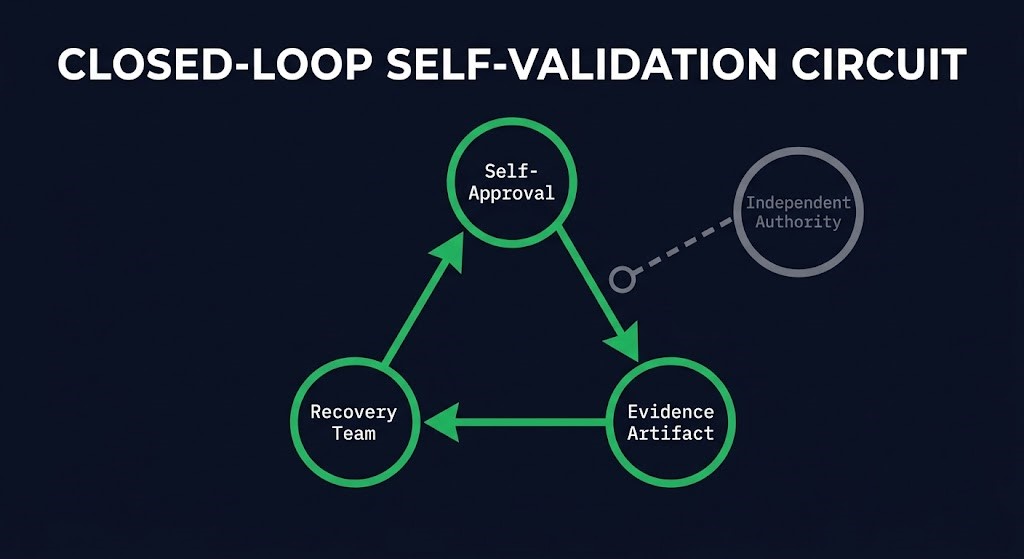
The Data Protection & Resiliency Learning Path is built as a progression, and every stage in it answers a different question about whether recovery works. The first five stages all ask some version of “can the system survive”:
| Stage | Question |
|---|---|
| Stage 1 | Can recovery be designed? |
| Stage 2 | Can recovery be executed? |
| Stage 3 | Can recovery survive compromise? |
| Stage 4 | Can recovery survive attack? |
| Stage 5 | Can continuity survive failure? |
| Stage 6 | Can recovery claims be independently proven? |
The first five are engineering questions, and the site has spent five stages building the case for each one — from recovery design boundary at the foundation, through recoverability under ransomware, to whether the business actually resumes operating once the technical failover succeeds. The sixth stage isn’t a sixth engineering question. It’s the first one that isn’t about the system at all. It’s about whether anyone besides the team that built the system is in a position to believe it.
Stage 1’s design question has a live example worth naming here, because it shows how quietly a dependency decision can bypass every stage that comes after it. Cloud-Based Recovery Didn’t Eliminate USB Drives. It Eliminated Recovery Independence. covers a recovery mechanism inheriting a vendor dependency through a default OS setting rather than a design decision — no evidence question can be asked about a dependency nobody at the organization ever reviewed in the first place.
That’s the recovery evidence boundary: the line at which recovery evidence exists, but nobody structurally independent from the team that produced it has the standing to reject the conclusion it draws.
The Recovery Evidence Boundary: Independent Validation Authority
Here’s the sharper version of the problem, because “evidence doesn’t exist” is too easy for a mature recovery program to argue against. Most organizations at this maturity level can produce plenty of evidence — backup completion reports, DR test results, compliance attestations, tabletop exercise summaries. The artifacts are real. The problem was never their existence.
The problem is who’s allowed to challenge them.
Recovery evidence can exist without recovery claims being independently validated. That’s the actual boundary condition, and it’s an authority question, not a documentation question: the organization has no independent authority that validates recovery claims. Not “no authority capable of validating them well” — no authority positioned to validate them at all. The distinction matters because it keeps the argument architectural rather than a maturity judgment about how good the reviewer is.
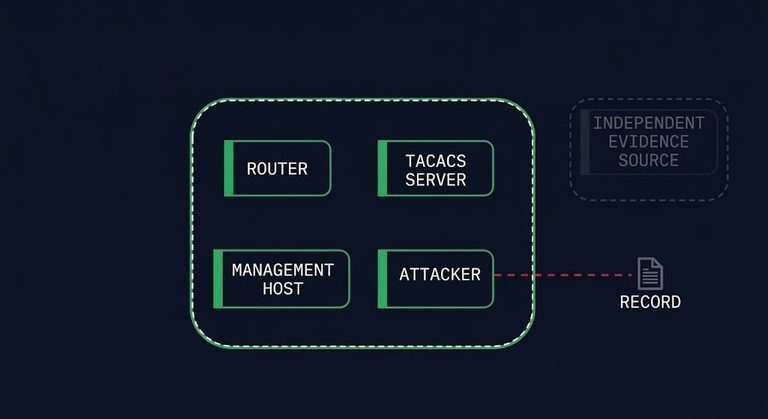
ISO 22301’s own definition of an audit draws exactly this line, and it’s worth sitting with for a moment. The standard distinguishes a first-party audit — an organization reviewing itself — from a second- or third-party audit conducted by someone with no responsibility for the thing being reviewed. Independence, in the standard’s own terms, is freedom from responsibility for the activity being audited. A recovery program can produce audit-grade documentation and still never cross that line, because the artifact and the reviewer are the same entity wearing two hats.
This isn’t unique to recovery. The same principle shows up in AI infrastructure evidence architecture: a platform that must exist in order to verify its own evidence hasn’t actually produced evidence — it’s produced an assertion the platform is willing to make about itself. Recovery evidence boundary is that same architectural condition, expressed in the recovery domain instead of the observability layer. Different pillar, identical failure geometry. Retention conflict architecture extends the same standard prospectively — asking whether a retention-precedence decision needs an independent authority before it’s acted on, rather than whether a recovery claim needed one after the fact.
The same architectural condition governs claims made to a party entirely outside the organization, not just an internal reviewer. Vendor Relationships End. Audit Rights Often Don’t. covers the case where the validating authority isn’t a compliance function the organization chose to empower — it’s a vendor’s legal team, holding contractual standing to reject an exit claim regardless of how internally confident that claim was. Self-validation fails the same way in both cases: the recovery team declaring its own test successful and the infrastructure team declaring its own migration complete are the identical structural error, just with a different party positioned to say “prove it.”
Distinguishing this from adjacent frameworks matters here, because it’s easy to collapse the recovery evidence boundary into problems the site has already named. Infrastructure Evidence Gap asks whether an infrastructure change’s actual execution matches its approved intent — a chain-of-custody problem, scoped to individual changes, living in the Modern Infrastructure & IaC pillar. Recovery evidence boundary asks something broader and one layer up: whether recovery claims — reports, test results, attestations, any of them — have an independent validator at all. One is about whether the record matches reality. The other is about whether anyone but the record-keeper is allowed to check.
The closest sibling in the archive is restore evidence, which named the artifact problem directly — a DR program without proof that a restore actually happened. Recovery evidence boundary is the governance layer above that: even where the artifact exists, cleanly, the question of who’s allowed to dispute it is usually still unanswered.
Self-Validation: The Mechanism That Creates Evidence Theater
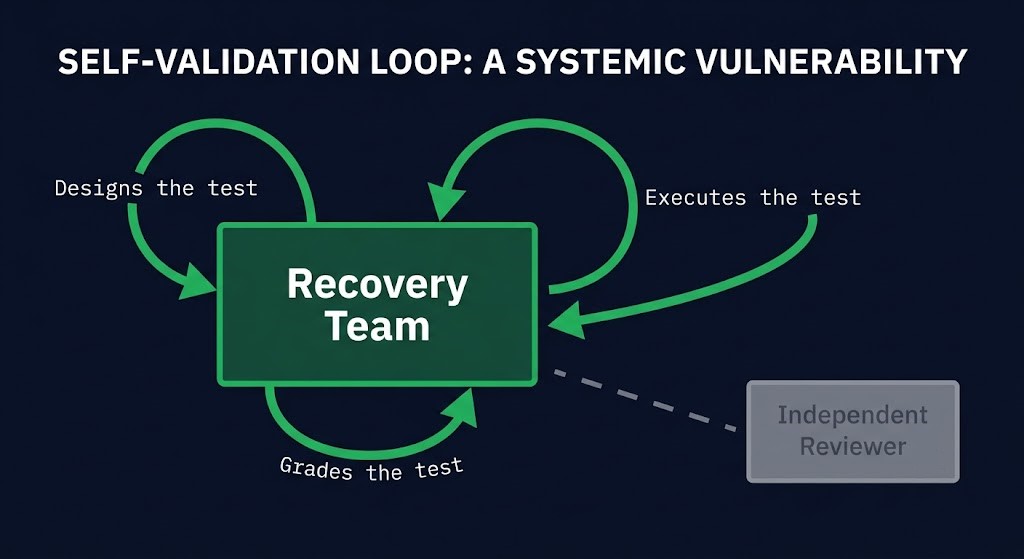
The mechanism behind almost every example above is the same pattern, and it’s worth naming directly instead of leaving it implicit: self-validation. The team that ran the DR test writes the report on whether the DR test succeeded. The platform owner approves their own resilience claim. The recovery team declares success with nobody in the room whose job is to say otherwise.
Why Most Disaster Recovery Tests Don’t Test Recovery already made half of this argument — that a test can complete cleanly while testing the wrong thing. Self-validation is the mechanism underneath that failure mode: when the test’s designer, executor, and grader are the same people, “the test passed” and “the test was designed to pass” become indistinguishable from the outside. Restore testing becoming an adversarial discipline is the corrective — testing that assumes the tester’s own incentives need checking, not just the infrastructure’s failure modes.
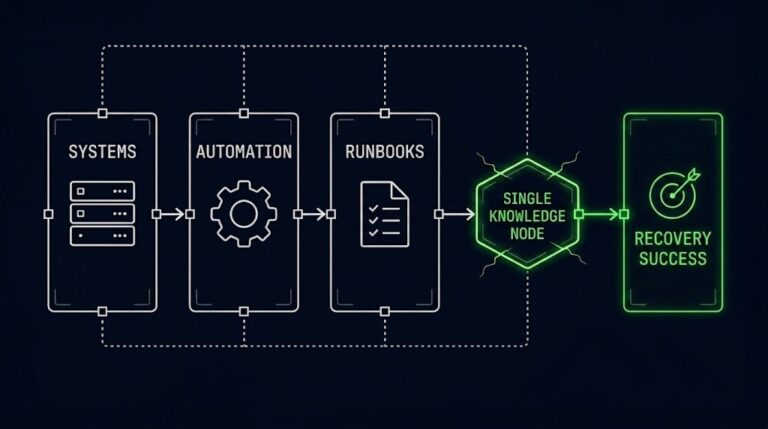
Recovery Bus Factor sharpens this further: self-validation isn’t only about incentive, it’s often a hard capability constraint. When the same one or two people designed the runbook, ran the test, and are the only ones who understand the sequencing exceptions that make it work, there’s no reviewer available to disagree with them even if independence were suddenly demanded. Evidence Theater and bus-factor concentration are the same underlying condition, viewed from different angles — one asks who’s allowed to challenge the claim, the other asks who’s even capable of it.
Backup metrics show the same pattern at a smaller scale. Backup success rate as a metric is dangerous for exactly this reason: a 99.8% success rate is a number the backup platform reports about itself, with no external party confirming what “success” was actually measuring. It’s not a fabricated number. It’s an unvalidated one, and those aren’t the same failure.
Self-validation is what happens when recovery evidence never has to survive contact with anyone who didn’t produce it.
Failure State: Evidence Theater
Evidence Theater is the name for what self-validation produces at scale: recovery artifacts that exist, look complete, and satisfy every internal review — while nobody with actual standing to reject the conclusion has ever been given the chance to.
Evidence Theater doesn’t look like negligence from the inside. It looks like diligence. Reports get filed. Tests get scheduled and run. Tabletops happen on schedule. The organization can point to a real paper trail. What it can’t do is produce a single instance of that paper trail surviving a challenge from someone structurally outside the chain that built it — because that challenge has never actually been attempted.
A 2026 industry resilience survey put a number on the gap this produces: 90% of security leaders reported high confidence in meeting their defined recovery time objectives, but among organizations that had actually been hit by ransomware, only 28% fully recovered the affected data. Confidence and proof are not the same measurement, and Evidence Theater is what fills the space between them — a program can be entirely sincere in its self-assessment and still be measuring the wrong thing.
FRAMEWORK #167 — RECOVERY EVIDENCE BOUNDARY
The point at which recovery evidence exists but no authority structurally independent from the team that produced it has standing to reject the claim it makes.
When this boundary is crossed without a survivable model, the organization discovers it has no answer the first time someone outside the recovery team asks to see the proof.
Architectural Relationships
Why It Connects
Governs — evaluating whether recovery/continuity claims are independently validated presupposes continuity itself has already been established as executable and survivable, not merely asserted.
Explore Framework →Why It Connects
Extends — #148 establishes whether recovery capability survives adversarial compromise; this framework asks whether the claim that it did so can be independently proven, one layer above.
Explore Framework →Recovery Authority Fragmentation
Why It Connects
Constrains — #144 evaluates whether the people and credentials needed to execute recovery survive the incident; this framework evaluates whether anyone independent of the executors can confirm the claim afterward. Different failure modes, same incident.
Explore Framework →Why It Connects
Defines — same architectural principle (evidence produced and judged by the same party), expressed cross-pillar: #151 is a chain-of-custody problem in Modern Infrastructure & IaC, this framework is an independent-authority problem in Data Protection.
Explore Framework →Why This Is Sovereign, Not Another Resilience Layer
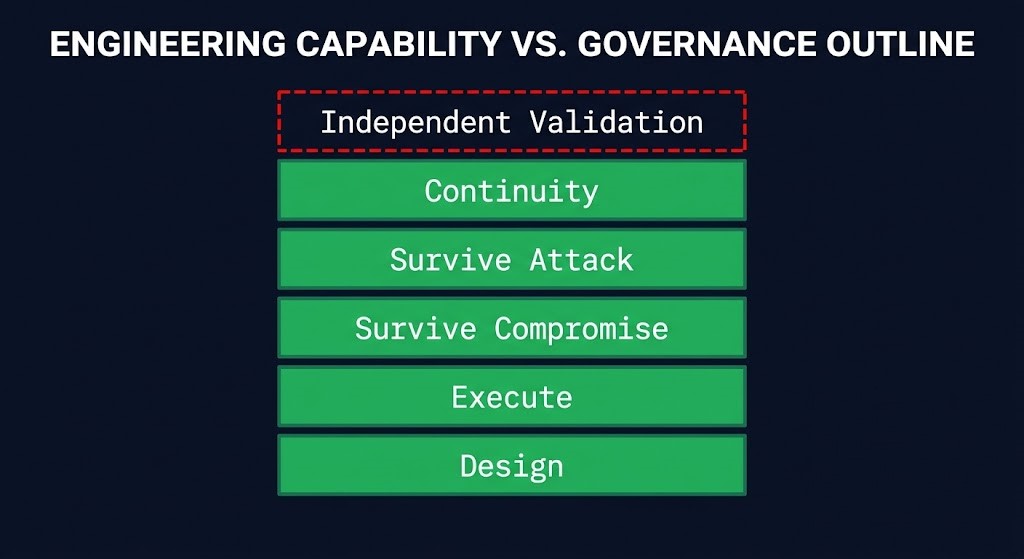
This is the section that decides whether this final stage earns its place at the top of the Data Protection maturity path or reads as an extra round of DR testing with a governance label on it — so the distinction needs to be explicit, not implied.
Resilient-tier architecture — the ransomware-survival and continuity stages before this one — answers whether recovery survives. Does the platform hold up under ransomware. Does continuity survive a failover. Those are engineering questions with engineering answers: build it, test it, harden it, and the system either does or doesn’t do the thing under load.
Sovereign-tier architecture asks a different kind of question: does the claim about that survival remain legitimate once it’s challenged by an authority outside the execution chain? That’s not a technology question. No amount of better tooling, faster failover, or more thorough testing closes this gap, because the gap was never about capability. It’s about who’s structurally positioned to say “prove it” and have that mean something.
Recovery Readiness Is Becoming A Board-Level Metric already shows where this pressure is coming from — boards, regulators, insurers, and acquirers increasingly want recovery claims presented the way financial claims are: reviewed by someone whose job is explicitly not to take the claimant’s word for it. That expectation doesn’t reach any of the earlier engineering-focused stages at all. It reaches exactly this boundary.
Recoverability established whether recovery capability survives an adversary. Continuity execution boundary established whether that capability, once it holds, actually gets the business back to operating — the same Disaster Recovery & Failover Architecture stage this framework sits directly above until its own stage page is built. The Recovery Boundary (covered separately) establishes something earlier still — whether the recovery boundary was ever architecturally scoped against the service’s real dependency boundary before any of the above got tested. Recovery evidence boundary sits above all three, asking a question none of them does: once you have a recovery claim that’s technically true, who else has to agree with you before it counts?
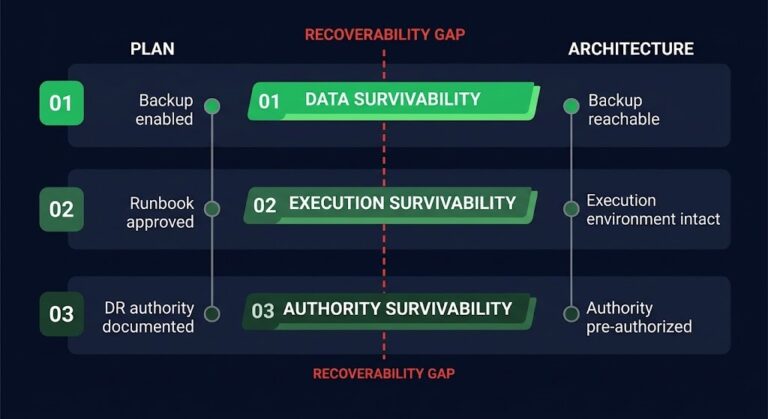
There’s a nearby framework worth separating out explicitly here, because the confusion is a natural one. Disaster recovery authority is about execution authority — whether the people and credentials needed to actually run recovery survive the incident that requires it. Recovery evidence boundary is about validation authority — whether anyone independent of the people who ran recovery is positioned to confirm the claim afterward. An organization can have flawless execution authority and zero validation authority at the same time. They’re different failure modes on different sides of the same incident.
Signals You’ve Already Crossed the Boundary
None of these require a new tool to detect. They require asking, plainly, who besides the team that produced the evidence has ever been allowed to challenge it — and writing down the honest answer.
SIGNALS YOU’VE ALREADY CROSSED THE BOUNDARY
- Recovery evidence lives only inside the platform that’s being evaluated — nowhere it could be checked independently.
- A reviewer outside the recovery team has never been able to reproduce a test result, only read a summary of one.
- Evidence lineage doesn’t survive personnel turnover — when the person who ran the last test leaves, the trail effectively resets.
- No named authority has ever been asked to accept or reject a recovery claim; “we passed” has never had a “someone else agreed” attached to it.
- Contracts and SLAs don’t define who has standing to reject insufficient recovery evidence — the language describes targets, not who gets to dispute whether they were met.
Architect’s Verdict
A recovery program can pass every internal test it runs and still fail the only question that matters at the sovereign tier: who, besides the people who built it, is allowed to say whether it’s true.
That’s not a documentation gap and it’s not a testing gap — both of those are things this maturity path already solved at the earlier stages. It’s an authority gap, and it’s invisible from inside the organization that has it, because self-validation doesn’t feel like a shortcut when you’re the one doing it. It feels like due diligence.
The recovery evidence boundary is the point where “we tested it and it passed” stops being enough, not because the test was wrong, but because nobody who didn’t run it has ever been asked to agree.
Additional Resources
View 4 more resources
Editorial Integrity & Security Protocol
This technical deep-dive adheres to the Rack2Cloud Deterministic Integrity Standard. All benchmarks and security audits are derived from zero-trust validation protocols within our isolated lab environments. No vendor influence.

R.M.
Senior Solutions Architect with 25+ years of experience in HCI, cloud strategy, and data resilience. As the lead behind Rack2Cloud, I focus on lab-verified guidance for complex enterprise transitions. View Credentials →
Get the Playbooks Vendors Won’t Publish
Field-tested blueprints for migration, HCI, sovereign infrastructure, and AI architecture. Real failure-mode analysis. No marketing filler. Delivered weekly.
Select your infrastructure paths. Receive field-tested blueprints direct to your inbox.
- > Virtualization & Migration Physics
- > Cloud Strategy & Egress Math
- > Data Protection & RTO Reality
- > AI Infrastructure & GPU Fabric
Zero spam. Includes The Dispatch weekly drop.
Architecture Audit Services
Fixed-scope audits for Zero-Trust Azure, VMware migration readiness, and recovery posture — no discovery call required to start.
>_ View Audit Services>_Related Posts
Your Recovery Architecture Has A Bus Factor Problem
Recovery bus factor is the gap between a recovery plan that has been tested, documented, and signed off — and a recovery plan that can actually be executed when the one or two people who know how to run it aren’t in the room. The recovery program had passed everything that mattered on paper: RTO…
Your Ransomware Recovery Plan Has a Recoverability Gap
The recoverability gap is the structural distance between what your recovery plan assumes and what your infrastructure can actually deliver under failure conditions. Most organizations don’t discover it during planning. They discover it on day three of an incident. >_ Architect’s Brief 60-second read before you commit to the full post · Full post: 12…
Your Ransomware Plan Is Fiction: 5 Recovery Metrics Nutanix, Cohesity, Rubrik & Pure Can’t Hide
Ransomware recovery metrics are the only thing standing between your recovery plan and a PowerPoint. Every vendor demo shows a single VM booting in 60 seconds. Every real ransomware recovery looks like this: the backups are intact, the ransomware is neutralized, the executives are on the bridge — and nothing is coming back online. >_…
Your Logs Are Not Evidence If The Infrastructure That Produces Them Can Rewrite The Record
The evidence layer is not a byproduct of your infrastructure — it is infrastructure, and on August 30, Sygnia documented what happens when the evidence layer is captured along with everything else. Fire Ant, a China-nexus threat actor Sygnia has tracked since 2025, spent this year moving past the VMware hypervisors it was previously known…
Your Identity System Is Your Biggest Single Point of Failure
Part 2 of the Rack2Cloud’s Cloud Fragility Series >_ Cloud Fragility Series 01 Multi-Cloud Cascading Failure Risks 02 Your Identity System Is Your Biggest Single Point of Failure [CURRENT] 03 Vendor Lock-In Happens Through Networking — Not APIs 04 Your Cloud Bill Quietly Increased in 2026 — Here’s Where the Money Is Actually Going >_…
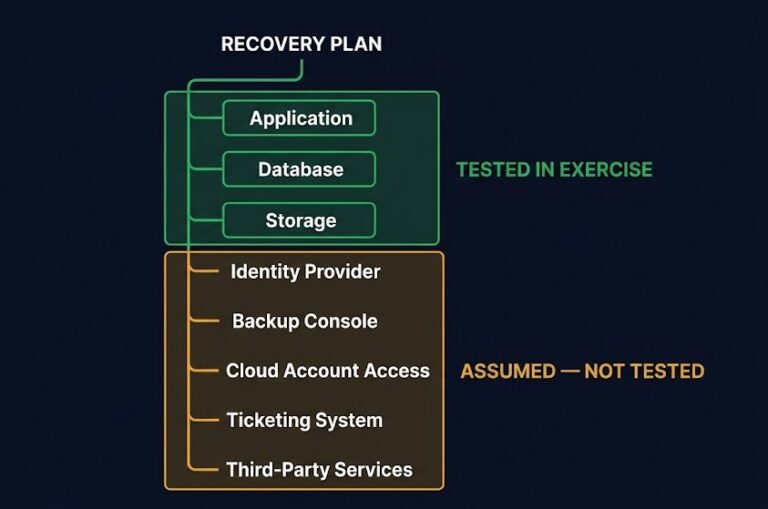
Your DR Test Passed. The Assumptions Didn’t.
DR plan failure rarely happens where you tested. It happens at the assumptions the exercise never reached — the dependencies that weren’t in scope, the runbook written for last year’s architecture, the authority chain nobody tested at 2am.