

The Automation Validation Tax: Why Trusting Automation Never Becomes Free
The automation validation tax is the recurring cost of confirming that automated outputs are still doing what they claim to do, and unlike most infrastructure spend, it never trends toward zero. Every automated system that makes a decision — approving a change, remediating a vulnerability, routing a deployment, closing a ticket — creates an ongoing question that never gets fully answered once: is this output still correct? Organizations budget for automation’s build cost and its maintenance cost. They rarely budget for the cost of continuing to believe it.
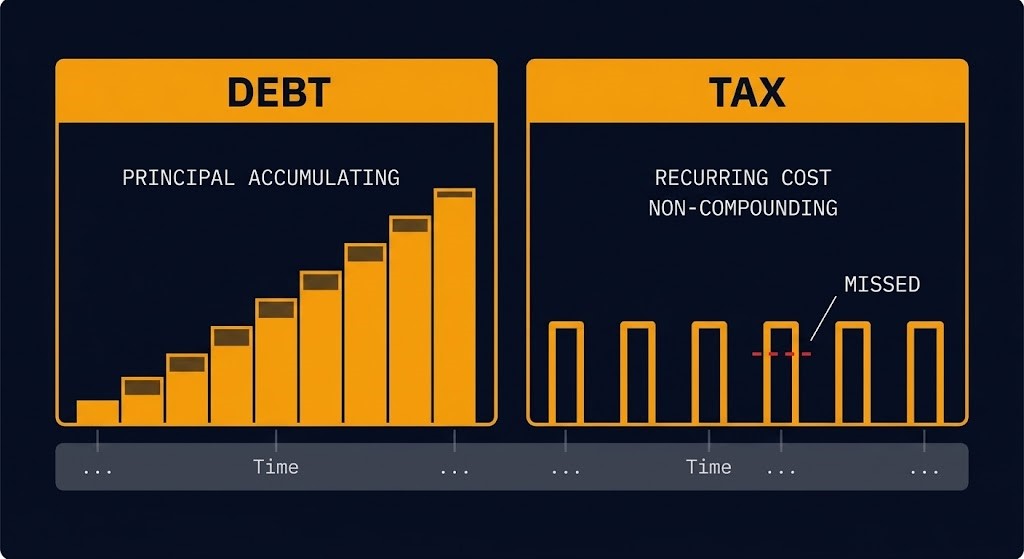
The Debt Curve Measures the Wrong Thing
Framework #139, the Automation Debt Curve, already gave this site’s Modern Infrastructure & IaC coverage a vocabulary for automation’s hidden cost: the second, invisible operating environment — pipelines, modules, policies, dependencies — that automation requires to stay functional. That framework is correct as far as it goes. It measures accumulated operating burden: the debt that builds when automation keeps expanding without anyone tracking what it costs to keep running.
But debt represents principal. It compounds from decisions already made, and in principle an organization can stop adding to it, pay it down, and reach equilibrium. The automation validation tax doesn’t work that way. It isn’t a balance that accumulates from past automation decisions — it’s a toll paid continuously, on every automated decision, regardless of how well-architected the automation is. You cannot pay down a tax. You can only decide whether you’re actually paying it or merely pretending to.
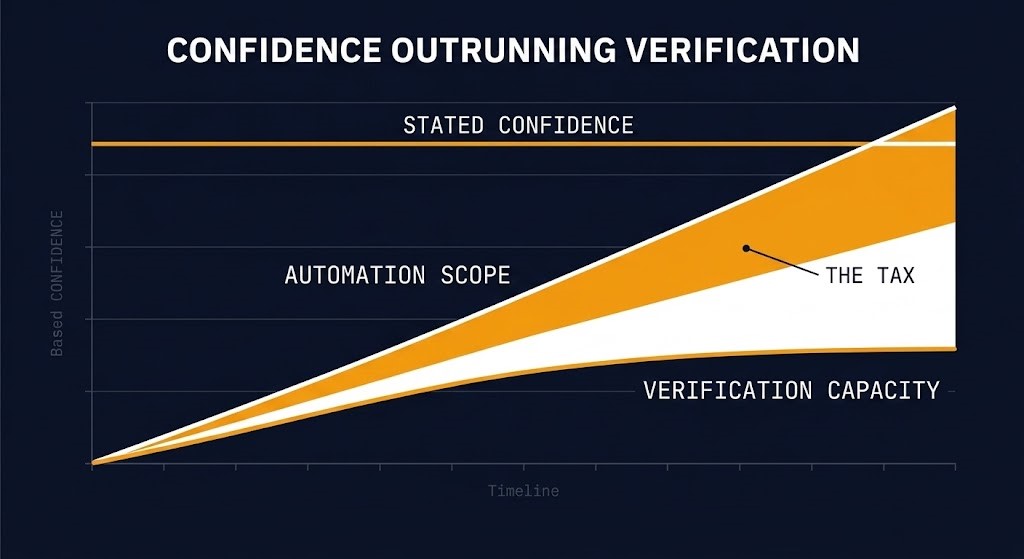
That distinction matters because the two failure modes look identical from the outside and are governed completely differently. An organization deep in Debt Phase (per #139) has too much automation relative to its capacity to maintain it. An organization paying an unaccounted validation tax may have perfectly maintainable automation — the pipelines run, the modules are current — and still have no real idea whether the automation’s decisions are correct, because nobody scaled the verification work alongside the automation’s scope.
The Automation Validation Tax, Defined
FRAMEWORK #172 — AUTOMATION VALIDATION TAX
The recurring human and operational cost required to confirm automated outputs remain trustworthy, independent of whether the automation itself is well-built.
The tax isn’t paid when automation is built. It’s paid every time someone has to decide whether to trust what it just did — and it comes due whether or not anyone budgeted for it.
Architectural Relationships
Why It Connects
Extends the Debt Curve’s accumulated-burden mechanism into a distinct recurring cost — #139 measures what automation costs to keep running; #172 measures what it costs to keep believing.
Explore Framework →This is the second entry toward the pillar’s economics-of-automation reading path — now joined by a third: Governance Cost Inversion (Framework #174), which measures the cost of the approval layer itself rather than the cost of confirming automated output. That stage page doesn’t exist yet, so for now the reading path continues at Governance & Drift, the pillar’s current governance-focused stage.
Where The Tax Actually Gets Paid
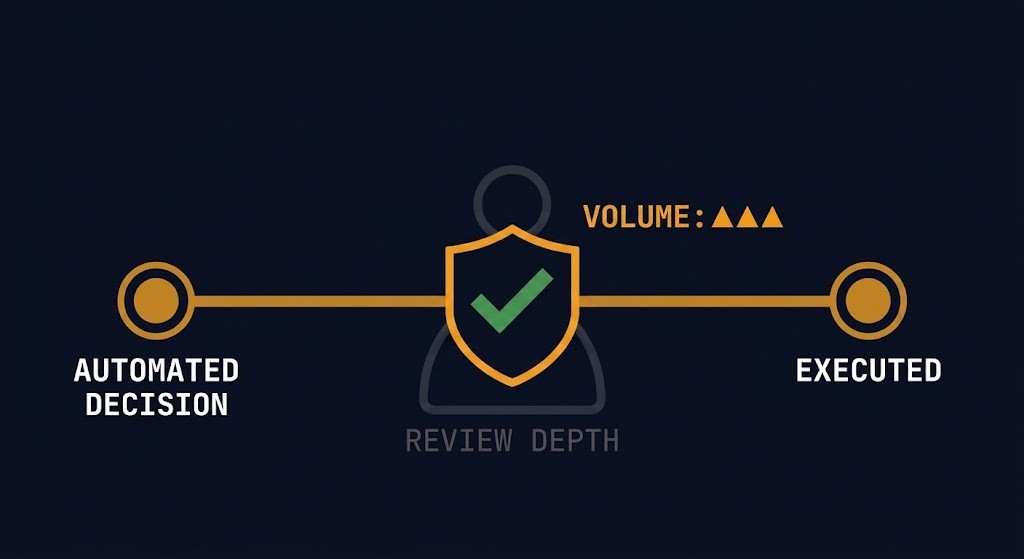
The automation validation tax shows up wherever an approval step exists to make automation trustworthy rather than to make a decision. AI approval workflows are one of the clearest current examples: a human reviewer sits in the loop specifically to validate automated output, and the review holds only as long as the reviewer’s actual attention scales with the volume of things being reviewed. It usually doesn’t. Volume rises because automation is working as intended; review depth falls because nobody hired more reviewers when the volume did. The approval step still exists. It has stopped doing what it was built to do.
This isn’t a hypothetical failure mode. Human-factors research on automation bias has repeatedly found that once people come to trust an automated system, they measurably reduce how closely they scrutinize its output — particularly under the exact conditions high automation volume creates: time pressure and heavy workload.
The same pattern shows up in policy engines that auto-remediate violations, in GitOps pipelines that auto-merge on passing checks, and in vulnerability scanners that auto-close tickets on a clean re-scan. In every case, the artifact of verification (an approval, a green check, a closed ticket) survives long after the actual verification behind it has thinned out.
DIAGNOSTIC QUESTION
“If you tripled your automation coverage tomorrow, would your verification capacity triple with it?”
Patch Visibility Debt Is A Validation Tax Story
Framework #170, Patch Visibility Debt, describes a specific instance of this same pressure: automated vulnerability management can create a confirmation lag between what scanners report as remediated and what’s actually been fixed, and organizations set remediation priority against that stale representation. Read through the validation-tax lens, the mechanism is the same shape — automated remediation scope expanded, and the verification work required to confirm each fix actually held did not expand with it. #170 is not being redefined here; its own identity (confirmation-lag driving a stale priority decision) stands as delivered. What connects the two is that both describe the same underlying failure to scale verification against automation’s growing footprint, applied to different domains.
The Standards Documentation Trap
Infrastructure standards without enforcement become documentation debt for the same reason, in a different register: a declared standard exists, automation is introduced to enforce it, and the actual state of the estate quietly diverges from both. The standard was never the whole problem — the missing question was whether automated enforcement was still enforcing it. An organization that wrote a standard once and automated its rollout once has, without meaning to, stopped paying continuous attention to whether the standard still holds. That’s the validation tax showing up as a governance artifact rather than a security one.
Security Entropy And The Same Curve
Security Entropy Accumulation describes configuration drift compounding silently across an estate over time. The validation tax angle on that same drift: automated configuration management was supposed to make drift detection cheaper, and in the volume sense it did — more of the estate gets scanned automatically than any human team could cover manually. But scanning coverage isn’t verification coverage. An automated scan confirming a configuration matches its declared state is a different claim than a human confirming the declared state is still the correct one. The automation validation tax is the gap between those two claims, and it’s easy to mistake the first for the second because both produce a green checkmark. A completeness gate checked against a model-written required list produces the same checkmark for a different reason: it confirms membership in the list, not that the list is complete.
The same structural mismatch shows up wherever automated monitoring outpaces the humans meant to act on it. Research on security-operations alert fatigue has traced SOC analyst burnout to a workload-capacity mismatch, not to alert volume by itself — scanning more doesn’t help if verifying what’s scanned was never scaled to match.
Why The Ladder Doesn’t See This Cost
The Infrastructure Automation Ladder measures how far an organization has progressed toward mature, self-service automation — and by design, it measures capability, not cost. An organization can climb the Ladder cleanly, reach a high maturity rung, and still be paying an unaccounted validation tax the entire way up, because the Ladder was never built to ask whether verification capacity climbed alongside automation capability. This is the same distinction the Debt Curve section drew earlier, restated against a different existing framework: maturity models describe position. They don’t describe what holding that position actually costs to keep trustworthy.
Architect’s Verdict
Automation was never supposed to eliminate verification. It was supposed to change what got verified — moving human attention away from the mechanical act of execution and toward confirming the outcome was correct. Instead, most organizations treated automation’s growth as license to shrink verification proportionally, on the assumption that automated meant trustworthy by default.
The real problem isn’t that automation makes mistakes. Every system does. The real problem is that organizations stopped measuring whether their capacity to catch those mistakes was keeping pace with how much they were automating — and confidence, once asserted, doesn’t automatically recalibrate downward just because the thing it was asserted about got bigger.
That’s the automation validation tax at work: automation doesn’t become free to trust. The cost of establishing that trust remains as long as the automation runs.
Additional Resources
Editorial Integrity & Security Protocol
This technical deep-dive adheres to the Rack2Cloud Deterministic Integrity Standard. All benchmarks and security audits are derived from zero-trust validation protocols within our isolated lab environments. No vendor influence.

R.M.
Senior Solutions Architect with 25+ years of experience in HCI, cloud strategy, and data resilience. As the lead behind Rack2Cloud, I focus on lab-verified guidance for complex enterprise transitions. View Credentials →
Get the Playbooks Vendors Won’t Publish
Choose the architecture problems you care about. Get field-tested playbooks and frameworks delivered to your inbox.
- > AI Infrastructure & Inference Economics
- > Cloud Strategy & Hidden Cost Models
- > Virtualization & Deterministic Migration
- > Kubernetes, IaC & Modern Infrastructure
- > Data Protection & Recovery Engineering
Zero spam. Includes The Dispatch weekly drop.
Need Architectural Guidance?
Independent review before major infrastructure decisions.
- > Validate assumptions
- > Identify hidden dependencies
- > Quantify migration risk
- > Challenge vendor narratives
Triage · Advisory · Fractional · Direct Hire