

Patch Rollback Risk: When Recovery Reintroduces the Exposure You Just Closed
Patch rollback risk is the operational reality sitting underneath Microsoft’s September 2026 Remote Desktop Services failure: the fastest way to restore a broken service can be the exact action that reopens a vulnerability the patch was written to close.
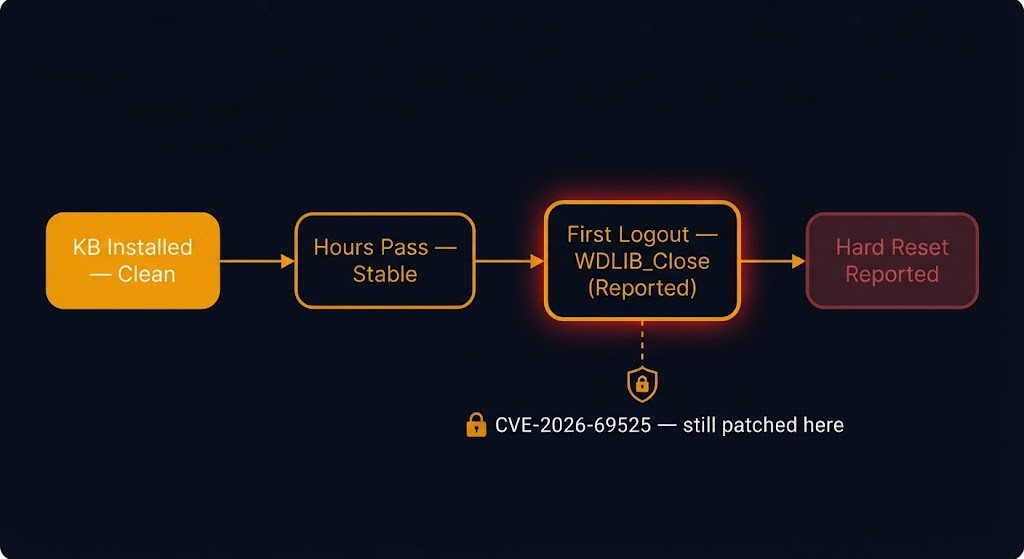
The September 8 cumulative updates — KB5122876 for Windows Server 2019, KB5122882 for Windows Server 2022, KB5122871 for Windows Server 2025 — appeared to install normally on affected hosts. Then, in reported cases, RDS began failing after users logged out: existing sessions stopped disconnecting cleanly, new connection attempts hung, and some administrators reported needing a hard reset. Microsoft subsequently documented stopping and restarting an affected VM as a temporary workaround.
The obvious fix — pull the update, restore RDS — is also the fix that undoes the security work that update shipped to do. That’s not a footnote to this story. It’s the actual subject. Not “was this patch buggy” (yes), and not “should you have staged it” (also yes, and beside the point). The subject is what happens architecturally the moment recovery and remediation start competing for the same decision — and who is actually positioned to make that call when they do.
What Microsoft Has Confirmed
Microsoft’s public documentation establishes the failure and the current mitigation. It does not establish the underlying mechanism. That distinction matters.
All three builds show the same pattern: RDS works normally for a window of hours after install, then destabilizes — typically triggered by the first wave of user logouts. Existing sessions stop disconnecting cleanly. New connections hang. Related tooling (MMC, RDS Licensing Diagnoser, File Explorer) can become unresponsive alongside it.
| KB | Server version | Failure behavior | Microsoft public status |
|---|---|---|---|
| KB5122876 | Windows Server 2019 | RDS sessions fail to disconnect; new connections hang after a stable window | Mitigated; VM restart workaround |
| KB5122882 | Windows Server 2022 | Same RDS failure pattern | Mitigated; VM restart workaround |
| KB5122871 | Windows Server 2025 | Same RDS failure pattern | Mitigated; VM restart workaround |
That status column needs to be read precisely, because “Mitigated” is doing less work than it sounds like. Microsoft’s own Windows Server 2025 release-health entry lists the issue as Mitigated as of September 11, with exactly one publicly documented workaround: stop and restart the affected VM. The same entry states Microsoft is “working to release a resolution in a future Windows update” — meaning the permanent fix, as of publication, has not shipped publicly. There is no Group Policy object or Known Issue Rollback package listed on that page.
Separately, several practitioner sources report that a Known Issue Rollback via Group Policy exists and is documented — but only inside Microsoft’s M365-admin-only Message Center, a channel most Windows Server shops without an M365 tenant relationship never see. We’re reporting that KIR’s existence here with that provenance attached, not folding it into “what Microsoft has confirmed publicly.” An administrator without M365 admin-center access and one with it may therefore be looking at different mitigation options for the same RDS failure, even though both are managing the same underlying security exposure — a preview of the authority problem this post is actually about, and one we’ll come back to directly in the decision surface below.
That gap also isn’t the only place information asymmetry showed up this quarter — Microsoft’s Entra ID exploitation-status reversal made the same point from the opposite direction: a status field changing underneath an admin who has no way to independently verify which version is current.
The trade-off that actually matters for modern infrastructure architecture isn’t RDS uptime versus a checkbox. It’s this: the same September cumulative cycle also shipped the fix for CVE-2026-69525, a CVSS 9.8 use-after-free remote code execution vulnerability in Windows RDS — unauthenticated, no user interaction required, published the same day as the cumulative update, and affecting Windows Server versions from 2012 through 2025 (plus several Windows client versions). It is not a Server-2025-specific fix: the confirmed affected-build ranges line up with the September patched builds across all three server versions this post covers — 17763.9245 for Server 2019 (KB5122876), 20348.5622 for Server 2022 (KB5122882), and 26100.33438 for Server 2025 (KB5122871). Roll any of the three cumulative updates back to restore RDS, and that fix goes with it.
What’s Still Just a Theory
⚠ UNCONFIRMED — TREAT AS PROVISIONAL
The mechanism below comes from an administrator’s own kernel-level debugging, reported on Reddit and covered by BleepingComputer. Microsoft has not confirmed it as the root cause. It may not survive the eventual RCA — and the architectural argument in this post does not depend on it being right.
Here’s what’s circulating as the working theory, and why it deserves exactly the weight “theory” implies. An administrator investigating a Server 2022 host reported debugging results on Reddit, quoted by BleepingComputer: “The service hangs at RDPSERVERBASE!WDLIB_Close, there seems to be no timeout set here. This results in a deadlock between RDP and LSM.” Microsoft has not confirmed this as the cause of the failures.
The theory is that a teardown routine in the RDP server base library blocks indefinitely instead of completing when a session disconnects, leaving dependent session operations unable to progress. Some later practitioner write-ups have gone further, tying the hang to a specific internal feature flag gating the code path. That’s Tier-2 evidence layered on Tier-2 evidence, and it stays labeled that way here.
This distinction matters for one practical reason: if you build your incident response, your monitoring, or your internal postmortem language around “it’s an LSM deadlock” and Microsoft’s eventual RCA names something else entirely, you’ve built process on a guess that happened to be plausible. The architectural point in the next section doesn’t require the mechanism to be right. It requires only that a patch broke availability and that the fix for the availability break also reverses a security fix. Both of those are confirmed regardless of what the eventual RCA says about WDLIB_Close.
The Actual Architecture Problem: When Remediation and Recovery Compete
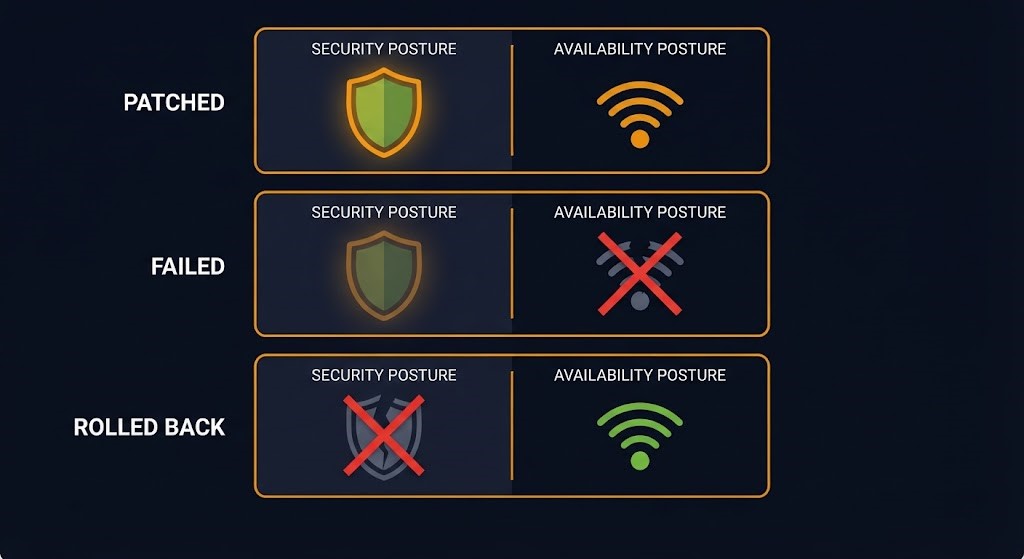
This is where patch rollback risk stops being a Microsoft incident story and becomes an architecture problem every enterprise running Windows Server RDS has to answer for itself. Once a remediation and the recovery from that remediation’s failure mode start competing for the same decision, there is no automatically “safe” state to fall back to — because the state that restores availability is, by construction, the state that removes the fix.
| State | Security posture | Availability posture |
|---|---|---|
| Patched (KB installed, RDS stable) | Remediated — CVE-2026-69525 is patched | Nominal, until the failure window begins |
| Failed (RDS hung post-logout) | Still remediated | Degraded to unavailable — sessions won’t disconnect, new connections won’t complete |
| Rolled back (KB removed to restore RDS) | Un-remediated — CVE-2026-69525 is restored to the vulnerable state | Restored |
No row in that table is a resting state you can walk away from. Patched-but-failing is a genuine outage. Rolled-back-but-available carries a genuine 9.8 RCE vulnerability on infrastructure that may be network-reachable over RDP — a real exposure, though vulnerability, confirmed exploitation, and actual internet exposure are three different things worth keeping separate. Security and reliability aren’t actually two separate checkboxes here — they’re the same lever, and this incident is what happens when you’re forced to pull it in one direction with full knowledge of what you’re giving up in the other.
This is also exactly the boundary where this post stops and Patch Visibility Debt picks up, and it’s worth being precise about the difference, because the two failure modes get conflated constantly. Patch Visibility Debt is about whether remediation actually propagated — whether the patch you believe is deployed is the patch that’s actually running. This post assumes propagation succeeded. KB5122871 installed exactly as intended on the host in question. The failure here isn’t a visibility gap; it’s that the remediation itself created an operational failure, and recovering from that failure requires deliberately reversing the remediation. Those are two different architectural problems that happen to rhyme, and treating them as the same one will produce the wrong runbook for both.
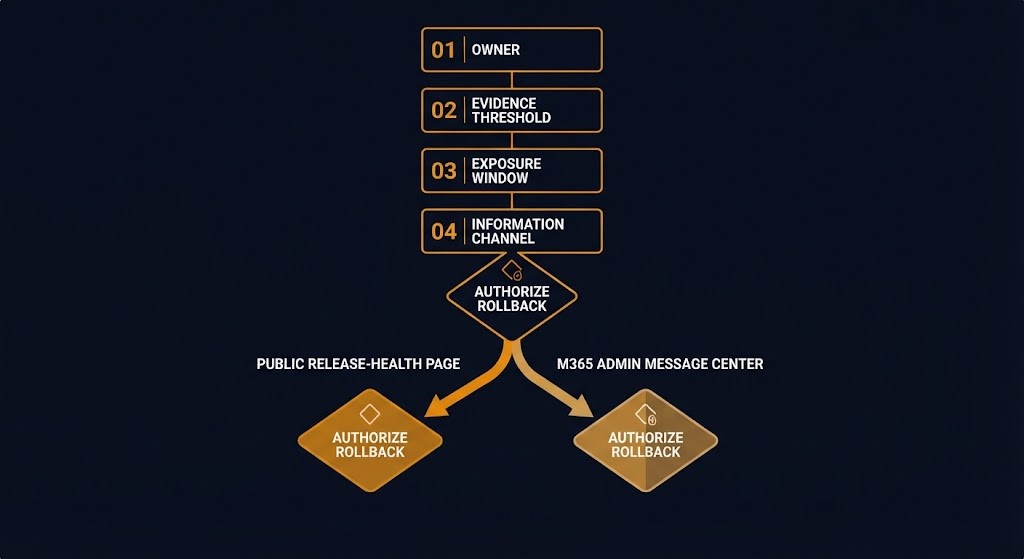
The Decision Surface: Who Has Authority to Reverse a Remediation {#the-decision-surface}
The question this incident actually forces isn’t “can we roll back.” Any admin with local access can uninstall a cumulative update. The question is who is authorized to decide that restoring service justifies restoring a CVSS 9.8 exposure, on what evidence, and for how long — and, as the status-channel gap above makes concrete, whether that person even has access to the same information another equally credentialed admin does.
01 — WHO HOLDS THE DECISION
Name the role, not the person — the owner who can authorize trading a confirmed remediation for restored availability. On most RDS estates this defaults to whoever’s on call for the outage, which is the wrong owner by design: an availability incident escalation path is not a security risk-acceptance path, even though this failure mode forces them through the same door.
02 — WHAT EVIDENCE THRESHOLD APPLIES
“RDS is down” is not sufficient evidence to authorize a rollback on its own. The threshold needs to include what’s actually being reopened (here: CVE-2026-69525, unauthenticated RCE, network-reachable over RDP), whether compensating controls exist in the interim (network isolation of the RDP-facing segment, for example), and whether a narrower fix — the VM restart workaround, or the KIR if your organization can actually reach it — resolves the outage without touching the CVE at all.
03 — HOW LONG THE EXPOSURE WINDOW STAYS OPEN
A rollback authorized as an emergency measure with no expiration becomes a permanent exposure by default the moment everyone stops thinking about it. The decision surface has to include a time-box from the moment of authorization, not from the moment someone happens to notice the host is still unpatched.
04 — WHICH INFORMATION CHANNEL THE DECISION-MAKER ACTUALLY HAS
This incident added a dimension most rollback-authority models don’t account for: the operational state an administrator can act on may depend on which Microsoft information channel they have access to. An M365-admin-center-connected team may see a documented KIR; an on-prem-only shop working from the public release-health page sees “VM restart, resolution pending.” Rollback authority that assumes uniform information access is authority built on an assumption that just failed in public.
That fourth point isn’t cosmetic. Windows 10 ESU procurement decisions run into the same structural problem from a different angle — the license or channel an organization happens to hold determines which options are even visible to the person making the call, before the technical merits enter the conversation at all. Rollback authority modeled only around “does this person have the right title” without accounting for “does this person have the right access” will produce confident, well-documented decisions made on an incomplete picture of what’s actually available. Verify what the decision-maker can see before verifying what they’re authorized to decide.
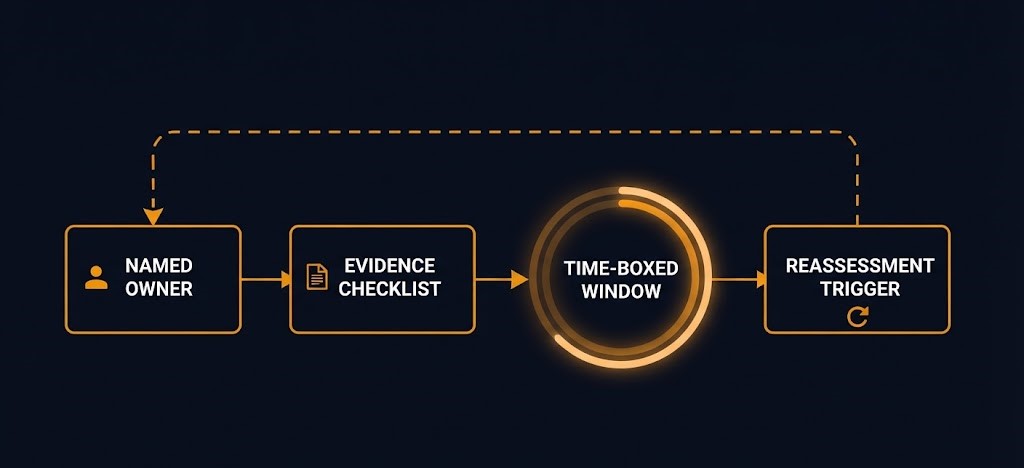
The Runbook Payoff: Operationalizing the Patch Rollback Risk Decision
None of the above is useful if it doesn’t operationalize into something a team can actually execute at 2 a.m. The authority model from the decision surface above translates directly into a runbook chain — this is deliberately not a generic “have a rollback plan” checklist, because generic rollback plans are exactly what produce 2 a.m. improvisation when remediation and availability collide.
RUNBOOK CHAIN — OWNER TO EXIT CONDITION
- Named owner, pre-designated — not whoever’s paged first. The security risk-acceptance authority and the availability incident commander are named separately, in advance, with an explicit handoff point between them.
- Evidence checklist attached to the runbook itself — the specific CVE(s) a rollback would reopen, current exploitation status, and whether a non-rollback workaround (VM restart, KIR if reachable) resolves the outage first. This has to live in the runbook, not in someone’s memory of a BleepingComputer article they read three days ago.
- Time-boxed exposure window set at authorization, not discovered later — a hard expiration on any rollback, logged with the authorization itself, not left open-ended pending “when Microsoft ships the real fix.”
- Reassessment trigger defined before it’s needed — what specifically causes the team to revisit the rollback: a public KIR release, a patched build, a change in exploitation telemetry. Waiting for someone to remember is not a trigger.
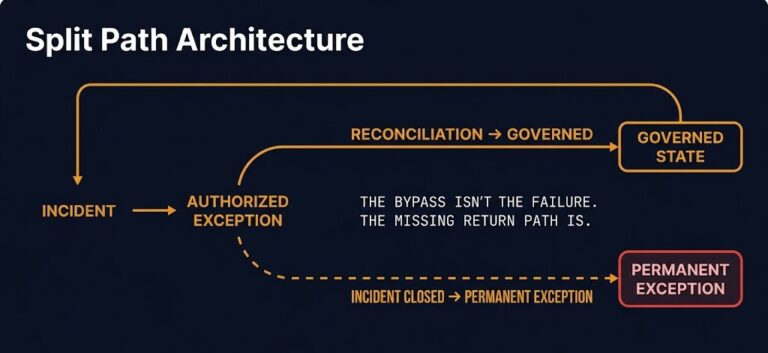
vSphere lifecycle management runs into the identical structural failure from the hypervisor side: the actual problem was never the patching mechanics, it was the absence of a governance model deciding who owns the exception once one gets made. This runbook chain is that governance model applied to the RDS rollback case specifically — and it’s the difference between a rollback that’s a documented, time-boxed exception and one that quietly becomes the new normal because nobody owned closing it out.
Architect’s Verdict
Patch rollback risk isn’t a story about a buggy Microsoft update — updates break things, and this one will get fixed. It’s a story about what your organization does in the hours between “the patch broke availability” and “Microsoft shipped a real fix,” when the only two states on the table are degraded-but-secure and available-but-exposed, and somebody has to choose.
The real problem most enterprise RDS environments have isn’t a missing rollback plan. It’s a rollback plan that was written assuming rollback is a technical action instead of a risk-acceptance decision — which means the authority to make that decision, the evidence threshold for making it well, and the exit condition for closing it back out were never actually assigned to anyone.
Security-complete is not the same claim as operationally-safe. This incident is what it looks like when an organization discovers the difference live, in production, with a CVSS 9.8 unauthenticated RCE sitting on the other side of the decision.
Additional Resources
Editorial Integrity & Security Protocol
This technical deep-dive adheres to the Rack2Cloud Deterministic Integrity Standard. All benchmarks and security audits are derived from zero-trust validation protocols within our isolated lab environments. No vendor influence.

R.M.
Senior Solutions Architect with 25+ years of experience in HCI, cloud strategy, and data resilience. As the lead behind Rack2Cloud, I focus on lab-verified guidance for complex enterprise transitions. View Credentials →
Get the Playbooks Vendors Won’t Publish
Field-tested blueprints for migration, HCI, sovereign infrastructure, and AI architecture. Real failure-mode analysis. No marketing filler. Delivered weekly.
Select your infrastructure paths. Receive field-tested blueprints direct to your inbox.
- > Virtualization & Migration Physics
- > Cloud Strategy & Egress Math
- > Data Protection & RTO Reality
- > AI Infrastructure & GPU Fabric
Zero spam. Includes The Dispatch weekly drop.
Architecture Audit Services
Fixed-scope audits for Zero-Trust Azure, VMware migration readiness, and recovery posture — no discovery call required to start.
>_ View Audit Services>_Related Posts
ZFS vs Ceph vs NVMe-oF: Choosing the Right Storage Backend for Modern Virtualization
I still have nightmares about a storage migration I ran back in 2014. >_ Architect’s Brief 60-second read before you commit to the full post · Full post: 7 min Generating brief… We were moving off a monolithic SAN and onto an early “software-defined” storage platform. The sales engineers promised infinite scalability and self-healing magic….
Your Kubernetes Cluster Isn’t Out of CPU — The Scheduler Is Stuck
Compute Tier 1 Authority Cascades to ➔ >_ Architect’s Brief 60-second read before you commit to the full post · Full post: 9 min Generating brief… [Storage] [Network] 🚨 Failure Signature Detected Grafana shows cluster CPU utilization is under 50%, but pods are stuck in Pending. Events show: 0/10 nodes are available: 10 Insufficient cpu….
Your Cloud Provider Is Not Your HA Strategy
A Tactical Playbook for Architecting, Testing, and Automating Real Multi-Cloud & Multi-Region Resilience We’ve previously explored why cloud SLAs fail as guarantees in our deep dive, Cloud SLA Failure & Resilience Strategy. This article focuses on how to survive those failures in practice — architecturally, operationally, and financially. >_ Architect’s Brief 60-second read before you…
Your CI-CD Pipeline Is Your Real Infrastructure Control Plane
Terraform defines desired state. Kubernetes reconciles workload state. Cloud consoles expose state. None of those systems decides whether infrastructure state is allowed to change. The ci-cd control plane does — or more precisely, the CI-CD pipeline is the only system in most environments that can hold that authority. That distinction — between storing state and…
Why Infrastructure Survivability Fails After The Design Review
Infrastructure survivability is not something an architecture has. It’s something an organization keeps proving, on a schedule nobody wrote down, long after the design review that approved it has been forgotten. >_ Architect’s Brief 60-second read before you commit to the full post · Full post: 8 min Generating brief… That review happened. Redundancy was…
Why Configuration Standards Fail During Emergency Changes
Configuration standards emergency changes have one thing in common across every organization we’ve reviewed: the standard survives the incident, and quietly stops applying about ninety seconds into it. >_ Architect’s Brief 60-second read before you commit to the full post · Full post: 10 min Generating brief… It’s 2 a.m. A load balancer rule is…