

Policy Drift Is the Real Day-2 Failure in GitOps
GitOps policy drift is what happens when a control plane keeps a policy perfectly reconciled long after the reason for that policy has stopped being true. Every commit is applied. Every pull request is merged cleanly. Every dashboard reads green. And the rule being enforced no longer reflects anything anyone would choose to enforce today — it just hasn’t been told to stop.
That gap is the subject of this post. Not configuration drift — the thing GitOps was built to kill — but a second, quieter failure mode that lives one layer above it: the policy is right by every technical measure and wrong by every practical one, and nothing in the reconciliation loop is capable of telling the difference.
The Promise GitOps Actually Kept
GitOps earned its place in the infrastructure as code architecture stack by solving a real and expensive problem: state drift. Before declarative reconciliation, infrastructure diverged from its source of truth constantly — a console change here, an emergency hotfix there, a manual override nobody logged. The git repository said one thing. Production said another. Reconciling the two was a forensic exercise.
GitOps closed that gap with a simple, durable mechanism: a controller that continuously compares declared state to actual state and corrects the difference without waiting for a human to notice. That’s not a small win. It’s the reason platform teams can run infrastructure at a scale that would have been operationally unmanageable a decade ago, and it’s why GitOps controllers sit at the center of nearly every modern infrastructure as code architecture built since.
This post isn’t an argument against that mechanism. It’s an argument that the mechanism’s success created a blind spot nobody designed for.
What GitOps Never Promised to Solve
Here’s the boundary GitOps was never built to cross: reconciliation proves that declared state and actual state match. It says nothing about whether the declared state should still exist in its current form.
A policy rule written eighteen months ago, in response to conditions that no longer hold, will reconcile exactly as cleanly today as it did the day it was written. The controller has no mechanism for asking whether the rule still makes sense — only whether it’s being correctly enforced. State convergence and intent validity are two completely different properties, and GitOps was only ever built to guarantee one of them.
GitOps guarantees that declared state converges toward desired state. It does not guarantee that the desired state still reflects a valid architectural decision.
That’s not a flaw in GitOps. It’s a scope boundary. The problem is that most teams never noticed where the boundary sat, because everything upstream of it — every dashboard, every pipeline status, every audit log — reports success in exactly the same language whether the underlying policy is current or six quarters stale.
⚠ COMMON MISTAKE
A reconciled system can still be enforcing a policy whose justification expired months ago. Treating “fully reconciled” as a proxy for “correctly governed” is the mistake — reconciliation is a state guarantee, not a judgment about whether the state is still the right one.
This is the moment worth sitting with, because it’s where most platform teams’ mental model of GitOps quietly breaks. The pipeline isn’t lying. It’s answering a question nobody’s asking anymore.
Understanding GitOps Policy Drift — Framework #133
Policy Intent Drift is the gap between the original justification for a policy and the current conditions under which that policy continues to be enforced.
Three elements have to be present for this to apply: an original justification (the specific condition or risk the policy was written to address), current conditions (what’s actually true now, which may have nothing to do with that original condition), and continued enforcement (the rule is still live, still reconciled, still passing every check). When all three diverge — justification gone, conditions changed, enforcement unchanged — you have Policy Intent Drift, and nothing in a standard GitOps pipeline is built to surface it.
It’s worth naming why this gap keeps widening rather than closing on its own. As control planes take on more orchestration, governance, and policy-evaluation work — what we’ve described elsewhere as rising coordination density — the number of policies any single team is responsible for reviewing grows faster than the team’s capacity to revisit them. Nobody decided to stop checking. The volume just outran the review cycle.
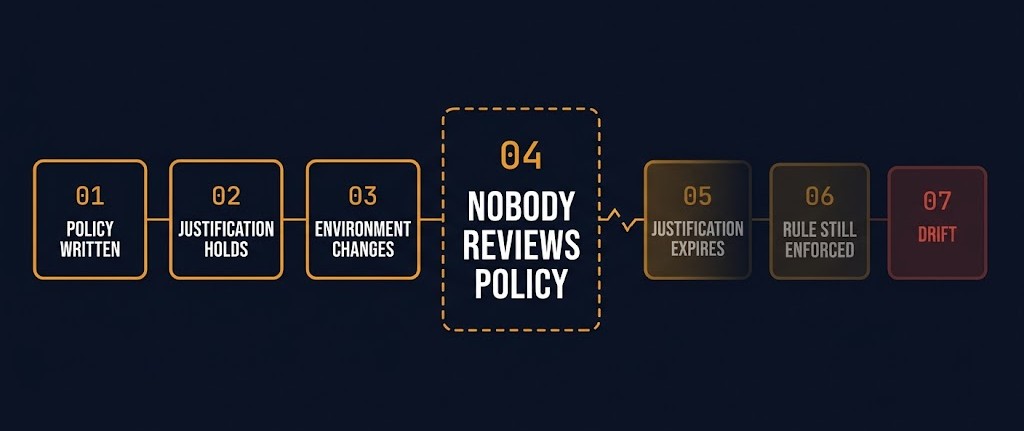
Here’s the seven-stage path from a defensible policy decision to an indefensible one nobody can explain:
01 — POLICY WRITTEN
A rule is committed in response to a specific, identifiable condition — a compliance requirement, a threat model, an architectural constraint.
02 — JUSTIFICATION HOLDS
For a period, the condition that motivated the rule is still true. The policy and reality agree.
03 — ENVIRONMENT CHANGES
The workload is redesigned, the team reorganizes, the compliance requirement is updated, the threat model shifts. The original condition stops being true.
04 — NOBODY REVIEWS POLICY
No review gate fires, because GitOps has no concept of a policy review trigger — only a reconciliation trigger. The rule isn’t flagged. It’s simply left alone.
05 — JUSTIFICATION EXPIRES (SILENT)
The original reason for the rule is now gone. There is no event, no alert, no commit that marks this moment — it simply happens.
06 — RULE STILL ENFORCED
The GitOps controller continues reconciling the policy exactly as designed. Every check passes. The system is functioning correctly by every metric it tracks.
07 — DRIFT
The enforced rule and its justification have fully separated. The infrastructure is compliant with a decision nobody currently stands behind.
State convergence and intent validity diverge at exactly stage four — not because conditions changed, but because nothing was watching when they did. That’s the load-bearing distinction in this entire framework: drift isn’t caused by change. It’s caused by unreviewed change.
Policy Intent Drift isn’t a GitOps-specific failure, either, even though GitOps is where this post is grounded. The same three-part gap — original justification, current conditions, continued enforcement — shows up anywhere a rule outlives the reasoning that produced it: IAM policies, Kubernetes admission controllers, security guardrails, cloud landing zone policies. GitOps just makes it unusually easy to miss, because GitOps is unusually good at making stale policy look healthy.
The Reconciliation Trap
Here’s the version of this every platform team has lived through, even if nobody called it Policy Intent Drift at the time.
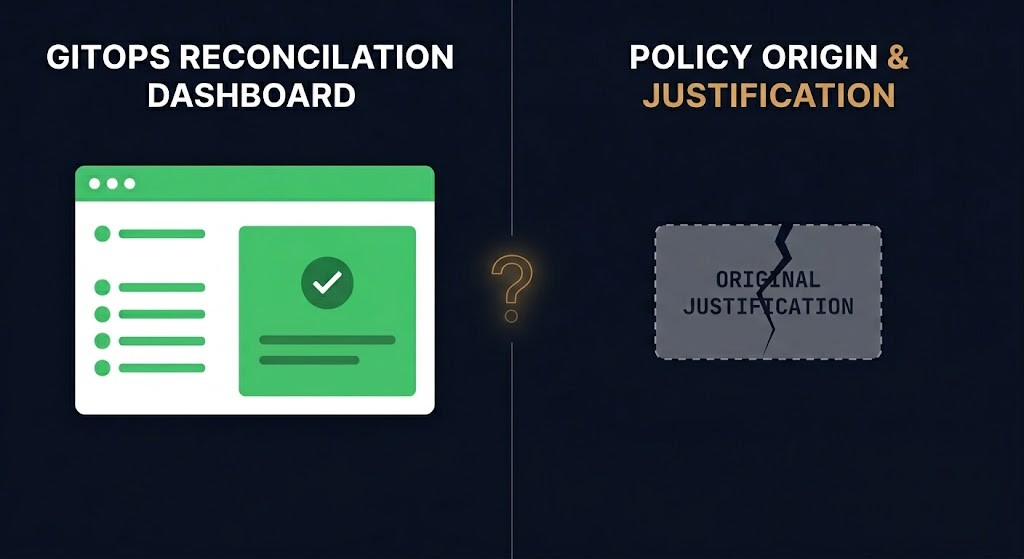
During a compliance initiative, a network restriction is added to isolate a sensitive workload — a reasonable, well-documented decision at the time, tied to a specific audit requirement and a specific architecture. Two years later, the workload has been redesigned twice, the compliance requirement that justified the restriction has been superseded by a newer standard, and the engineers who made the original call have moved teams or left the company. GitOps continues enforcing the restriction perfectly. Every deployment remains compliant. Every reconciliation cycle reports green. Nobody currently on the team can explain why the restriction exists, and removing it feels riskier than leaving it — so it stays, indefinitely, enforced by a system that has no way of knowing it’s defending a decision that no longer has an owner or a reason.
That’s the trap: the failure mode produces zero signal in any tool built to detect drift, because nothing about the state has drifted. The policy is exactly where it was committed to be. What’s drifted is invisible to a reconciliation loop by design.
WHY RECONCILIATION TOOLING MISSES THIS
- Reconciliation checks declared state against actual state — never declared state against current justification
- There is no commit, event, or alert generated when a policy’s underlying condition changes — the expiration is structurally silent
- Audit logs confirm the rule was applied correctly, which is a different claim than the rule being correct
- Ownership of the original decision typically does not survive team changes, so there’s frequently nobody left who can authoritatively revisit it
Where Configuration Ownership Fits
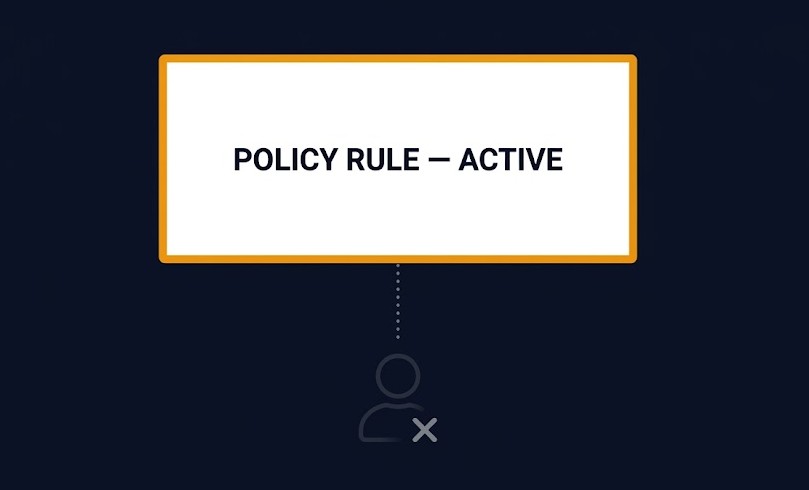
This sits directly downstream of an argument we’ve made before: that configuration drift is a symptom, and ownership is the actual problem. Policy Intent Drift is what that ownership gap looks like once the configuration itself stops moving — the rule is stable, but nobody owns the decision behind it anymore, which means nobody is positioned to retire it even after its justification is long gone.
It also rhymes with a separate failure mode we’ve documented in the console: when manual changes operate outside the GitOps boundary entirely, the console becomes a shadow control plane no pipeline ever sees. Policy Intent Drift is the inverse case — the change happens entirely inside the GitOps boundary, fully version-controlled and fully reconciled, and is still invisible, because the boundary was only ever built to track state, not reasoning.
There’s a third variant worth naming here, because it sits at the collision point of both: what happens when an emergency change bypasses the pipeline entirely, gets authorized on purpose, and then never gets reconciled back into the governed system. That’s the Emergency Reconciliation Gap (#159) — Policy Intent Drift’s incident-time cousin, where the divergence isn’t a stale justification quietly expiring but an authorized exception nobody assigned an owner or a deadline to close.
A fourth variant sits beside these three, and it inverts the ownership assumption entirely: GitOps Has Escaped The Platform Team covers what happens when reconciliation authority isn’t missing or unreviewed but multiplied — four separately-owned GitOps loops, each correctly reconciling its own scope, converging on the same cluster with no arbitration layer between them. Framework #165 — Authority Arbitration Gap — names that condition directly: not a stale rule enforced past its justification, but several current, correctly-owned rules colliding at a boundary nobody built to adjudicate. Policy Intent Drift is what happens when one reconciler stops being watched. The Authority Arbitration Gap is what happens when several reconcilers are watched perfectly and still collide.
Every one of these variants — stale, multiplied, silently expired, or perfectly reconciled — shares the same root condition: the control plane doing the reconciling has itself become the infrastructure, with a failure mode and a blast radius of its own. That’s the general shape cloud governance failure domains names directly: policy engines, identity providers, and admission controllers that no longer advise deployment but sit inside its execution path.
Extending the Drift Detection Model
We’ve argued before that drift detection has to be designed for — that you build infrastructure assuming drift will happen and instrument for catching it, rather than assuming prevention alone is sufficient. That argument was built entirely around state drift: the gap between what’s declared and what’s running.
Policy Intent Drift is the next layer up from that argument, not a contradiction of it. Detecting state drift is necessary and GitOps does it well. But a detection model built only to compare declared state against actual state will never catch the case where both are identical and both are wrong — because the thing that drifted isn’t the state, it’s the reasoning that justified the state in the first place. Any drift detection architecture that stops at the reconciliation layer has a structural blind spot exactly this shape. That blind spot is also an evidence problem: a pipeline that cannot prove whether a policy’s justification still held at execution time has crossed the Infrastructure Evidence Gap — the absence of a chain-of-custody record linking authorized intent to actual execution.
The existence of tools like the GitOps Boundary Mapper reflects the same underlying architectural reality driving this whole post: as control planes scale, teams increasingly need visibility into who owns a control boundary long after the original implementation decisions that created it have been forgotten. A boundary map doesn’t tell you whether a given policy’s justification has expired — that’s a judgment call no tool can fully automate — but it tells you who’s accountable for making that call, which is the precondition for ever reviewing the policy at all. Without an ownership map, Policy Intent Drift doesn’t just go undetected. It goes unowned.
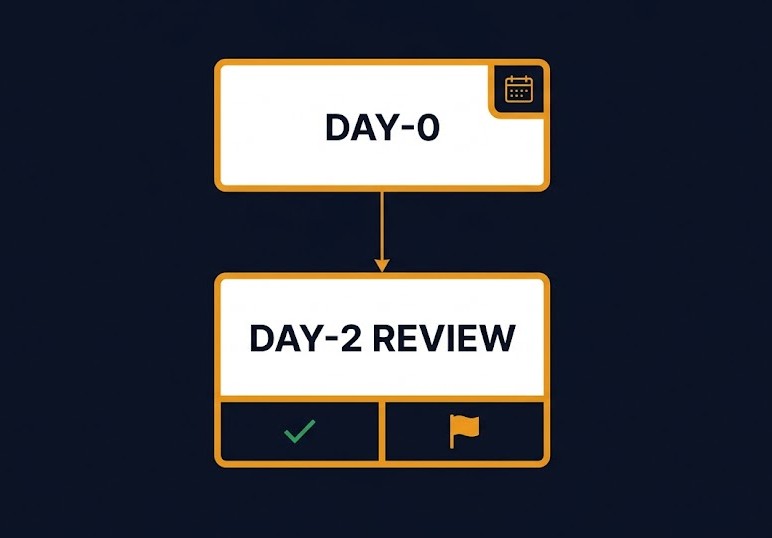
Building Policy Review Into Day-2, Not Day-0
The fix isn’t more reconciliation — reconciliation already works exactly as designed. The fix is treating policy review as a first-class Day-2 operation rather than a one-time Day-0 decision that’s assumed to remain correct indefinitely.
In practice, that means attaching a review cadence to policy artifacts the same way you’d attach one to a TLS certificate or a credential: an explicit owner, an explicit re-justification date, and an explicit consequence — flagged for review, not silently expired — when that date passes without action. This is exactly the kind of operations debt we’ve described as inherited from Terraform-era IaC practice more broadly: provisioning was automated long before operations was, and policy review is one of the last Day-2 disciplines still running on tribal memory instead of architecture. That review cadence is Burden in the Automation Debt Curve’s (Framework #139) sense specifically — the recurring effort of re-certifying that a policy still does what it claims, not a one-time build cost. Skipping it doesn’t make the cost disappear; it just moves the policy estate further into the framework’s Debt Phase without anyone tracking the move.
Worth separating that Debt Curve reference from a second, easily-confused framework it sits beside: the Automation Validation Tax (Framework #172). Debt Phase is what happens when the review cadence above never gets built at all — burden accumulates because nobody budgeted for it. The Validation Tax is subtler and applies even to a team that built the cadence: reconciliation still reports green on every cycle, so the review that does happen keeps checking the thing GitOps already guarantees (state matches declaration) rather than the thing this post argues actually needs checking (declaration still matches reality). A policy review process can exist, run on schedule, and still be paying the wrong bill — verifying convergence instead of verifying intent.
A third adjacent framework sits beside these two, on the approval side rather than the review-cadence side: Governance Cost Inversion (Framework #174) is the cost-side version of this same cadence blind spot, one layer over in change approval rather than policy reconciliation. Where this post asks whether a policy’s justification still holds, #174 asks whether an approval control’s cost still justifies itself against the risk it protects — the same missing-reassessment shape, applied to the gate a change passes through rather than the rule it’s checked against.
None of this requires abandoning GitOps or adding a second source of truth. It requires treating “why does this rule exist” as a tracked piece of metadata with the same operational seriousness as “is this rule currently applied” — because right now, only one of those two questions has a system watching it.
Architect’s Verdict
GitOps did exactly what it was built to do: it killed state drift as a routine failure mode, and that’s a genuine architectural achievement worth keeping. The mistake is assuming a fully reconciled system is therefore a fully governed one.
State drift occurs when infrastructure stops matching its declaration. Policy Intent Drift occurs when the declaration survives long after the reason it was written has expired — and the system enforcing it has no way of knowing, because it was never asked to check. GitOps solved the first problem completely. Day-2 operations are increasingly defined by the second, and almost nothing in the standard reconciliation toolchain is built to see it coming.
There’s a third variant of this same blind spot, and it runs in the opposite direction: Framework #162 — Security Entropy Accumulation is what happens when declared state and enforced state stay in perfect agreement — no stale policy, no expired justification — and security posture degrades anyway, because reconciliation was never scoped to check anything except state-vs-declared variance. A fourth sits one layer below all three: Infrastructure Pipeline Survivability Boundary (Framework #164) asks whether the pipeline enforcing any of this reconciliation is itself reconstructable — a reconstruction question, not a reconciliation one.
A fifth sits one layer above all four, asking a question none of them do: whether the standard being reconciled was ever verified as a standard in the first place. Infrastructure Standards Without Enforcement Become Documentation Debt names this post’s own argument — enforcement, Layer 02 in that post’s three-layer model — as the well-covered half of a larger failure. Policy Intent Drift is what happens when Layer 02 stops being watched. That post’s actual subject is Layer 03: what happens when nobody can prove Layer 02 was ever checked at all, reconciled or not.
A green pipeline is not the same claim as a correct policy. Most platform teams are currently treating them as identical.
Additional Resources
View 11 more resources
Editorial Integrity & Security Protocol
This technical deep-dive adheres to the Rack2Cloud Deterministic Integrity Standard. All benchmarks and security audits are derived from zero-trust validation protocols within our isolated lab environments. No vendor influence.

R.M.
Senior Solutions Architect with 25+ years of experience in HCI, cloud strategy, and data resilience. As the lead behind Rack2Cloud, I focus on lab-verified guidance for complex enterprise transitions. View Credentials →
Get the Playbooks Vendors Won’t Publish
Field-tested blueprints for migration, HCI, sovereign infrastructure, and AI architecture. Real failure-mode analysis. No marketing filler. Delivered weekly.
Select your infrastructure paths. Receive field-tested blueprints direct to your inbox.
- > Virtualization & Migration Physics
- > Cloud Strategy & Egress Math
- > Data Protection & RTO Reality
- > AI Infrastructure & GPU Fabric
Zero spam. Includes The Dispatch weekly drop.
Architecture Audit Services
Fixed-scope audits for Zero-Trust Azure, VMware migration readiness, and recovery posture — no discovery call required to start.
>_ View Audit Services>_Related Posts
ZFS vs Ceph vs NVMe-oF: Choosing the Right Storage Backend for Modern Virtualization
I still have nightmares about a storage migration I ran back in 2014. >_ Architect’s Brief 60-second read before you commit to the full post · Full post: 7 min Generating brief… We were moving off a monolithic SAN and onto an early “software-defined” storage platform. The sales engineers promised infinite scalability and self-healing magic….
Your Kubernetes Cluster Isn’t Out of CPU — The Scheduler Is Stuck
Compute Tier 1 Authority Cascades to ➔ >_ Architect’s Brief 60-second read before you commit to the full post · Full post: 9 min Generating brief… [Storage] [Network] 🚨 Failure Signature Detected Grafana shows cluster CPU utilization is under 50%, but pods are stuck in Pending. Events show: 0/10 nodes are available: 10 Insufficient cpu….
Your Cloud Provider Is Not Your HA Strategy
A Tactical Playbook for Architecting, Testing, and Automating Real Multi-Cloud & Multi-Region Resilience We’ve previously explored why cloud SLAs fail as guarantees in our deep dive, Cloud SLA Failure & Resilience Strategy. This article focuses on how to survive those failures in practice — architecturally, operationally, and financially. >_ Architect’s Brief 60-second read before you…
Your CI-CD Pipeline Is Your Real Infrastructure Control Plane
Terraform defines desired state. Kubernetes reconciles workload state. Cloud consoles expose state. None of those systems decides whether infrastructure state is allowed to change. The ci-cd control plane does — or more precisely, the CI-CD pipeline is the only system in most environments that can hold that authority. That distinction — between storing state and…
Why Infrastructure Survivability Fails After The Design Review
Infrastructure survivability is not something an architecture has. It’s something an organization keeps proving, on a schedule nobody wrote down, long after the design review that approved it has been forgotten. >_ Architect’s Brief 60-second read before you commit to the full post · Full post: 8 min Generating brief… That review happened. Redundancy was…
Why Configuration Standards Fail During Emergency Changes
Configuration standards emergency changes have one thing in common across every organization we’ve reviewed: the standard survives the incident, and quietly stops applying about ninety seconds into it. >_ Architect’s Brief 60-second read before you commit to the full post · Full post: 11 min Generating brief… It’s 2 a.m. A load balancer rule is…