

Infrastructure Needs Auditability, Not Just Idempotency
Infrastructure auditability is not a property your pipeline inherits from idempotency — it’s a separate architectural requirement that most IaC implementations have never addressed. The field spent a decade optimizing for deterministic execution. That work is largely done. The gap now is not whether your infrastructure runs consistently. It’s whether you can prove, after the fact, that what executed was authorized, reviewed under the correct policy, and consistent with what was actually approved.
Those are different problems. Most teams treat them as the same one.
What Idempotency Actually Guarantees
Idempotency is an execution property. It guarantees that running the same operation multiple times produces the same outcome. In modern infrastructure & IaC architecture, idempotency is foundational — Terraform, Ansible, Kubernetes manifests, and GitOps pipelines all depend on it. Apply the same configuration twice: same result. That guarantee is real and valuable.
What idempotency does not guarantee: that the change was authorized. That the person or system that triggered the run had current approval. That the policy state active at execution time matched the policy state in effect when the change was reviewed. That the plan artifact applied was the same one that was signed off. That anyone could reconstruct the authorization chain a month later without access to the live system.
Idempotency describes the relationship between input and output. It says nothing about the legitimacy of the input itself.
Why Teams Mistake Idempotency for Auditability
The confusion is understandable because IaC pipelines produce visible feedback that feels like proof.
The plan succeeded. The apply succeeded. The state file matches the desired configuration. The CI/CD run is green. Drift detection shows no variance. Everything looks clean.
None of those facts answer the questions an auditor, a post-incident review, or a security team will actually ask: Who authorized this change? What policy was active when it was approved? Was the executed plan the same artifact that was reviewed? Did anything change in the environment between approval and execution that would have altered the decision?
Infrastructure teams that have built intent-driven systems know this distinction well — a system can faithfully execute what it was told while the original intent has long since drifted from the current operational context. The state machine is correct. The authorization trail is gone.
The pipeline being green is not evidence of legitimate execution. It’s evidence of successful execution. Those are not the same thing. Execution success standing in for verified authorization is a pattern that recurs across every infrastructure domain, not one unique to IaC pipelines.
That distinction — successful execution standing in for verified legitimacy — is the same one the Automation Validation Tax (Framework #172) draws at the level of automated decision-making generally: a green pipeline run and a green validation-tax payment look identical from the outside, and only one of them actually happened. The pipeline can run idempotently forever without anyone ever re-confirming the authorization behind it was still current — the automation didn’t get less trustworthy, the organization just stopped checking.
The Auditability Gap in Modern IaC Pipelines
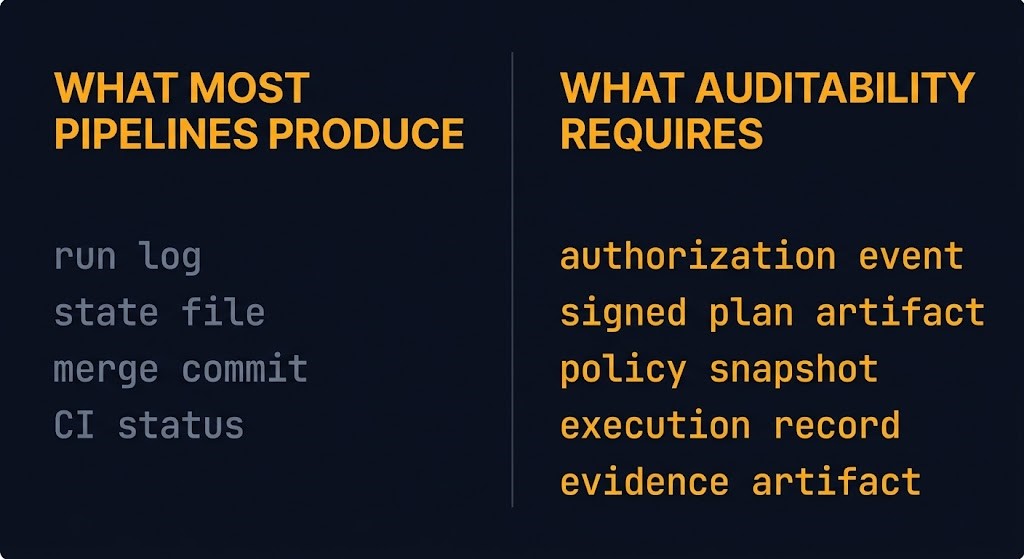
Infrastructure auditability requires four things that most IaC pipelines do not produce:
THE FOUR AUDITABILITY GAPS
- Change provenance — who triggered the change, from what state, at what point in the approval chain
- Intent capture — the approved intent at review time, preserved as an artifact, not just a Git commit
- Policy state at execution — what constraints were active when the apply ran, not when the plan was generated
- Execution evidence — a record that links the applied plan to the authorization event and survives beyond the pipeline run
Logs are not a substitute for any of these. A pipeline log records what happened. Configuration drift detection catches variance after the fact. IaC drift detection tooling tells you when state diverges from desired configuration. None of those tell you whether the desired configuration was legitimately authorized at the time it was applied.
The auditability gap is structural. It exists because IaC was designed to solve execution consistency, not authorization traceability.
Why the Gap Widens in GitOps Environments
GitOps accelerated the auditability problem by decoupling human approval from execution in a way that feels rigorous but isn’t.
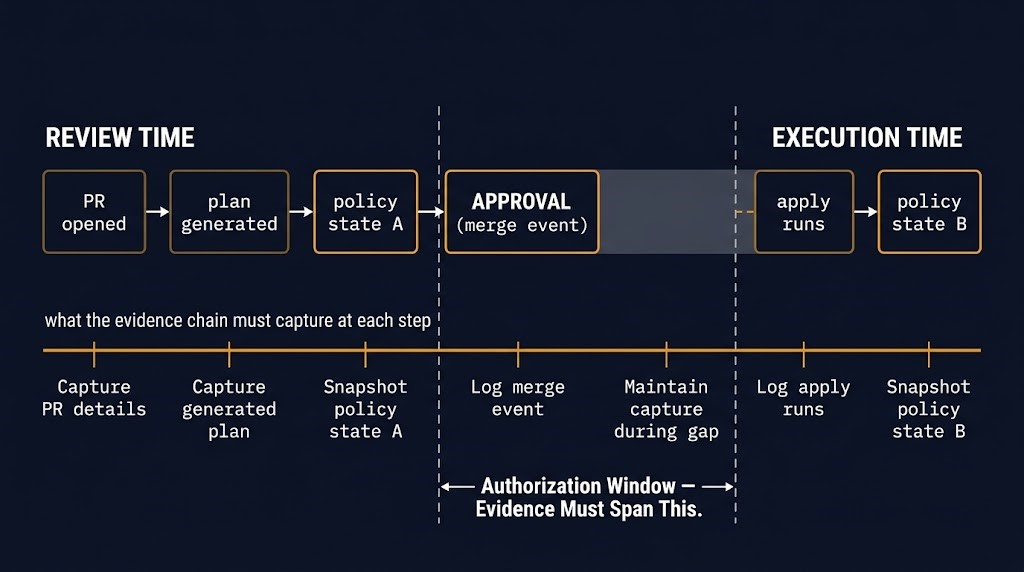
The standard GitOps model treats a pull request merge as the authorization event. That framing is directionally correct — the PR captures intent, the merge signals approval, the pipeline executes. But a pull request captures intent at review time. The infrastructure executes later, under a potentially different policy state, against a potentially different environment, using a potentially different plan artifact.
Policy drift in GitOps pipelines is a documented failure pattern. A policy exception added and then removed. An environment variable changed after the plan was generated. A module version pinned in the PR but resolved differently at apply time. The execution diverges from the reviewed intent — not because anyone made a mistake, but because the system has no mechanism to detect or record the divergence as an authorization failure.
Consider the sequence: a Terraform change opens a security group. The plan is generated and reviewed Tuesday. The apply runs Thursday. Between those events, a policy exception governing that specific security group class is removed from the enforcement pipeline. The apply succeeds — the plan is idempotent, the state transitions cleanly.
Six weeks later, a security review asks three questions: Who authorized this change? What policy was active at execution time? Was the applied configuration consistent with the reviewed plan?
The pipeline logs are gone past the retention window. The state file exists and reflects current configuration. The Git history has the PR and the merge commit. Nobody can answer the second question. Nobody can prove the answer to the third.
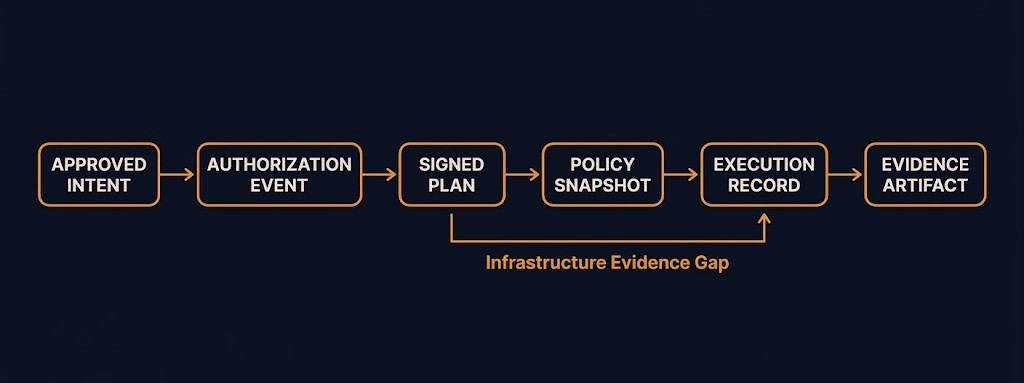
That is the Infrastructure Evidence Gap — and it is reproducible in any environment where plan generation and plan execution are temporally separated.
What Infrastructure Auditability Requires
Auditability is not a log retention problem. It’s a chain-of-custody problem.
Solving it requires treating each infrastructure change as an evidence artifact that must survive outside the systems that produced it. The evidence doctrine that applies to AI execution proof applies here with equal force — the question is not whether your system recorded what happened, but whether that record constitutes defensible proof to a party that has no access to the live system.
Framework #151 — Infrastructure Evidence Gap defines the chain:
01 — APPROVED INTENT
The human-readable change description as reviewed and approved — captured as a signed artifact, not just a Git commit hash. What the approver believed they were authorizing.
02 — AUTHORIZATION EVENT
The explicit approval record — who authorized, at what time, under what role or policy scope. Not a PR merge timestamp. A discrete authorization artifact linked to an identity.
03 — SIGNED PLAN ARTIFACT
The exact plan that will execute — signed at generation time, verified at apply time. If the plan at apply time does not match the signed artifact, execution should not proceed.
04 — POLICY STATE SNAPSHOT
The active policy constraints at execution time — captured as an immutable snapshot, not derived retroactively from current policy state. This is the record that closes the Tuesday-to-Thursday gap.
05 — EXECUTION RECORD
A tamper-evident record linking the actual execution to the signed plan artifact, the authorization event, and the policy state snapshot. The execution record is what proves all four upstream elements were honored.
06 — EVIDENCE ARTIFACT
The portable, externally-readable package of the above five elements — readable by a third party without access to the live pipeline, CI/CD system, or Git provider. The evidence artifact is the unit of auditability. Everything else is scaffolding.
Infrastructure Standards Without Enforcement Become Documentation Debt applies this same six-step chain to a narrower, upstream question: not the evidence gap in infrastructure change generally, but what happens when the standard governing that change was never verified in the first place. That post’s three-layer model — standard, enforcement, evidence — treats this framework’s evidence artifact as the missing third layer most organizations never build, and works through what a document-only standard looks like once nobody’s checked it against deployed reality in months.”
The EU AI Act’s Article 12 evidence-generation requirement is this same six-step chain applied to AI systems under a regulatory deadline — the Act doesn’t invent a new architecture pattern, it makes the Infrastructure Evidence Gap enforceable with fines attached.
The Modern Infrastructure & IaC Learning Path addresses governance architecture across the full maturity curve — the evidence layer maps to the MI4 Governance & Drift stage, where intent alignment and policy enforcement converge.
The Audit Trail Is a Control Plane Requirement
Infrastructure audit trails are not a compliance deliverable. They are operational infrastructure.
Postmortem analysis requires change provenance — not just what state the system is in now, but what changed, when, under what authorization. Blast radius analysis after an incident depends on being able to reconstruct which changes were active in the affected environment at the time of failure. Security reviews require evidence that changes were authorized under current policy, not just that they executed successfully.
None of those use cases are served by pipeline logs alone. The IaC Governance workbench treats governance as an architectural requirement for exactly this reason — policy enforcement, drift detection, and ownership boundaries are the upstream conditions that make evidence artifacts meaningful. Without them, you are logging executions you cannot defend.
DIAGNOSTIC QUESTION
“If your Git provider, Terraform backend, and CI/CD platform disappeared tomorrow, could you still prove who approved your last production infrastructure change, what policy state governed it, and what actually executed?”
For most teams the honest answer is: the Git history survives because it’s replicated, the Terraform state file survives if it’s in remote backend, and everything else — the authorization event, the plan artifact at apply time, the active policy snapshot — exists nowhere that doesn’t depend on the live system.
That is not an audit trail. It is a state record. The distinction matters the moment someone asks you to prove the state was reached legitimately.
Architect’s Verdict
Idempotency solves the wrong problem for auditability. It guarantees that your infrastructure can be reproduced. It does not guarantee that anyone can reconstruct why it was changed, who authorized it, or what policy governed the execution. A system that runs correctly and reproducibly can still be impossible to audit — and in regulated environments, in post-incident reviews, and in security investigations, that gap becomes a liability. That same look-compliant-but-unproven gap shows up wherever architecture is validated by design intent rather than by an actual test — the cloud exit readiness version of this problem is covered in Why “Portable” Systems Still Fail During the First Real Exit Test. It also shows up in security-posture terms: infrastructure can pass every configuration-reconciliation check while its real security value falls further from what the design intended — the pattern Framework #162 — Security Entropy Accumulation names. It shows up in identity terms too: a credential chain can pass every individual authentication and elevation check while the organization has no way to prove the sequence itself was ever legitimate — Your Identity Controls Passed. Your Authorization Chain Failed. names that exact gap at the authorization layer, the same execution-versus-authorization distinction this post draws for infrastructure change. It shows up at the vendor-relationship layer too: a third party’s standing access can be exactly as procedurally correct as this post’s own idempotent pipeline, and just as unable to prove the trust behind it is still current — /third-party-cloud-access/ names that gap as a persistence problem rather than a chain-of-custody one, but it’s the same underlying failure: a system that keeps working exactly as designed for a condition that quietly stopped being true. It shows up in its most adversarial form when the evidence-producing infrastructure itself is compromised rather than merely never built: Your Logs Are Not Evidence If The Infrastructure That Produces Them Can Rewrite The Record documents an attacker hooking a TACACS daemon’s own binary to falsify authentication records in memory, so a filesystem inspection still reports the binary as intact. This post’s Infrastructure Evidence Gap is a chain nobody built. That post’s evidence layer is a chain someone actively rewrote. The same root principle reappears one layer up, in a different pillar: Data Protection’s Recovery Evidence Boundary (#167) asks whether recovery claims have any independent authority positioned to validate them at all — a broader question than this post’s chain-of-custody problem, since even a perfectly reconstructible change record doesn’t establish that anyone outside the team that produced it was ever entitled to reject it.
The Infrastructure Evidence Gap (#151) is not a tooling shortfall. No amount of better logging closes it. It is an architectural shortfall — the evidence layer was never designed into the pipeline because the pipeline was designed for execution, not for defensibility. The six-step chain from approved intent to portable evidence artifact requires deliberate architecture decisions that most IaC implementations have never made.
Infrastructure teams spent the last decade making change deterministic. The next decade will be spent making change defensible.
Additional Resources
View 12 more resources
Editorial Integrity & Security Protocol
This technical deep-dive adheres to the Rack2Cloud Deterministic Integrity Standard. All benchmarks and security audits are derived from zero-trust validation protocols within our isolated lab environments. No vendor influence.

R.M.
Senior Solutions Architect with 25+ years of experience in HCI, cloud strategy, and data resilience. As the lead behind Rack2Cloud, I focus on lab-verified guidance for complex enterprise transitions. View Credentials →
Get the Playbooks Vendors Won’t Publish
Field-tested blueprints for migration, HCI, sovereign infrastructure, and AI architecture. Real failure-mode analysis. No marketing filler. Delivered weekly.
Select your infrastructure paths. Receive field-tested blueprints direct to your inbox.
- > Virtualization & Migration Physics
- > Cloud Strategy & Egress Math
- > Data Protection & RTO Reality
- > AI Infrastructure & GPU Fabric
Zero spam. Includes The Dispatch weekly drop.
Architecture Audit Services
Fixed-scope audits for Zero-Trust Azure, VMware migration readiness, and recovery posture — no discovery call required to start.
>_ View Audit Services>_Related Posts
ZFS vs Ceph vs NVMe-oF: Choosing the Right Storage Backend for Modern Virtualization
I still have nightmares about a storage migration I ran back in 2014. >_ Architect’s Brief 60-second read before you commit to the full post · Full post: 7 min Generating brief… We were moving off a monolithic SAN and onto an early “software-defined” storage platform. The sales engineers promised infinite scalability and self-healing magic….
Your Kubernetes Cluster Isn’t Out of CPU — The Scheduler Is Stuck
Compute Tier 1 Authority Cascades to ➔ >_ Architect’s Brief 60-second read before you commit to the full post · Full post: 9 min Generating brief… [Storage] [Network] 🚨 Failure Signature Detected Grafana shows cluster CPU utilization is under 50%, but pods are stuck in Pending. Events show: 0/10 nodes are available: 10 Insufficient cpu….
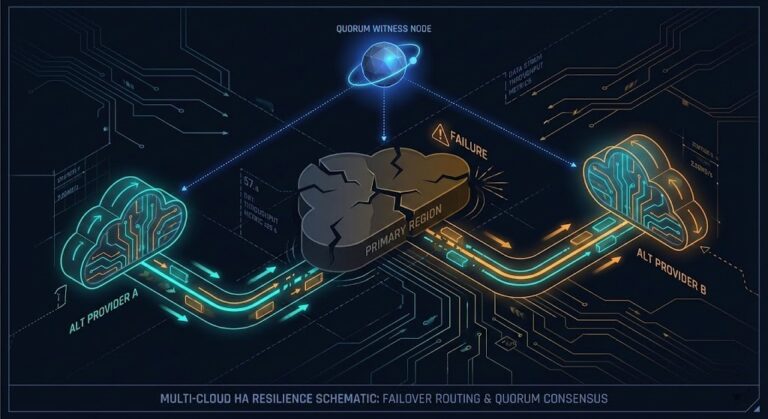
Your Cloud Provider Is Not Your HA Strategy
A Tactical Playbook for Architecting, Testing, and Automating Real Multi-Cloud & Multi-Region Resilience We’ve previously explored why cloud SLAs fail as guarantees in our deep dive, Cloud SLA Failure & Resilience Strategy. This article focuses on how to survive those failures in practice — architecturally, operationally, and financially. >_ Architect’s Brief 60-second read before you…
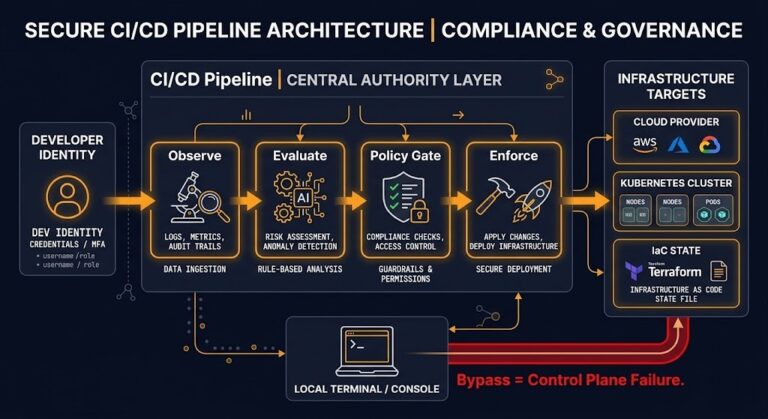
Your CI-CD Pipeline Is Your Real Infrastructure Control Plane
Terraform defines desired state. Kubernetes reconciles workload state. Cloud consoles expose state. None of those systems decides whether infrastructure state is allowed to change. The ci-cd control plane does — or more precisely, the CI-CD pipeline is the only system in most environments that can hold that authority. That distinction — between storing state and…
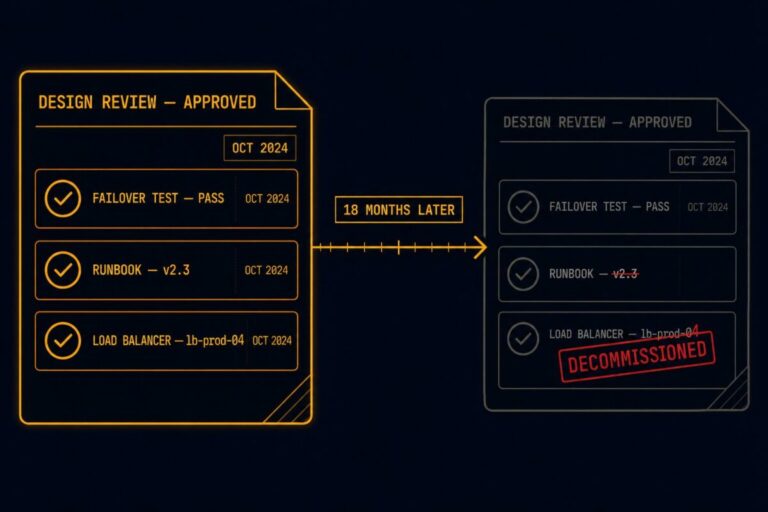
Why Infrastructure Survivability Fails After The Design Review
Infrastructure survivability is not something an architecture has. It’s something an organization keeps proving, on a schedule nobody wrote down, long after the design review that approved it has been forgotten. >_ Architect’s Brief 60-second read before you commit to the full post · Full post: 8 min Generating brief… That review happened. Redundancy was…
Why Configuration Standards Fail During Emergency Changes
Configuration standards emergency changes have one thing in common across every organization we’ve reviewed: the standard survives the incident, and quietly stops applying about ninety seconds into it. >_ Architect’s Brief 60-second read before you commit to the full post · Full post: 11 min Generating brief… It’s 2 a.m. A load balancer rule is…