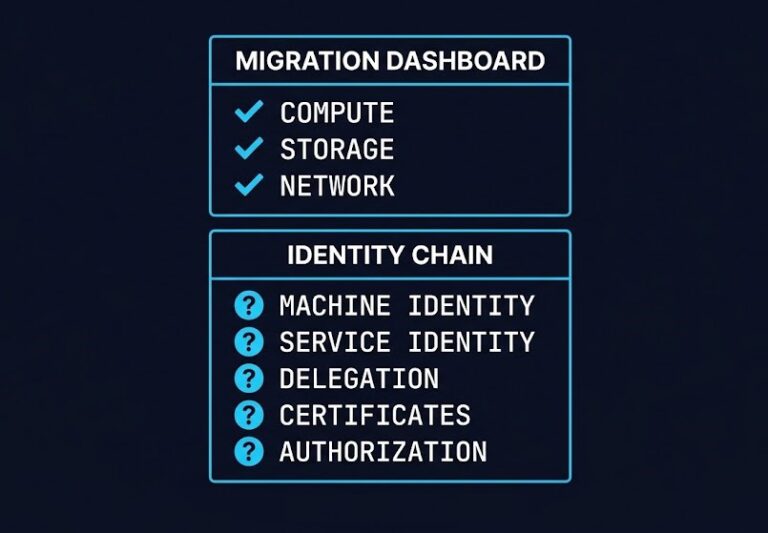


Recovery Readiness Is Becoming A Board-Level Metric
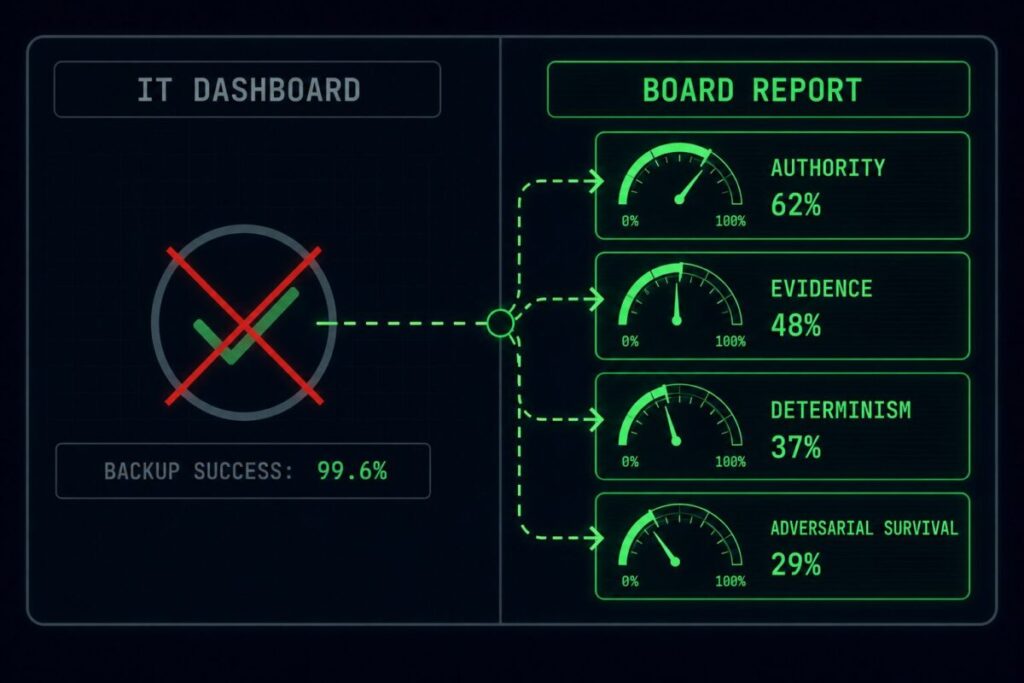
Boards don’t actually want to know whether last night’s backup job succeeded. They want to know whether the organization would survive its next major disruption, and the recovery readiness metric has quietly become the proxy boards now use to answer that question without waiting for an actual outage to test it.
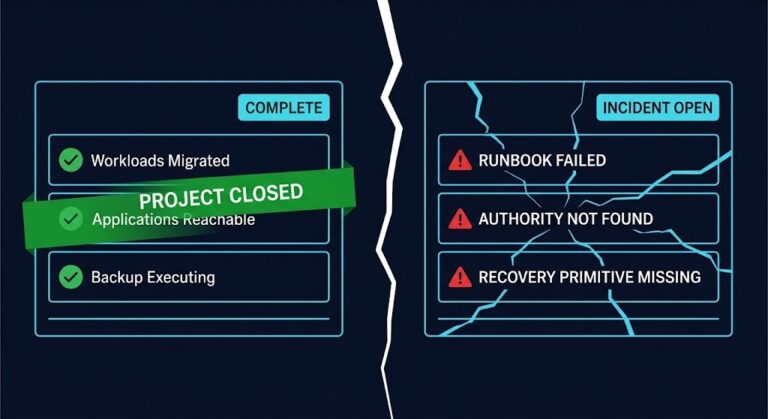
That shift didn’t come from IT. It came from insurers who started pricing cyber policies against demonstrated recovery capability instead of stated intent, from regulators who now require boards to describe their oversight of cybersecurity risk in annual filings, and from auditors who stopped accepting “we have a DR plan” as an answer. Recovery used to be an operational line item reported up when something broke. It is becoming a governance metric reported up whether anything breaks or not — and that distinction changes who owns the number, what evidence supports it, and what happens when it’s wrong.
The Metric Boards Actually See
Recovery has historically lived one layer below where boards look. A director’s committee sees uptime percentages, maybe a line in the risk register referencing “business continuity,” and an annual attestation that DR testing occurred. None of that was designed to answer a board-level question — it was designed to close an internal audit finding. The recovery readiness metric changes that relationship: it’s built to be reported upward, compared period over period, and defended in a room where nobody present configured a single backup job.
This is consistent with how data protection architecture has matured generally — the discipline keeps moving decisions that used to sit entirely inside infrastructure teams up into governance conversations, because the cost of getting them wrong no longer stays contained inside infrastructure.
What Boards Actually Mean By Recovery Readiness
Engineers and boards are not asking the same question, even when they use the same words. An engineer asking about recovery readiness means: did the backup job complete, did the restore succeed in test, did we hit our RTO target. A board asking about recovery readiness means something closer to: would the company still be standing, would regulated operations resume on schedule, would revenue restart before the damage compounds, and could leadership defend the response publicly if it had to.
That gap is the entire problem with treating backup success rate as the number that matters. A 99.6% backup success rate answers the engineer’s question completely and the board’s question not at all.
THE TRANSLATION GAP
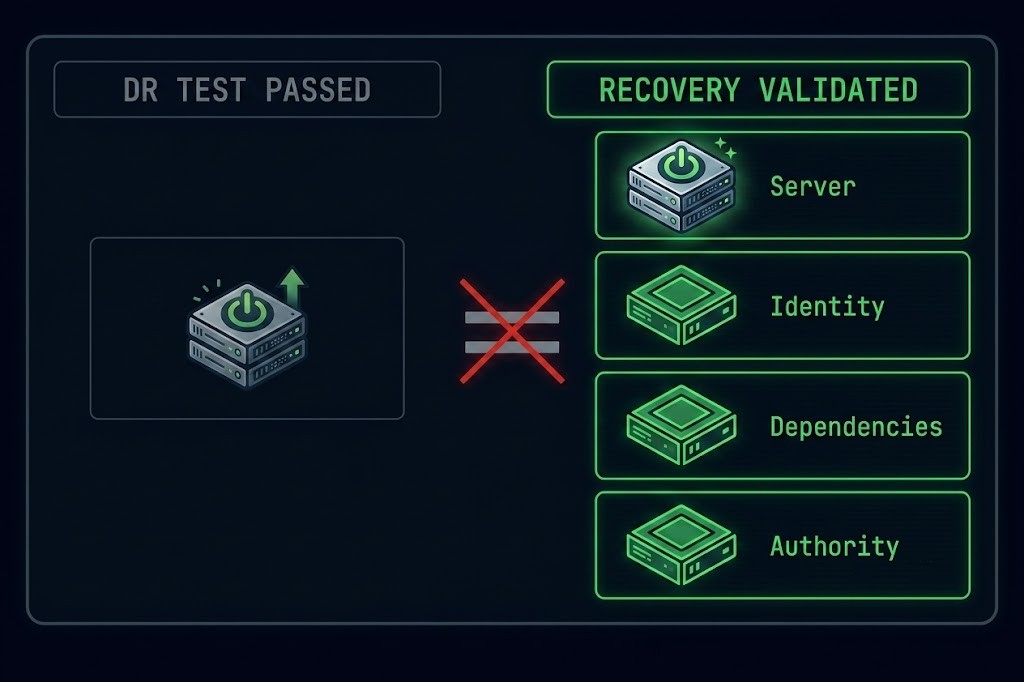
- Engineers ask: Did the backup job finish? → Boards ask: Could the business actually recover?
- Engineers ask: Did the restore work in test? → Boards ask: Would it still work under real pressure?
- Engineers ask: Did we hit our RTO? → Boards ask: Would customers and regulators notice the difference?
The site’s own coverage of this exact failure mode is worth reading directly — backup success rates are a dangerous metric precisely because they measure the job, not the outcome the board is actually being asked to certify.
The Recovery Confidence Illusion
Most organizations that believe they have a defensible recovery number are actually reporting on a passed test, not a validated capability. That distinction is the entire premise behind the Recovery Confidence Illusion — the condition in which a successful DR test creates organizational confidence that exceeds what the test actually proved, because most DR tests validate that a workload restarts, not that recovery holds under the conditions that make recovery necessary in the first place.
The Disaster Recovery & Failover Architecture learning path stage covers the RPO/RTO/RTA mechanics this illusion sits on top of — worth the deeper read if the last DR test in your environment was scoped as a restart drill rather than a full recovery validation.
DIAGNOSTIC QUESTION
“If your board asked today, ‘Show us evidence that recovery would succeed under ransomware conditions,’ what would you hand them besides the last successful restore report?”
Authority Is the Board’s Real Question
Before a board asks whether recovery works, it asks who is accountable for making the call that invokes it. That’s not a technical question — it’s an authority question, and it’s usually the first one a board actually cares about, because a readiness number with no named accountable owner isn’t something leadership can act on when something goes wrong. It’s a figure nobody signed for.
This is the exact gap Recovery Authority Fragmentation names: recovery plans that document technical steps in detail but leave the decision rights — who can authorize invoking DR, who escalates to legal, who briefs the board mid-incident — implicit or scattered across roles that assume someone else has it covered. A board-grade recovery readiness metric has to answer the authority question before it answers anything about backups, because a well-tested recovery process with no clear owner still stalls at the moment it’s needed most.
Evidence Is the Missing Layer
Authority answers who owns recovery. The next question a board should ask — and rarely does, until an auditor asks it for them — is whether that ownership produces anything a third party could actually inspect. Most recovery programs can describe their process verbally with real confidence and produce almost nothing in writing that survives outside the room.
Restore evidence is the artifact layer most DR programs skip entirely: documentation that’s portable, meaning a regulator, insurer, or incoming CISO could review it without live access to the systems it describes. A readiness claim backed only by verbal assurance from the person who built the process isn’t something a board can defend — it’s a testimonial.
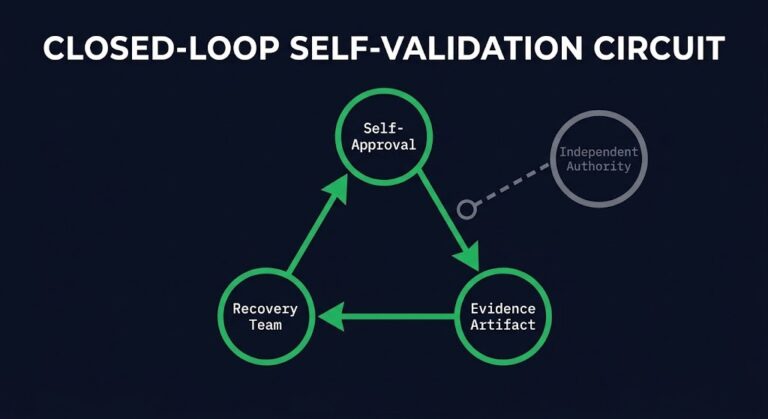
Portable evidence closes most of that gap, but not all of it. An artifact a regulator can review without live system access still tells that regulator nothing about who, if anyone, was ever positioned to challenge what the artifact concludes — the team that wrote the runbook can also be the only party who’s ever assessed whether the runbook’s own claims hold up. That’s the layer the Recovery Evidence Boundary (#167) sits on top of evidence itself: portability answers whether the record survives outside the room. Independent authority answers whether anyone in the room was ever allowed to say no.
Determinism, Not a Single Good Test
Evidence proves a capability existed once. It doesn’t prove it will exist again, under a different failure, run by a different on-call engineer, six months from now. That’s the determinism question, and it’s the one most recovery programs fail quietly, because a single successful DR test is treated as proof of a repeatable capability when it’s actually proof of one specific, favorable set of conditions.
Recovery determinism is the real DR problem underneath most “we tested and it passed” reporting — the same four variables (authority, evidence, dependency mapping, validation criteria) need to hold consistently across every recovery attempt, not just the one someone happened to schedule and staff well. A recovery readiness metric that can’t answer “would this same result hold next quarter, with a different team on call” isn’t measuring determinism — it’s measuring luck with better documentation.
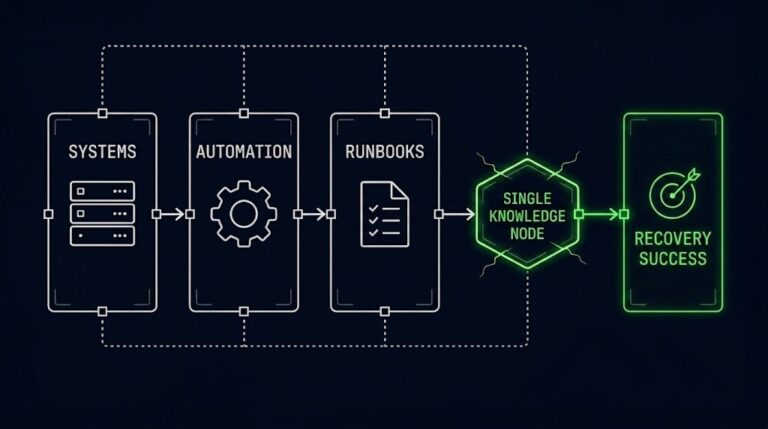
“Would this hold with a different team on call” is worth pressure-testing directly rather than rhetorically — recovery bus factor measures exactly that: how many people could be unreachable before a documented, tested, board-reported recovery plan stops being executable. A 500-person infrastructure organization can report a clean recovery readiness number and still have a bus factor of one, because headcount and redundancy are not the same measurement.
The Recoverability Gap: What Survives Contact
Everything above this section assumes a clean failure — a server dies, a site goes dark, recovery gets invoked on a system nobody was actively attacking. Ransomware removes that assumption, and it’s the condition every board-level readiness claim eventually has to survive, because it’s the scenario insurers and regulators are actually underwriting against.
⚠ COMMON MISTAKE
Reporting recovery readiness against a clean-failure test and presenting it as adversarial resilience. A recovery process that survives a dead server tells a board nothing about whether it survives an attacker who compromised identity and backup infrastructure first — the two conditions are not the same test.
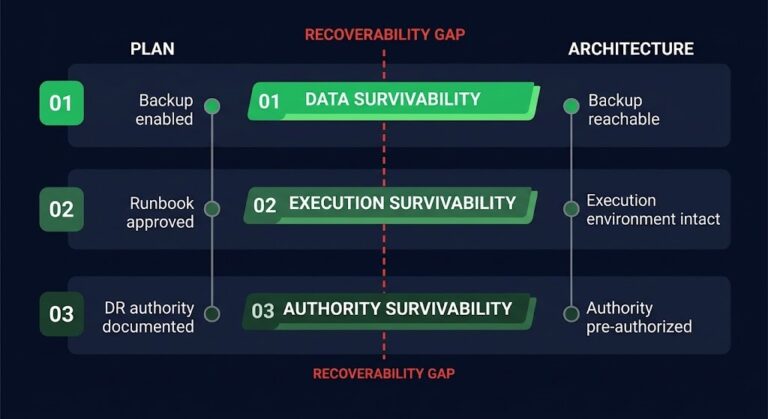
Your ransomware recovery plan has a recoverability gap if it hasn’t been evaluated against identity compromise, credential loss, and management-plane failure specifically — not generically. That’s the scenario in which a recovery readiness metric either holds up under hostile conditions or turns out to have only ever been tested against friendly ones.
Validating that fourth quality against your actual environment — rather than assuming it — is what Ransomware Survival Architecture exists to test: whether the identity, credential, control-plane, backup, governance, and storage authority recovery depends on survive the same compromise that triggered it. The Ransomware Recovery Survivability Analyzer runs that evaluation directly — six authority domains against five ransomware-class threat scenarios, surfacing exactly where a board-grade readiness claim would break under contact rather than in theory.
Even a readiness number that survives adversarial contact is still answering a narrower question than most boards assume. ZEGO Textilveredelungszentrum’s systems came back after a six-week ransomware outage — recovery worked, on every measure this section just described. The company filed for insolvency months later anyway, because recovery succeeding and the organization surviving long enough to benefit from it turned out to be different claims. Authority, evidence, determinism, and adversarial survival describe whether recovery works. None of them describe whether the business can wait for it.
What Makes a Recovery Readiness Metric Board-Grade
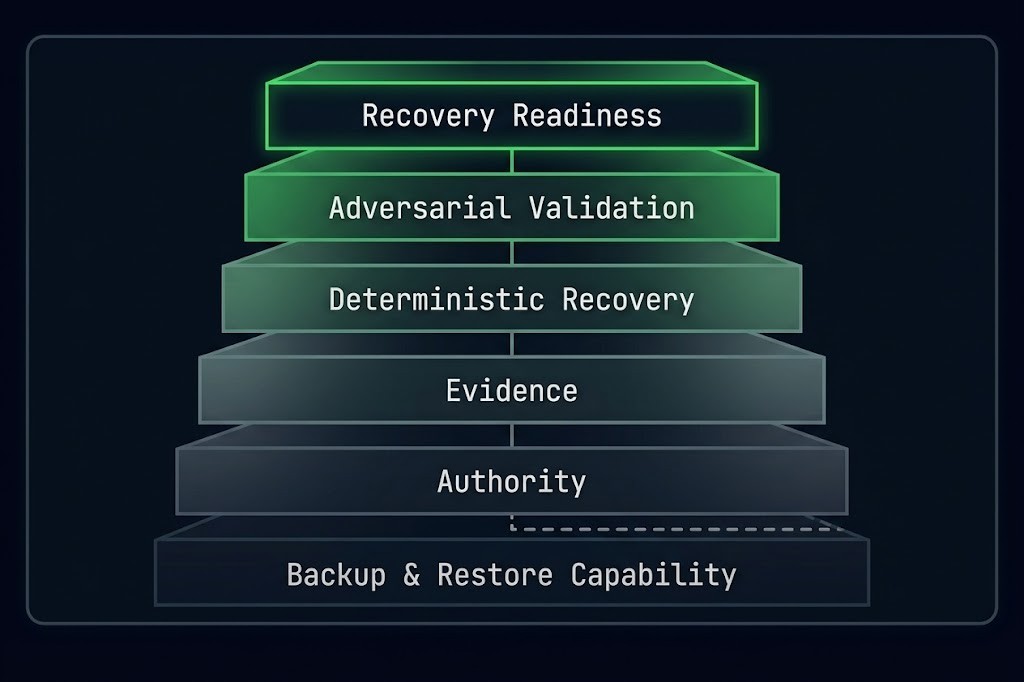
Authority, evidence, determinism, and adversarial survival aren’t KPIs to hit a target number on — they’re qualities a number either has or doesn’t. It can look identical on a dashboard whether it’s backed by all four or none of them, which is exactly why boards keep getting reassured without being informed.
| Traditional Recovery Metric | Board-Level Question |
|---|---|
| Backup success rate | Could the business actually recover? |
| Restore completed in test | Could it recover under real pressure? |
| RTO achieved | Would customers and regulators notice? |
| DR test passed | Could leadership defend the outcome publicly? |
01 — AUTHORITY
A named, accountable owner exists for the decision to invoke recovery — not implied, not distributed across roles that assume someone else has it.
02 — EVIDENCE
The capability is documented in artifacts a third party can review without live system access — not asserted verbally by the person who built it.
03 — DETERMINISM
The result holds across repeated attempts, different on-call staff, and different failure conditions — not just the one favorable test that got scheduled.
04 — ADVERSARIAL SURVIVAL
The capability has been tested against identity compromise and management-plane failure specifically, not just a clean, friendly failure scenario.
A number that satisfies all four is something a board can actually rely on in a room where the stakes are real. One that satisfies zero, dressed up as a single clean percentage, is the illusion this entire piece has been describing.
Architect’s Verdict
Recovery readiness was never really an IT metric — it was an IT process that happened to produce a number, and for years nobody above the infrastructure team asked to see it. That’s over. Insurers price against it, regulators expect boards to describe oversight of it, and auditors have stopped accepting a plan document as proof that a plan works. The number is now a governance artifact whether anyone updated the reporting template to reflect that or not.
The real failure isn’t that organizations lack a recovery readiness metric — almost everyone has one. It’s that the metric most boards are shown answers the engineer’s question and gets presented as though it answers the board’s. Authority without evidence is an assertion. Evidence without determinism is a snapshot. Determinism without adversarial validation is confidence that’s never been tested against the conditions that actually matter. Stack all four and the number finally means something a board can act on.
Recovery readiness isn’t measured by the quality of yesterday’s restore. It’s measured by confidence in tomorrow’s recovery.
Additional Resources
Editorial Integrity & Security Protocol
This technical deep-dive adheres to the Rack2Cloud Deterministic Integrity Standard. All benchmarks and security audits are derived from zero-trust validation protocols within our isolated lab environments. No vendor influence.

R.M.
Senior Solutions Architect with 25+ years of experience in HCI, cloud strategy, and data resilience. As the lead behind Rack2Cloud, I focus on lab-verified guidance for complex enterprise transitions. View Credentials →
Get the Playbooks Vendors Won’t Publish
Field-tested blueprints for migration, HCI, sovereign infrastructure, and AI architecture. Real failure-mode analysis. No marketing filler. Delivered weekly.
Select your infrastructure paths. Receive field-tested blueprints direct to your inbox.
- > Virtualization & Migration Physics
- > Cloud Strategy & Egress Math
- > Data Protection & RTO Reality
- > AI Infrastructure & GPU Fabric
Zero spam. Includes The Dispatch weekly drop.
Architecture Audit Services
Fixed-scope audits for Zero-Trust Azure, VMware migration readiness, and recovery posture — no discovery call required to start.
>_ View Audit Services>_Related Posts
Your VMware Exit Was Successful. The First Incident Will Tell You If That’s True.
VMware exit survivability is the question your migration project never formally scheduled — and the first production incident on the new platform will answer it whether you are ready or not. The cutover completed. The workloads are running. The project closed green. None of that tells you whether the operating model, runbooks, authority structures, and…
Your Recovery Program Has a Recovery Evidence Boundary
Recovery evidence boundary is the point where a recovery program stops being an engineering question and starts being a governance one — and most organizations cross it without ever finding out, because everything on the way there still looks like success. The backups completed. The DR test passed. The tabletop went well. Somebody wrote a…
Your Recovery Architecture Has A Bus Factor Problem
Recovery bus factor is the gap between a recovery plan that has been tested, documented, and signed off — and a recovery plan that can actually be executed when the one or two people who know how to run it aren’t in the room. The recovery program had passed everything that mattered on paper: RTO…
Your Ransomware Recovery Plan Has a Recoverability Gap
The recoverability gap is the structural distance between what your recovery plan assumes and what your infrastructure can actually deliver under failure conditions. Most organizations don’t discover it during planning. They discover it on day three of an incident. >_ Architect’s Brief 60-second read before you commit to the full post · Full post: 12…
Your Ransomware Plan Is Fiction: 5 Recovery Metrics Nutanix, Cohesity, Rubrik & Pure Can’t Hide
Ransomware recovery metrics are the only thing standing between your recovery plan and a PowerPoint. Every vendor demo shows a single VM booting in 60 seconds. Every real ransomware recovery looks like this: the backups are intact, the ransomware is neutralized, the executives are on the bridge — and nothing is coming back online. >_…
Your Migration Succeeded. The Identity Chain Didn’t.
Identity chain continuity is the thing every migration runbook assumes and almost none of them prove. A migration dashboard can go fully green — compute online, storage attached, network reachable — while the identity chain underneath it is already broken, and nothing in that dashboard will tell you. >_ Architect’s Brief 60-second read before you…