

Proxmox Isn’t Replacing VMware. It’s Replacing Assumptions.
Proxmox migration assumptions are the part of the VMware exit that doesn’t appear on any migration checklist — and the part that causes the most damage after go-live.
The migration succeeded. Six weeks later, a storage event occurred. The runbook assumed vSphere behavior. Proxmox behaved correctly. The runbook didn’t. That’s when the migration actually started..
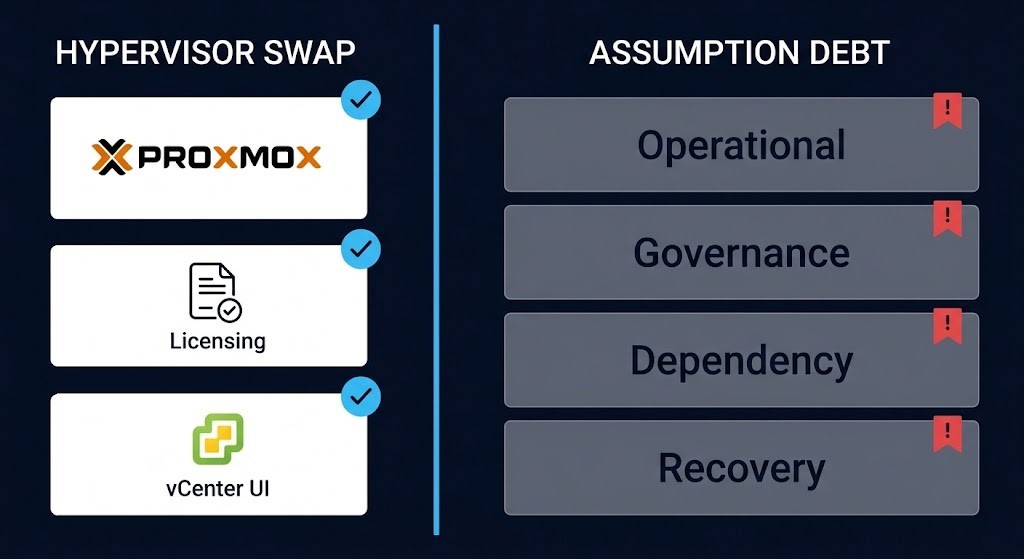
What Proxmox Actually Replaces
The hypervisor, the licensing contract, and the vCenter UI. That’s the complete list. Everything else — the operational layer, the governance model, the recovery dependencies — doesn’t migrate. It carries forward unchanged, sitting on top of a platform that no longer behaves the way those layers expect.
This is the part the virtualization architecture conversation keeps circling without landing on. The platform decision gets treated as the migration. The operating model decision gets deferred, or never made at all.
VMware normalized certain infrastructure behaviors for so long that most organizations stopped distinguishing between platform behavior and infrastructure behavior. DRS, vMotion, snapshot semantics, HA clustering — these aren’t infrastructure primitives. They’re VMware implementations of infrastructure primitives. When the implementation changes, teams discover the distinction the hard way.
That’s the actual proxmox migration assumption problem. Not whether Proxmox can handle the workloads — it almost always can. Whether the operating model built on top of VMware behaviors survives the swap.
For the deeper architecture of what changes at the operating model layer, the VMware migration strategy track covers the governance portability gap in detail. The control plane architecture stage maps what each hypervisor is actually doing at the control plane layer — and where the behavioral differences compound.
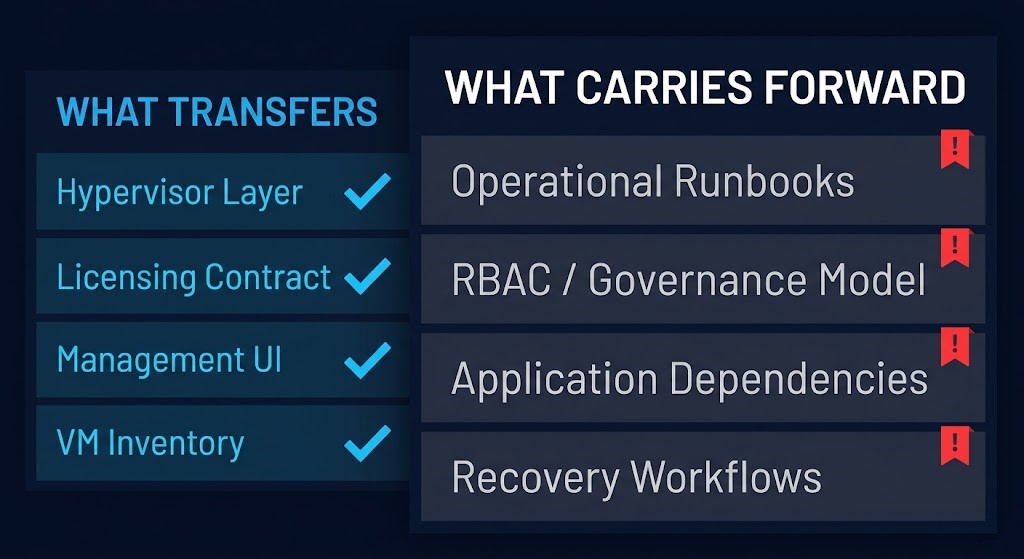
The Proxmox Migration Assumptions Nobody Audits
There are four categories of assumption that survive the hypervisor swap. Most migration checklists address zero of them.
The organizations making the smoothest exits are rarely the ones with the most aggressive migration timelines. They’re the ones that performed a dependency and operating-model assessment before selecting a target platform — and documented what the VMware environment was actually enforcing, not just what it was running.
FOUR ASSUMPTION LAYERS
- Operational — Runbooks, monitoring integrations, and alerting thresholds tuned to vSphere behavior. They fire on vSphere signals. Proxmox doesn’t emit the same signals.
- Governance — Change control models built around vCenter RBAC and DRS policy enforcement. The approval workflows exist. The enforcement mechanism they referenced doesn’t.
- Dependency — Applications and integrations that assume vSphere-specific storage or network behavior. VMDKs, VMFS paths, snapshot-consistency hooks, NSX segment assumptions.
- Recovery — Backup workflows, snapshot expectations, replication behavior, DR orchestration, and recovery runbooks written against vSphere semantics. This is the layer nobody tests until they need it.
Recovery sits last on that list because it’s the least visible and the most dangerous. The hypervisor as policy enforcement point — the observation from FN-10 — applies directly here: when the enforcement substrate changes, every policy that relied on it silently degrades. Recovery policies degrade the same way, and the degradation is invisible until the moment they’re needed.
The VMware coexistence era post framed this dynamic at the portfolio level. FN-14 is the operator-level view: what specifically breaks, in what order, and why.
The Assumptions Fail in Predictable Order
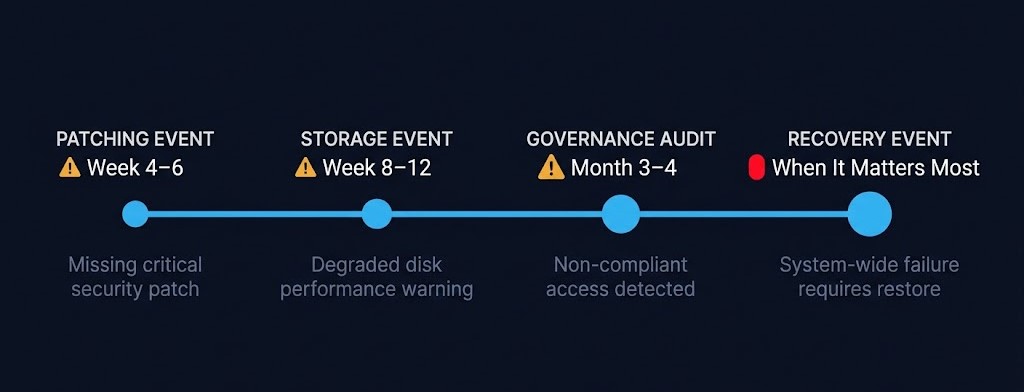
The failure sequence isn’t random. It follows the operational calendar almost exactly, which is why it reads as a series of unrelated incidents rather than a single structural problem.
01 — PATCHING EVENT
First scheduled maintenance cycle after go-live. No DRS to drain nodes automatically. The runbook says “migrate VMs off the host before patching.” It doesn’t say how — it assumed vMotion semantics and a DRS recommendation queue. Someone improvises. Some do it right. Some don’t touch it and patch live. The inconsistency becomes the new standard.
02 — STORAGE EVENT
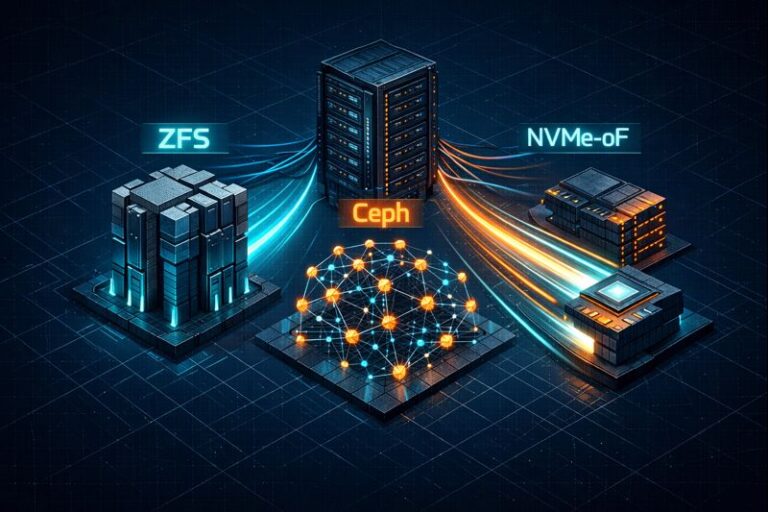
First time the storage layer behaves unexpectedly under contention. ZFS and Ceph have different performance profiles under write pressure than vSAN. The alerting threshold was calibrated for vSAN latency behavior. The alert either fires too late or not at all. The monitoring runbook references a vCenter storage performance view that doesn’t exist.
03 — GOVERNANCE AUDIT
First internal or external audit after migration. The auditor asks who has administrative access to the hypervisor layer. The answer involves reconstructing RBAC from scratch because the migration didn’t transfer vCenter permissions — it replaced the permission model entirely. The evidence trail for change control exists in vCenter logs that were decommissioned.
04 — RECOVERY EVENT
A backup restore is required — test or real — and the recovery runbook references snapshot-consistency behavior, replication topology, and DR orchestration tooling built for VMware. Proxmox’s snapshot model differs from vSphere’s. The backup agent’s VSS integration assumed ESXi. The DR orchestration tool has a Proxmox connector, but nobody configured it because the migration plan said “DR to be addressed post-cutover.”
⚠ RECOVERY ASSUMPTION RISK
Recovery assumptions are the last to surface and the first to cause irreversible damage. A patching assumption creates inconsistency. A storage assumption creates performance debt. A recovery assumption fails at the moment of maximum pressure, with no fallback. The recovery authority model breaks down completely when the platform the DR runbook was written for no longer exists.
FN-12 documented the same failure mode from the DR testing angle: your DR test passed — the assumptions didn’t. The recovery event here is what happens when you never ran that test after the platform changed.
Proxmox Is a Valid Target. The Operating Model Isn’t.
The architecture question isn’t whether Proxmox can replace VMware. Evaluated on hypervisor capability, storage backend flexibility, and licensing economics, Proxmox is a legitimate platform for most enterprise workloads outside the Microsoft licensing exception territory.
That legitimacy question sits squarely inside the Replacer camp — one of three strategic postures the virtualization market has split into. Consolidator and Absorber organizations are solving a different problem entirely; everything in this post’s assumption audit applies only to teams actually swapping hypervisors.
A separate question about Proxmox as a vendor — not as a migration target — is worth flagging here rather than conflating it with the assumption audit above. Proxmox’s Arm64 Bet Runs On Lifecycle Parity, Not A Feature Release reads Proxmox VE 9.2’s Arm64 edition as a vendor-commitment signal: full lifecycle parity on a second CPU architecture, not a migration-risk argument at all. Whether Proxmox is a durable, well-resourced vendor and whether your operating model survives moving to it are two different diligence questions, and this post is entirely about the second one.
The question is whether the team migrating to it audited what VMware was actually doing beyond the hypervisor. The operating model transfer gap — Framework #137 — is the named failure mode: the hypervisor transfers cleanly, the operational dependencies don’t.
The skills gap analysis identified this from the human capital side: the vSphere-certified engineers who ran the VMware environment built their competency on VMware abstractions. Those abstractions are now gone. The post-Broadcom constraint analysis covers where Proxmox specifically exposes architectural gaps that VMware papered over — particularly in enterprise HA models and network policy enforcement.
The organizations that succeed with Proxmox treat the operating model as a migration artifact with the same discipline they applied to the VM inventory. They audit the assumption layers before go-live, not after the first recovery event.
That audit starts before the operating model audit. Most VMware estates cannot reconstruct their own dependency surface from configuration state alone — the licensing exposure, integration authority, and platform behavioral assumptions that determine which of the four assumption layers above are actually load-bearing. VMware Licensing Pressure Created a Dependency Audit Problem is the recovery mechanism for that surface — the structured pass that identifies what the VMware estate was actually governing before the assumption audit begins.
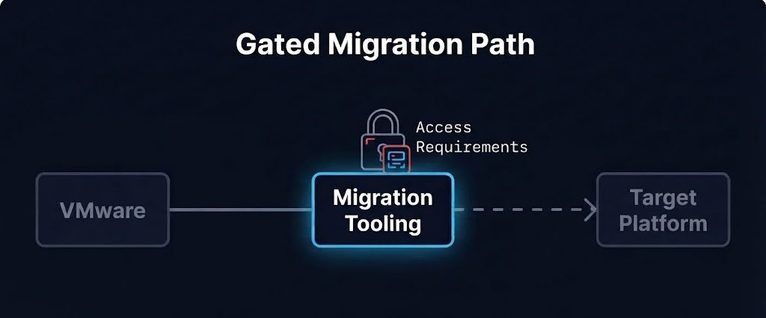
One more assumption belongs on that list, and it sits earlier than any of the four above: that the migration tooling itself stays obtainable for the duration of the project. Your VMware Exit Plan Assumed a Tool You Didn’t Control covers what happens when that assumption fails — a VDDK access change mid-migration, unrelated to Proxmox specifically, that stalls the move before the four assumption layers above ever get tested.
Architect’s Verdict
Proxmox migrations rarely fail because Proxmox can’t replace VMware. They fail because VMware spent fifteen years teaching organizations assumptions they no longer realize they’re carrying. The platform changed. The operating model didn’t.
Additional Resources
View 10 more resources
Editorial Integrity & Security Protocol
This technical deep-dive adheres to the Rack2Cloud Deterministic Integrity Standard. All benchmarks and security audits are derived from zero-trust validation protocols within our isolated lab environments. No vendor influence.

R.M.
Senior Solutions Architect with 25+ years of experience in HCI, cloud strategy, and data resilience. As the lead behind Rack2Cloud, I focus on lab-verified guidance for complex enterprise transitions. View Credentials →
Get the Playbooks Vendors Won’t Publish
Field-tested blueprints for migration, HCI, sovereign infrastructure, and AI architecture. Real failure-mode analysis. No marketing filler. Delivered weekly.
Select your infrastructure paths. Receive field-tested blueprints direct to your inbox.
- > Virtualization & Migration Physics
- > Cloud Strategy & Egress Math
- > Data Protection & RTO Reality
- > AI Infrastructure & GPU Fabric
Zero spam. Includes The Dispatch weekly drop.
Architecture Audit Services
Fixed-scope audits for Zero-Trust Azure, VMware migration readiness, and recovery posture — no discovery call required to start.
>_ View Audit Services>_Related Posts
ZFS vs Ceph vs NVMe-oF: Choosing the Right Storage Backend for Modern Virtualization
I still have nightmares about a storage migration I ran back in 2014. >_ Architect’s Brief 60-second read before you commit to the full post · Full post: 7 min Generating brief… We were moving off a monolithic SAN and onto an early “software-defined” storage platform. The sales engineers promised infinite scalability and self-healing magic….
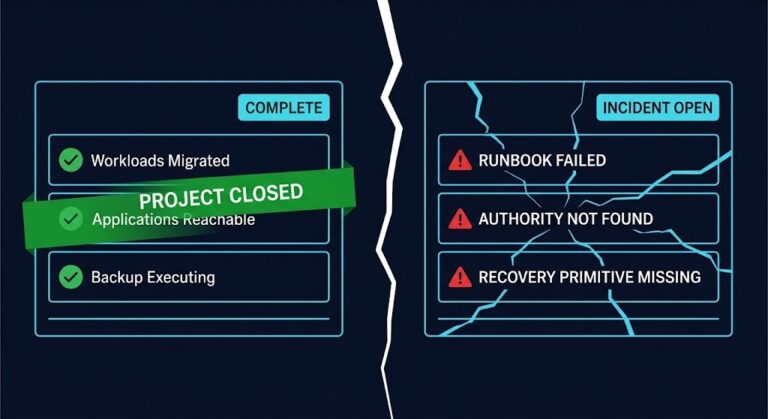
Your VMware Exit Was Successful. The First Incident Will Tell You If That’s True.
VMware exit survivability is the question your migration project never formally scheduled — and the first production incident on the new platform will answer it whether you are ready or not. The cutover completed. The workloads are running. The project closed green. None of that tells you whether the operating model, runbooks, authority structures, and…
Your VMware Exit Plan Assumed a Tool You Didn’t Control
A VMware exit plan usually treats the migration tooling as a given — something you download, install, and use, not something you have to keep asking permission for. In late August, the public self-service path to the Virtual Disk Development Kit (VDDK) stopped working. No deprecation notice. No public transition announcement. A download path that…
Your Vendor Review Process Never Saw The Real Supplier
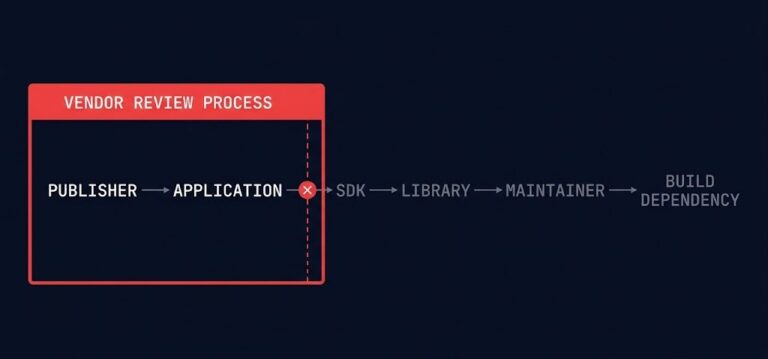
Every vendor review process assumes it’s evaluating a supplier — but a scan finding foreign-origin code embedded in more than one in eight mobile apps used by US military personnel makes the actual assumption visible: organizations review the company they bought from, not the code that arrived inside what they bought. >_ Architect’s Brief 60-second…
Your Migration Succeeded. The Identity Chain Didn’t.
Identity chain continuity is the thing every migration runbook assumes and almost none of them prove. A migration dashboard can go fully green — compute online, storage attached, network reachable — while the identity chain underneath it is already broken, and nothing in that dashboard will tell you. >_ Architect’s Brief 60-second read before you…
Your Identity Controls Passed. Your Authorization Chain Failed.
A credential chain functioned exactly as it was designed to. No firewall failed. No exploit executed. No malware bypassed a control. A red team walked past physical and social barriers using nothing more exotic than a plausible pretext, and came out the other side holding network admin credentials — issued correctly, authorized correctly, working exactly…